Le Monde, Arcanum XXI: The Open Circle of the Marseille Tarot
In brief
- Le Monde marks the point where a person’s individual journey opens onto a universal order, fusing earth and sky, chaos and form, without ever becoming a final stop.
- Upright, it points to a person who has crossed every stage and now finds total realization, public recognition, and a natural affinity for travel and foreign connections.
- Reversed, it reveals a person who remains stuck in a narrow frame, feeling out of place, with voyages delayed or confined to a national scale, and a closure that isolates.
- The central paradox: the card holds perfect balance, but that balance is a passage, not a resting place; stopping there turns accomplishment into inaccomplishment.
Contents
Le Monde is the twenty-first major arcanum of the Marseille Tarot, numbered XXI in additive form. Its central image, a nude woman inside an oval crown of foliage with four living figures at the corners, signifies accomplishment when upright and incompletion when reversed. These two orientations are not opposites but two distinct axes of meaning.
| Numeral | Card |
|---|---|
| no numeral | The Fool |
| I | The Juggler |
| II | The Popess |
| III | The Empress |
| IIII | The Emperor |
| V | The Pope |
| VI | The Lover |
| VII | The Chariot |
| VIII | Justice |
| IX | The Hermit |
| X | The Wheel of Fortune |
| XI | Strength |
| XII | The Hanged Man |
| XIII | The Nameless Arcanum |
| XIIII | Temperance |
| XV | The Devil |
| XVI | The House of God |
| XVII | The Star |
| XVIII | The Moon |
| XIX | The Sun |
| XX | Judgement |
| XXI | The World |
Justice is VIII and Strength XI, the reverse of the Rider-Waite. Card XIII bears no name.
The Card
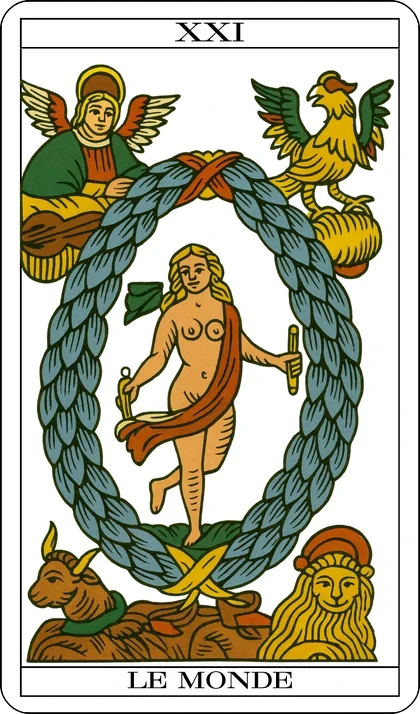
On the Marseille card, a nude woman stands at the center of an oval crown of foliage. A scarf crosses her body, and she holds a small stick in each hand. At the four corners of the card appear four figures: a winged being with a halo, an eagle, a bull, and a lion. The numeral XXI is printed on the card. Nothing else is drawn: no landscape, no additional symbols, no text beyond the number.
What the Card Says
The whole arrangement signifies a passage from chaos to order, from the multiple to the One. The oval wreath frames the human figure without confining it, and the four corner figures mark the four directions or elements, brought into balance. This is not a card of departure but of arrival after all stages have been crossed. The person has not stopped at any stage, neither from discouragement nor from pleasure.
Le Monde signifies the opening of the individual to the universal, the human to the divine, the earth to the sky. The central figure is not isolated; the four figures at the corners connect the human center to the wider cosmos. This is the meaning of reuniting the elements in perfect balance. The two sticks in her hands and the scarf across her body are not weapons or burdens; they show a state of active receptivity, a person who has integrated opposites.
This image does not signify a future event; it describes a condition of wholeness that can be recognized in any area of life. The oval crown is not a prison but a completed circle, a form that has no missing piece.
Upright
When Le Monde appears upright, it signifies total realization. The person is seen in a state of fulfillment and accomplishment, not as a promise but as a present condition. This orientation also signifies revelation, the fact of finding one’s own path after a long crossing. It is associated with favorable conditions for travel and for relations with foreign countries. The social expression follows: openness, communication, public visibility, and even celebrity. The order of importance runs from the inner fact of completion outward to its public recognition.
Reversed
The reversed orientation of Le Monde has its own axis of meaning: inaccomplishment. This is not the failure of the upright meaning but a distinct state in which a person does not flourish, does not realize themselves, and may feel ill at ease in their own skin. Travel is not simply absent; it is met with resistance or postponed, and development tends to remain on a national level only. The social dimension closes: isolation and withdrawal replace openness and communication. The reversed Le Monde does not mean the opposite of the upright; it names a different condition, one of enclosure where the upright names an opening.
What Nuances This Reading
A single card never makes a reading. The meaning of Le Monde depends on its position in a spread, the cards that surround it, and the question asked. The same upright Le Monde can signify an inner completion in a question about work and a public recognition in a question about a relationship. The reversed orientation is not the negation of the upright; the axis is different. Duration is not inherent to a card: only a position in a spread can suggest timing, and this page describes no spread. The reader must always weigh the whole table before drawing a conclusion.
Frequently Asked Questions
Does Le Monde always mean a happy ending?
Upright, it signifies accomplishment and fulfillment. Reversed, it has its own meaning of incompletion and unease. The surrounding cards and the position in the spread decide how that meaning applies.
What is the difference between Le Monde upright and reversed?
They are two independent axes, not opposites. Upright signifies total realization, revelation, openness, travel, and public visibility. Reversed signifies inaccomplishment, feeling ill at ease, resistance to travel, national scope, and isolation.
Does Le Monde predict travel?
Upright, it is associated with favorable conditions for travel and relations with foreign countries. Reversed, it signifies resistance or delay and a development that stays on a national level. No card sets a date or a duration.
Why does the woman hold two sticks?
The sticks are part of the Marseille design, often read as signs of active balance or receptivity. The meaning of Le Monde comes from the whole arrangement, not from any single detail.