Le Bateleur: The First Gesture of Every Beginning
In brief
- Le Bateleur signifies the raw potential of a beginning, where you are the active forger of your own destiny.
- The central tension is that this creative power is rich and uncertain, your energy builds either solid or precarious foundations depending on your choices.
- Upright, it signifies dynamic activity, positive professional setup, and the concrete launch of a new project or meeting.
- Reversed, it signifies blocked action and professional stagnation, where the same energy turns into laziness or a lack of drive.
- The card never acts for you, it only signifies your power to decide, so the outcome rests entirely on the use you make of your energies.
Contents
Le Bateleur is the first numbered card of the twenty-two major arcana in the Marseille Tarot. It speaks of commencement, of the moment when raw possibility meets the hands that will shape it. This card does not promise success or failure: it shows a person standing at the threshold, equipped and undecided, with everything still to be made.
| Numeral | Card |
|---|---|
| no numeral | The Fool |
| I | The Juggler |
| II | The Popess |
| III | The Empress |
| IIII | The Emperor |
| V | The Pope |
| VI | The Lover |
| VII | The Chariot |
| VIII | Justice |
| IX | The Hermit |
| X | The Wheel of Fortune |
| XI | Strength |
| XII | The Hanged Man |
| XIII | The Nameless Arcanum |
| XIIII | Temperance |
| XV | The Devil |
| XVI | The House of God |
| XVII | The Star |
| XVIII | The Moon |
| XIX | The Sun |
| XX | Judgement |
| XXI | The World |
Justice is VIII and Strength XI, the reverse of the Rider-Waite. Card XIII bears no name.
The card
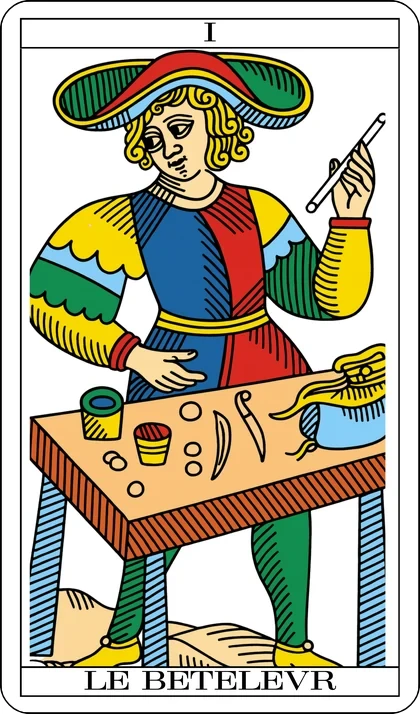
Le Bateleur stands behind a table with four legs. He wears a hat with a wide, wavy brim. One hand is raised, holding a wand. The other hand hovers above the tabletop. On the table lie goblets, small discs, a knife, and a purse. Nothing else is drawn. No landscape, no companion, no building. The figure is alone with his tools, and the table is the only surface between him and the world.
The numeral I is printed on the card in its additive form. It is the first of the major arcana, and its position at the head of the sequence matters: this is the card that opens the series, the one that shows what a beginning looks like before anything has been decided.
What the card says
Le Bateleur carries the commencement of a destiny, rich and uncertain at once. The person represented here is an active and transformative power, the one who decides, the forger of their own existence. The card does not say whether the foundation will hold. It says that the foundation is being laid, and that the quality of the work depends entirely on the use made of the energies at hand.
The objects on the table are not decorations. They are available means: goblets, discs, a knife, a purse. Each one can be taken up or left alone. The raised wand suggests direction, intention, the first movement toward something. The other hand, open above the table, suggests hesitation or readiness, the moment before choice. Le Bateleur is not a figure of mastery. He is a figure of potential in motion, of skill not yet proven, of beginnings that carry no guarantee.
This card speaks of the individual as the element that decides. Nothing outside the person determines the outcome. The table is set, the tools are present, and the hand is raised. What follows belongs to the one who acts.
Upright
Upright, Le Bateleur carries the axis of setting things in motion. It signifies activity in all its forms, the positive development of professional life, the favorable launch of a project. It speaks of novelty, of encounters, of beginnings. Creation is favored across every domain, not because the card grants anything, but because the conditions for starting are present and the person is in a position to use them.
The card can also designate a person: a child, an adolescent, a young man. Not necessarily in age, but in position: someone at the start of something, someone whose trajectory is still open, someone who has not yet fixed the shape of their life.
What matters here is the first movement. The card does not describe completion. It describes the moment when a project, a relationship, a path, or a decision begins to take form. The energy is available. The direction is not yet certain, but the capacity to act is real.
Reversed
Reversed, Le Bateleur carries the axis of action prevented. This is not the absence of the upright meaning. It is a distinct state, with its own weight. The card speaks of professional difficulties of every kind, of being without activity, of blockage. It describes involution, the turning inward that happens when movement outward is stopped. The action is not simply delayed: it is impeded.
Reversed, the card can also point to lack of ardor, to laziness, to the absence of dynamism. The tools are still on the table, but the hand does not move. The person may see the possibilities and still not act, or may act without conviction, or may find that every attempt meets resistance. The card can designate a child in difficulty, someone young who is struggling, someone whose beginning is marked by obstacles rather than openness.
This orientation does not mean the end of anything. It means that the first gesture is blocked, and that the blockage itself is the subject. The card shows a beginning that cannot get started, or that starts badly, or that consumes its energy without producing movement.
What nuances this reading
A single card never makes a reading. Le Bateleur takes its full meaning from its position in a spread, from the cards that surround it, and from the question that was asked. The same card can describe a professional launch in one context and a personal encounter in another. Its position tells you whether it speaks of the past, the present, or what is to come. The cards beside it tell you what supports or opposes the beginning it describes.
The question asked also matters. Le Bateleur does not answer the same thing when someone asks about work, about love, or about a decision. The card remains what it is: a beginning, rich and uncertain. But the field in which that beginning unfolds changes everything about how the card is read.
Frequently asked questions
Does Le Bateleur mean success?
No. Le Bateleur means that a beginning is possible and that the means are present. Success or failure depends on what the person does with those means. The card shows potential, not outcome.
Is Le Bateleur always about work or projects?
No. The card speaks of beginnings in any domain: a relationship, a creative act, a personal change, a decision. Work is one field among many where the card’s meaning applies.
Does the reversed card mean the upright card is blocked?
No. The reversed card has its own meaning: action prevented, lack of dynamism, difficulty. It is not the upright meaning with obstacles added. It is a distinct state, read for what it is.
Can Le Bateleur represent a person?
Yes. Upright, it can designate a child, an adolescent, or a young man, someone at the start of a path. Reversed, it can designate a child in difficulty, someone whose beginning is marked by struggle.