L’Arcane sans nom: The Unnamed Passage of the Marseille Tarot
In brief
- Forced abandonment is the only way out of the Hanged Man: every crisis resolves when you let go of certain desires or projects, and this loss is inseparable from what can be born afterward.
- Upright, the card signifies a radical, brutal rupture that, however painful, always turns out positive for you: the destruction is necessary before any rebuilding.
- The central tension is that the transformation is violent yet favorable: you cannot have the gain without the break, they are one single movement.
- Reversed, the same energy is held back: only slight modifications are possible, or a refusal to change, a conservative clinging to the past that delays the inevitable.
- L’Arcane sans nom never acts; it signifies a passage where you must choose between a painful but liberating break or a stagnant holding pattern.
Contents
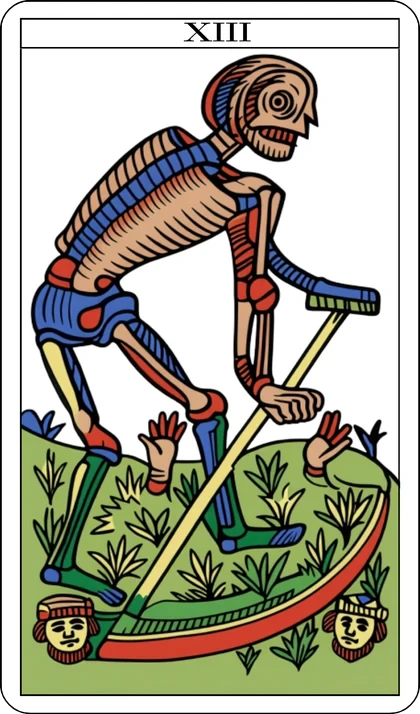
L’Arcane sans nom is the thirteenth of the twenty-two major arcana in the Marseille Tarot. The card face shows a skeleton reaping crowned heads and raised hands, while the bottom label stays empty, giving the card no name. Upright, it signifies a radical transformation that ultimately benefits the person; reversed, it signifies transformation held back, where only measured change is possible.
| Numeral | Card |
|---|---|
| no numeral | The Fool |
| I | The Juggler |
| II | The Popess |
| III | The Empress |
| IIII | The Emperor |
| V | The Pope |
| VI | The Lover |
| VII | The Chariot |
| VIII | Justice |
| IX | The Hermit |
| X | The Wheel of Fortune |
| XI | Strength |
| XII | The Hanged Man |
| XIII | The Nameless Arcanum |
| XIIII | Temperance |
| XV | The Devil |
| XVI | The House of God |
| XVII | The Star |
| XVIII | The Moon |
| XIX | The Sun |
| XX | Judgement |
| XXI | The World |
Justice is VIII and Strength XI, the reverse of the Rider-Waite. Card XIII bears no name.
The card face
On the Marseille card, a skeleton reaps toward the left, holding a scythe. The ground carries severed crowned heads and hands still raised. The bottom label is empty: the card bears no name. The numeral XIII appears on the card, printed in additive form. Nothing else is drawn. There is no landscape, no living figure, no additional object. The image is stark: a cutting figure, the remains of power and gesture, and an unnamed threshold.
What the card says
 Le Pendu
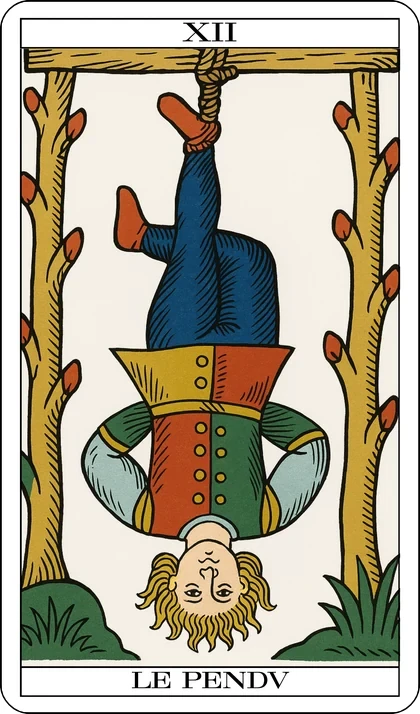
L’Arcane sans nom follows the suspension of Le Pendu. After a long immobility, the only possible exit is a passage through abandonment. A crisis does not resolve by adding more force or more will. It resolves when certain desires, certain projects, certain ways of holding on are cut away. The skeleton does not represent a person. It represents the stripping that a person undergoes when a situation has exhausted its form.
This passage has two inseparable terms. One is destructive: the person feels loss, the end of a known shape, the fall of what once seemed stable. The other is constructive: what is cut away leaves room for something that could not appear before. The crowned heads and raised hands on the ground show what is left behind: status, grasping, the gestures of a previous life. The empty label matters. This transition cannot be named in advance, because its outcome is not yet fixed.
L’Arcane sans nom is not a final stop. It is a transition, a movement between two states. The person does not disappear. A structure, an attachment, a self-image disappears. What remains is the raw material for a different arrangement.
Upright
Upright, L’Arcane sans nom signifies a radical transformation. The change is brutal, often sudden, and it can be experienced as painful or liberating. Either way, the transformation benefits the person. What is cut away was already blocking the next step. The card indicates that comfort is not guaranteed. It shows a necessary break.
The upright orientation also signifies the end of a situation. A relationship, a job, a belief, a phase of life reaches its term. Ruptures of various kinds belong here: separations, departures, the collapse of a plan. The person may resist, but the image is clear: the scythe has already moved. What remains on the ground is no longer part of the living structure.
Before rebuilding, something must be destroyed. The upright L’Arcane sans nom shows that destruction is not an accident. It is the condition for a new arrangement. The person does not lose everything. The person loses what had to be lost so that a different form could take shape.
Reversed
Reversed, L’Arcane sans nom does not mean the opposite of upright. It carries its own axis: transformation held back. The person keeps large-scale change at a distance. Only measured modifications are possible. The scythe does not sweep through. It trims, adjusts, or pauses.
This orientation often shows a refusal to change. The person avoids questioning themselves, avoids breaking a bond, avoids leaving the past behind. The crowned heads and raised hands are not cut away. They are held onto, even when they no longer serve. The empty label becomes a silence: the person does not want to name what needs to end.
A conservative nature can appear here. The person prefers to preserve the existing order, even at the cost of stagnation. Difficulties in breaking away, in letting go, in accepting that a phase is over, all belong to this reversed meaning. The transformation is not absent. It is retained, slowed, or refused.
What nuances this reading
A single card never makes a spread. The meaning of L’Arcane sans nom shifts with its position, the cards around it, and the question asked. A position in a spread can frame time, but the card itself carries no duration. Neighboring cards can emphasize the destructive pole or the constructive pole. If the surrounding cards show structure, the passage may concern a framework. If they show movement, the passage may be more fluid.
The question also matters. The surrounding cards and the position in a spread can specify the domain, but the card itself does not fix any outcome. It shows what is at stake in the passage.
Frequent questions
Why does the card have no name?
The bottom label is empty because the passage shown by L’Arcane sans nom cannot be fixed by a label. The threshold is unnamed, and the person crossing it does not yet know what will take shape on the other side.
Is L’Arcane sans nom the same as Death in other decks?
No. In the Marseille Tarot, this card is not named Death. The Rider-Waite-Smith deck names its thirteenth card Death, but the Marseille card keeps the label empty. The meaning here is transition, not literal death.
Does reversed mean the opposite of upright?
No. Reversed L’Arcane sans nom carries its own meaning: transformation held back, measured change, refusal to let go. It is not the negation of the upright. It is a different axis, with its own weight and its own consequences.
Can this card predict a physical death?
No. L’Arcane sans nom does not signify physical death. It signifies a passage, an abandonment, a structural change. The skeleton is a figure of stripping away, not a medical or fatal omen.