Le Mat: The Unnumbered Doorway of the Marseille Tarot
In brief
- Le Mat stands at the edge of ordinary life, inviting you to experience what lies beyond the well-trodden paths, where every route is equal and none deserves to be dismissed.
- The central tension is movement versus immobility: the urge to set out and abandon everything against the pull of staying put, and neither pole is a failure.
- Upright, the card signals displacement, mutation, a fresh start that leaves everything behind, creation and originality as ways of being.
- Reversed, it speaks of sedentariness, cancelled or delayed travel, remaining in the same situation, and the feeling of being misunderstood.
- The guiding line: no path is to be excluded, the other is your equal, and the goal remains the same whatever road you take.
Contents
Le Mat is the only major arcana in the Marseille Tarot that has no printed numeral. Its image shows a walker in motion, and its two orientations do not oppose each other as positive and negative: upright it signifies movement, reversed it signifies immobility. This guide reads the card itself, not any particular spread.
| Numeral | Card |
|---|---|
| no numeral | The Fool |
| I | The Juggler |
| II | The Popess |
| III | The Empress |
| IIII | The Emperor |
| V | The Pope |
| VI | The Lover |
| VII | The Chariot |
| VIII | Justice |
| IX | The Hermit |
| X | The Wheel of Fortune |
| XI | Strength |
| XII | The Hanged Man |
| XIII | The Nameless Arcanum |
| XIIII | Temperance |
| XV | The Devil |
| XVI | The House of God |
| XVII | The Star |
| XVIII | The Moon |
| XIX | The Sun |
| XX | Judgement |
| XXI | The World |
Justice is VIII and Strength XI, the reverse of the Rider-Waite. Card XIII bears no name.
The Card
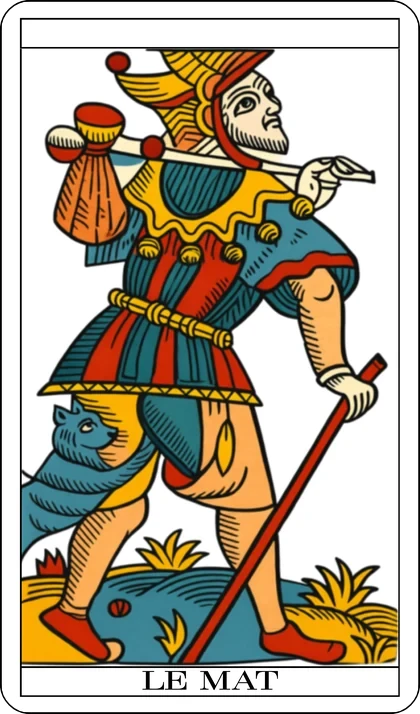
A man walks toward the right, a stick over his shoulder with a bundle hanging from it, a second stick in his hand. An animal clings to the back of his leg and tears his breeches. He wears a cap with bells and red shoes. The upper panel is empty: the card has no numeral. Nothing else is drawn on the card. The image is sparse, direct, and entirely focused on a figure in transit.
What the Card Signifies
Le Mat shows a person who stands at the margin of ordinary existence. The empty panel is not an omission but a sign: this card does not sit inside the numbered sequence like the others. Le Mat signifies an experience outside common paths. The walker carries almost nothing, yet he moves forward. The bundle on the stick suggests that what he needs is small enough to carry, not a fixed household or a settled role.
The animal tearing his breeches is not an enemy. It is a grip from behind, a reminder that leaving a place or a condition always costs something. The torn fabric shows that the margin is not comfortable. Still, the man does not stop. The card does not signify that one path is better than another. It signifies that routes differ, but the goal remains the same. No road is to be excluded from the start, and the other person, the other choice, the other way of living is worth as much as your own.
Le Mat presents a paradox: it is both the most unprotected figure in the deck and the most free. The absence of a number means the card can be placed at the head of the series or outside it. That freedom is the core of the card. Le Mat does not signify safety, but the possibility of moving without a fixed rank.
Upright
Upright, Le Mat signifies movement. The first meaning is displacement: a change of place, a journey, a physical move. Then comes mutation, a deeper change of state or condition. The card also signifies vacations, being mobile, and the simple fact of not staying still. It can signify a new departure in which the person abandons everything that weighed them down. Creation and innovation belong here, because making something new often requires leaving the known. Finally, the upright Le Mat signifies originality, the fact of being different, of walking a road that others do not take.
Reversed
Reversed, Le Mat does not mean the opposite of movement. It has its own axis: immobility. The first meaning is sedentariness, a life rooted in one place. Then comes immobility itself, the absence of physical or inner motion. A displacement may be cancelled or delayed, not as a failure of the upright meaning but as a distinct situation: the person remains in the same situation. There is no change, and that stillness can be chosen or endured. The reversed Le Mat also signifies the feeling of being misunderstood, because staying still while others move can isolate a person. This orientation is not a blocked version of the upright card. It is a full meaning in its own right, and this orientation is read without moral judgment.
What Nuances This Reading
A single card never constitutes a spread. The full meaning of Le Mat comes from its position, the cards around it, and the question asked. In a position that concerns the past, the movement or immobility it shows belongs to what has already happened. In a position that concerns the present, it signifies a current state. No card has a date or a duration by itself. The surrounding cards can also shift the tone: next to a card of structure, Le Mat may point to a departure from that structure. Next to a card of stillness, it may indicate the cost of staying. The question asked gives the final frame, because the same card does not have the same meaning for a question about work as for a question about a relationship.
Frequently Asked Questions
Why does Le Mat have no number?
The empty panel is a fact of the Marseille card. It is the only major arcana without a printed numeral. This absence means the card is outside the ordinary sequence, either at its head or beyond it, and it is part of the card’s meaning: Le Mat is not ranked like the others.
What does the animal tearing the breeches mean?
The animal clings to the back of the walker’s leg and tears his clothing. It shows that leaving a situation always has a grip on the person, a cost or a memory that pulls from behind. The walker does not stop, but the tear remains visible.
Is Le Mat the same as the Fool in the Rider-Waite deck?
No. Le Mat belongs to the Marseille Tarot, type II, and its card shows a walker with a stick, a bundle, a bell cap, red shoes, and an animal at his leg. The Rider-Waite Fool has a different iconography, including a cliff and a small dog, and it follows another tradition. The Marseille card must be read from what is actually drawn on it.
Does reversed Le Mat mean the opposite of upright Le Mat?
No. The two orientations have two independent meanings. Upright Le Mat signifies movement. Reversed Le Mat signifies immobility. The reversed card is not a blocked or failed version of the upright card; it is its own axis, with its own value.