Le Pendu: The Suspended Vision of Arcanum XII
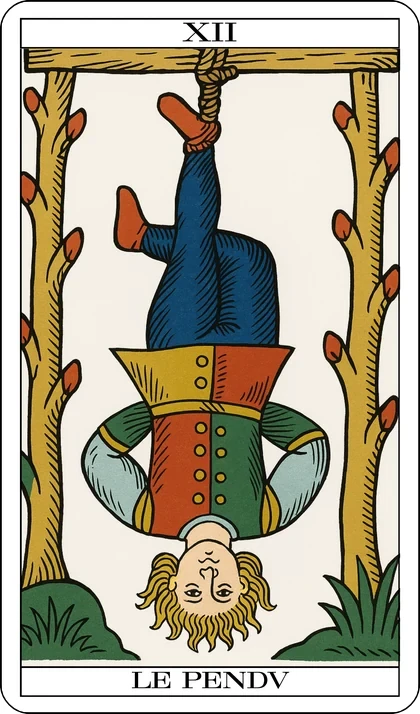
In brief
- Le Pendu signifies a painful but necessary ordeal: your immobilization comes from past mistakes, and while you can do nothing, your mind becomes more active than ever.
- The upright position holds an unfavorable tension: powerlessness, blockages, and constraints force you into waiting, yet this very patience opens a possible spiritual awakening.
- The reversed position flips the axis: great joy, liberation, and a way out of the tunnel, with dynamism and positive action returning to your hands.
- The core paradox: the inverted posture gives you another vision of reality, and your resistance is measured in difficulty, not comfort, so the card never promises an easy path.
Contents
Le Pendu is the twelfth major arcana of the Marseille Tarot, and it presents one of the most striking reversals in the entire deck: upright, it signifies constraint and powerlessness; reversed, it signifies deliverance and joy. The card shows a man hanging by one foot, yet his face holds no distress. Understanding this card means accepting that immobility can sharpen the mind, and that what looks like a dead end may be a threshold seen from an unfamiliar angle.
| Numeral | Card |
|---|---|
| no numeral | The Fool |
| I | The Juggler |
| II | The Popess |
| III | The Empress |
| IIII | The Emperor |
| V | The Pope |
| VI | The Lover |
| VII | The Chariot |
| VIII | Justice |
| IX | The Hermit |
| X | The Wheel of Fortune |
| XI | Strength |
| XII | The Hanged Man |
| XIII | The Nameless Arcanum |
| XIIII | Temperance |
| XV | The Devil |
| XVI | The House of God |
| XVII | The Star |
| XVIII | The Moon |
| XIX | The Sun |
| XX | Judgement |
| XXI | The World |
Justice is VIII and Strength XI, the reverse of the Rider-Waite. Card XIII bears no name.
The Card
What you see on the Marseille card is precise and verifiable. A man hangs suspended by one foot from a crossbar. That crossbar rests on two trees that have been pruned bare, their cut branches leaving visible stumps. His other leg is folded at a right angle. His hands are hidden behind his back, and his face shows no tension, no grimace, no struggle. The numeral XII appears in additive form, printed as twelve, never as a subtractive abbreviation. There is no halo, no coins falling, no crowd watching. The image is stark: a body held in place, a face at rest, and the quiet geometry of a suspension that has already happened.
What the Card Signifies
Le Pendu signifies an ordeal that is painful but necessary. The immobilization it describes does not come from nowhere: it is the consequence of past errors, a position reached through choices that have narrowed the field of action. The person is not being punished by an outside force; the suspension is the result of a chain that began earlier. What matters here is not the fall but the stillness after the fall.
And yet, within that stillness, something unexpected occurs. When action is taken away, mental activity does not diminish: it intensifies. The person who cannot move begins to think with a clarity that movement had obscured. The inverted position, head below the feet, is not a humiliation: it is a different angle of vision. What was familiar becomes strange, and what was hidden becomes visible. The world does not change; the perspective does.
This card also signifies a hard truth about endurance. Resistance is not measured in comfort. It is measured in difficulty. Le Pendu implies no precise duration for the ordeal. It shows that the ordeal itself is the place where something essential is learned, and that the learning cannot happen any other way.
Upright
Upright, Le Pendu signifies first of all powerlessness. The person finds themselves blocked, constrained, unable to act. Obstacles and hindrances surround the situation, and every attempt to move forward meets resistance. This is not a temporary inconvenience: it is a structural impasse, a position where the usual levers no longer work.
From that powerlessness comes a necessary patience. The card does not suggest that waiting is pleasant. It suggests that waiting is the only honest response to a situation that cannot be forced. Acceptance is not resignation; it is the recognition that struggle would only deepen the entanglement. In that acceptance, something else can open: a spiritual or reflective dimension that was previously drowned out by activity. The upright Le Pendu is unfavorable, but it is not empty. It is the difficult ground where a different kind of attention begins.
Reversed
Reversed, Le Pendu has an entirely different meaning. This is not the upright meaning blocked or negated: it is its own axis, and it is favorable. The dominant note is deliverance. The person emerges from the tunnel. The constraint that held them in place loosens, and a solution appears where none seemed possible. The feeling is one of great joy, a liberation that is felt in the body as much as in the mind.
With deliverance comes dynamism. Action becomes possible again, and it is positive action, directed and effective. The person who was suspended now moves, and the movement is not frantic: it is grounded in what the suspension taught. The reversed Le Pendu does not deny the ordeal. It shows what the ordeal signified, and it indicates a way out where the ordeal seemed to close every door.
What Nuances This Reading
A single card never shows the whole story. Le Pendu’s full meaning depends on where it falls in a spread, on the cards that surround it, and on the question that was asked. In a position that indicates the past, the suspension may describe an ordeal already lived and integrated. In a position that indicates the present, it may signify a constraint that is active right now. In a position that indicates what is coming, it may signify an impasse or, reversed, signify a release.
The surrounding cards also matter. Next to a card of movement, Le Pendu may emphasize the contrast between stillness and action. Next to a card of rupture, it may suggest that the rupture has already happened and what remains is the aftermath. The question asked shapes everything: a question about work will read differently from a question about relationship, and neither can be assumed without seeing the actual spread.
Frequently Asked Questions
Does Le Pendu always mean something bad when upright?
Upright, Le Pendu is unfavorable, but it is not catastrophic. It describes constraint, blockage, and the need for patience. The difficulty is real, but it is also productive: the suspension forces a kind of attention that comfort never allows.
Is the reversed Le Pendu simply the opposite of the upright?
No. The reversed card has its own meaning: deliverance, liberation, joy, and positive action. It is not the upright meaning blocked or negated. It is a distinct axis, and for this card, the reversed is favorable while the upright is not.
Why does the man on the card look so calm?
The face without tension is part of what the card teaches. The suspension is not a struggle; it is a state that has been accepted. The calm is not indifference. It is the quiet that comes when resistance has been exhausted and something else begins.
Does Le Pendu indicate a specific length of time?
No. A card has no duration. Only the position of the card in a spread can indicate time, and that depends entirely on the spread being used. Le Pendu describes a state, not a calendar.