Tempérance, Major Arcanum XIIII: Circulation, Rupture, and the Art of Transformation
In brief
Contents
Tempérance is the fourteenth major arcanum of the Marseille Tarot, numbered XIIII in additive Roman form. Upright, it signifies circulation, exchange, mediation, and positive adaptation. Reversed, its own independent meaning is rupture of exchange, conflict, isolation, and excess. This guide details the card’s imagery, its two orientations, and what modulates its reading.
| Numeral | Card |
|---|---|
| no numeral | The Fool |
| I | The Juggler |
| II | The Popess |
| III | The Empress |
| IIII | The Emperor |
| V | The Pope |
| VI | The Lover |
| VII | The Chariot |
| VIII | Justice |
| IX | The Hermit |
| X | The Wheel of Fortune |
| XI | Strength |
| XII | The Hanged Man |
| XIII | The Nameless Arcanum |
| XIIII | Temperance |
| XV | The Devil |
| XVI | The House of God |
| XVII | The Star |
| XVIII | The Moon |
| XIX | The Sun |
| XX | Judgement |
| XXI | The World |
Justice is VIII and Strength XI, the reverse of the Rider-Waite. Card XIII bears no name.
The Card
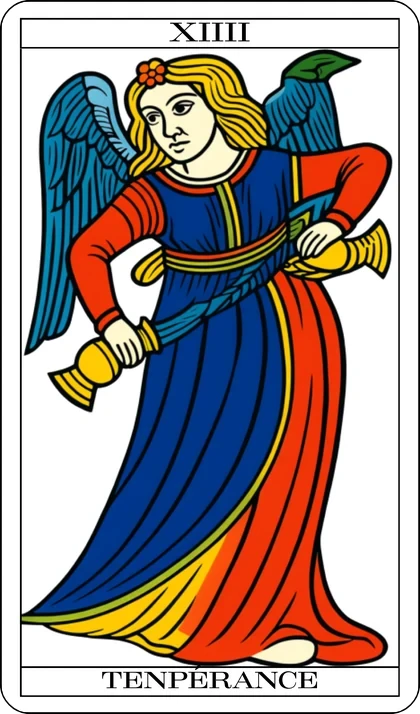
On the Marseille plank, the numeral XIIII is printed on Tempérance, in additive form, never XIV. A winged figure stands upright, pouring the contents of one vase into another, from one hand to the other. A flower is placed at the figure’s temple. The image is simple and focused entirely on the transfer between two containers. No other elements appear on the card.
What the Card Says
The core meaning of Tempérance is circulation without loss. The liquid moves from one vase to another, but nothing spills. This is not a static balance; it is an active, ongoing transfer. The person who embodies this arcanum learns to adapt to new conditions by keeping what is essential and letting the rest change form.
Tempérance also signifies mediation and exchange. The two hands, each holding a vessel, suggest a dialogue between opposites. The winged figure stands between them, not to choose one side, but to keep the flow moving. In this sense, the card represents the talent of conciliation, the ability to hear two positions and find a passage between them.
 L'Arcane sans nom
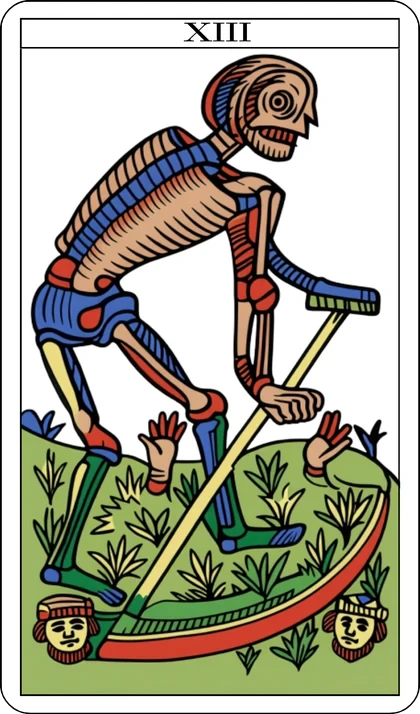
This arcanum follows L’Arcane sans nom, which signifies the stripping away of what must die. Tempérance does not repeat that rupture. Tempérance signifies a rebalancing after the rupture. The previous arcanum signifies destabilization, while Tempérance signifies stabilization, not by returning to the old form, but by integrating what remains into a new arrangement.
Upright
Upright, Tempérance signifies a period favorable to communication and exchange. Dialogue flows, meetings are constructive, and the person finds themselves well surrounded. Harmony with others is not forced; it results from a natural give and take. The upright card points to positive adaptation: the person adjusts to new circumstances without losing their core. This is the talent of the mediator, the conciliator who can hold two positions and keep the conversation moving.
As an accessory meaning, upright Tempérance can also indicate good circulation of energies, a sense of vitality and physical ease. This is not a medical statement; it is a symbolic indication of flow rather than blockage.
Reversed
The reversed Tempérance has its own axis: rupture of exchange. The flow between the two vases is interrupted. This does not mean the upright meaning is blocked; it means the situation is defined by conflict, disputes, and disagreement. The relational climate is tense, and the person may find themselves badly surrounded. Isolation can follow, not as a chosen retreat, but as a consequence of repeated relational problems.
In this reversed position, aggressiveness is not simply a flaw. It can be a necessary force to settle conflicts that have festered. The card points to moments when direct confrontation, even harsh words, becomes the only way to reopen a closed circuit.
As an accessory meaning, reversed Tempérance can indicate poor circulation of energies, excess, excessiveness, and nervous tension. The person may feel overstimulated, unable to find a stable rhythm, pushed toward extremes.
What Nuances This Reading
A single arcanum is never the whole story. The meaning of Tempérance is modulated by its position in a spread. Depending on that position, the meaning may describe a context of exchange already present, or a need to create that exchange. The card itself does not indicate when. The surrounding cards matter: next to a card of rupture, Tempérance can indicate the effort to restore flow; next to a card of stability, it can suggest that circulation is already present. The question asked also shifts the emphasis. A question about work will foreground mediation and exchange; a question about a relationship will foreground harmony or its rupture. None of this is visible in the card alone.
Frequently Asked Questions
What does the numeral XIIII mean on Tempérance?
It is the additive Roman numeral for 14, printed as XIIII on Marseille cards, never XIV. It marks Tempérance as the fourteenth of the twenty-two major arcana.
Is reversed Tempérance just the opposite of upright?
No. In Marseille tradition, each orientation has an independent meaning. Upright points to circulation and exchange; reversed points to rupture of exchange, conflict, and excess. It is not a blocked version of the upright.
Does Tempérance predict good health?
No card predicts health. Upright, Tempérance can symbolically indicate good circulation of energies and vitality. Reversed, it can point to nervous tension and excess. These are symbolic, not medical statements.
Why is the figure pouring from one vase to another?
The image depicts a transfer without loss. The liquid changes container but does not disappear. This is the core of Tempérance: nothing is created, nothing is lost, everything transforms.