La Maison-Dieu: When the Structure Falls, Something Else Begins
In brief
- For La Maison-Dieu, collapse and fall are not punishment but the logical consequence of presumption and pride, and nothing is ever definitive or truly owned.
- Upright, this side is unfavorable: it brings failure, painful difficulties, disillusionment, and brutal unexpected events that destabilize.
- Reversed, the axis shifts to shelter and security: home, domestic life, real estate projects, and a comfortable living or working place.
- The reversed side is modulated by other cards: it holds a latent threat if the following card is unfavorable, or a catastrophe avoided if the whole is favorable.
- The paradox holds: failure strengthens the strong and weakens the weak, so adversity becomes a potential engine of evolution, not a verdict.
Contents
La Maison-Dieu is the sixteenth major arcanum of the Marseille Tarot, and it signifies one of the most direct messages in the entire deck: what was built on presumption cannot stand. This card signifies collapse, but not as punishment. It signifies the moment when a structure, a belief, or a situation gives way under its own weight, and what that moment reveals about the person who experiences it.
| Numeral | Card |
|---|---|
| no numeral | The Fool |
| I | The Juggler |
| II | The Popess |
| III | The Empress |
| IIII | The Emperor |
| V | The Pope |
| VI | The Lover |
| VII | The Chariot |
| VIII | Justice |
| IX | The Hermit |
| X | The Wheel of Fortune |
| XI | Strength |
| XII | The Hanged Man |
| XIII | The Nameless Arcanum |
| XIIII | Temperance |
| XV | The Devil |
| XVI | The House of God |
| XVII | The Star |
| XVIII | The Moon |
| XIX | The Sun |
| XX | Judgement |
| XXI | The World |
Justice is VIII and Strength XI, the reverse of the Rider-Waite. Card XIII bears no name.
The Card
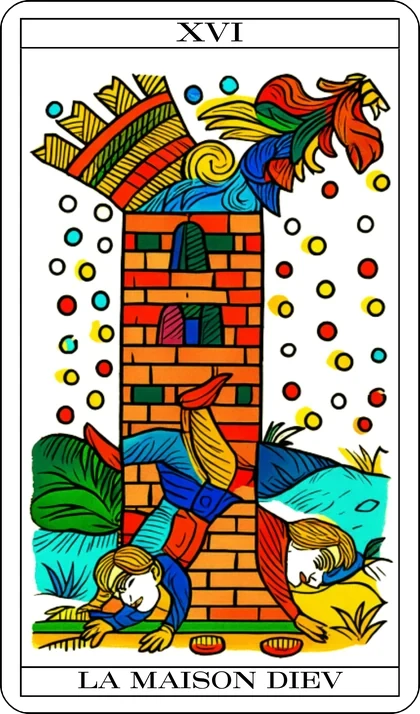
Look at the card and you see a brick tower whose top has been blown clean off. The top of the tower is gone, leaving the structure open to the sky. Two figures fall from the tower, one on each side, both headfirst, their bodies inverted as they plummet toward the ground. Around them, colored discs rain down through the air, scattered like debris. The numeral XVI appears at the top of the card, written in the additive form proper to the Marseille tradition. Nothing else is drawn. No lightning bolt strikes the tower. No hand reaches from a cloud. The scene is stark: a broken structure, two falling bodies, and a shower of discs.
What the Card Signifies
La Maison-Dieu rests on a simple truth: nothing is permanent, and nothing truly belongs to anyone. The tower is not struck down by an outside force. It collapses because it was built on presumption, on the belief that what stands will keep standing, that what is owned will stay owned, that what is certain will remain certain. The fall is the logical consequence of that error, not a punishment for it. The card does not moralize. It simply shows what happens when a person confuses their constructions with reality.
The two figures falling headfirst are the most important detail. They do not jump. They do not climb down. They are ejected from the structure they trusted, and they fall in the most vulnerable position possible: headfirst, unable to see where they will land. This is what the card means by adversity. It is not a test sent from above. It is the moment when the ground you assumed was solid turns out to be air, and you discover that you never had the control you thought you had.
Yet the card also signifies a strange promise. Failure strengthens the strong and weakens the weak. The same collapse that destroys one person can become the greatest engine of change for another. The tower falls, but the bricks remain. The discs scatter, but they can be gathered. What La Maison-Dieu signifies is not the end of everything. It is the end of the illusion that anything was ever guaranteed.
Upright
Upright, La Maison-Dieu signifies the axis of collapse. This is a difficult card to receive, and it should be read as such. It signifies failure, the kind that arrives suddenly and leaves a person reeling. It signifies painful difficulties, the kind that are not chosen and not easily absorbed. It signifies disillusionment, the moment when a belief, a relationship, a project, or a self-image reveals itself to be hollow. It signifies accidents of circumstance, the unexpected events that destabilize everything and force a person to confront what they had refused to see.
This is not a card of gentle lessons. It is a card of brutal clarity. What falls was already falling. What breaks was already cracked. The upright La Maison-Dieu shows the moment when the pretense ends and the truth of the situation becomes impossible to ignore. It is unfavorable, and it should be read as unfavorable. But it is not meaningless. The collapse it signifies is the only thing that could have opened the way to something more honest.
Reversed
Reversed, La Maison-Dieu signifies the axis of shelter. This is not the opposite of the upright meaning. It is a different meaning entirely, and it is favorable. The reversed card signifies the home, the domestic sphere, the place where a person lives and the life they build within it. It signifies real estate projects, of finding or creating a place to belong. It signifies the workplace as a place of stability, of a situation that is comfortable and secure, of benefiting from circumstances that hold.
Where the upright card shows a tower falling, the reversed card shows a structure that holds. It is the card of the roof over your head, the walls that keep out the weather, the daily life that continues because the foundation is sound. It is a card of protection, not in a dramatic sense, but in the quiet sense of having a place to return to. The reversed La Maison-Dieu signifies: here, for now, you are safe.
But this meaning is modulated by the surrounding cards. If the card that follows is unfavorable, the shelter may be threatened, a latent danger that has not yet materialized. If the surrounding cards are favorable, the reversed La Maison-Dieu can mean a catastrophe avoided, a collapse that was narrowly escaped, a structure that held when it might have fallen.
What Nuances This Reading
La Maison-Dieu is one of the most context-dependent cards in the Marseille Tarot. Its meaning shifts dramatically depending on where it falls in a spread and what cards surround it. A card of collapse placed next to a card of renewal does not mean the same thing as a card of collapse placed next to a card of stagnation. The position of the card in a reading indicates what area of life the collapse or the shelter touches. The neighboring cards indicate whether the collapse is final or whether it opens onto something else, whether the shelter is solid or whether it is already cracking.
The question asked also matters. La Maison-Dieu does not mean the same thing in a question about love as it does in a question about work or about a creative project. The card itself is not univocal. It is a sign that points toward a kind of event, and the rest of the reading indicates what that event touches and what it leaves behind.
Frequently Asked Questions
Does La Maison-Dieu mean something bad is going to happen to me?
No. A card does not predict events. It signifies a kind of situation or a kind of inner state. La Maison-Dieu upright signifies collapse, failure, or disillusionment. It does not indicate that these things will happen to you. It indicates that the situation you are asking about has this quality, or that this is the energy at work in the question.
Is the reversed La Maison-Dieu always a good card?
It is favorable in itself, but it is always modulated by the cards around it. A reversed La Maison-Dieu surrounded by unfavorable cards can indicate a shelter that is threatened or a security that is about to be tested. A reversed La Maison-Dieu surrounded by favorable cards can indicate a catastrophe avoided or a structure that holds.
Why does the card show two people falling and not one?
The two figures falling from the tower show that collapse is rarely a solitary event. What falls affects more than one person. The two figures also mirror each other, one on each side of the tower, suggesting that the collapse is complete, that nothing remains standing, and that everyone involved is caught in the fall.
What is the difference between La Maison-Dieu and the card as it appears in other decks?
La Maison-Dieu is the Marseille name for this card, and it is the name painted on the card itself. Other decks, following a different tradition, call it by a different name and add iconographic elements that do not appear on the Marseille card, such as a lightning bolt or a crown at the top of the tower. The Marseille card shows only what is described above: a brick tower with its top blown off, two figures falling headfirst, and colored discs raining down.