La Lune, Arcanum XVIII: The Inner Tide of the Marseille Tarot
In brief
- La Lune points to your inner world as a landscape of both creative riches and perilous illusions, where imagination can either build or mislead.
- Your intuition only serves you when it stays anchored in reality, otherwise the same receptivity that feeds your art can dissolve into confusion.
- Upright, the card signifies fertile imagination, artistic composition, and a calm exterior masking deep inner activity, often linked to water, femininity, and creation.
- Reversed, it shows the shadow side: sadness, pessimism, total inertia, and intellectual disorder, where the inner world turns against you.
- The card never acts on its own, it simply signifies that your psyche holds both poles, and only you can choose whether your imagination becomes a source or a trap.
Contents
La Lune, the eighteenth major arcanum of the Marseille Tarot, signifies the inner world: its fertile imagination and its capacity for illusion. On the card, a faced crescent shines over two howling dogs, two towers, and a crayfish in water. Upright, it signifies creative receptivity; reversed, confusion and melancholy.
| Numeral | Card |
|---|---|
| no numeral | The Fool |
| I | The Juggler |
| II | The Popess |
| III | The Empress |
| IIII | The Emperor |
| V | The Pope |
| VI | The Lover |
| VII | The Chariot |
| VIII | Justice |
| IX | The Hermit |
| X | The Wheel of Fortune |
| XI | Strength |
| XII | The Hanged Man |
| XIII | The Nameless Arcanum |
| XIIII | Temperance |
| XV | The Devil |
| XVI | The House of God |
| XVII | The Star |
| XVIII | The Moon |
| XIX | The Sun |
| XX | Judgement |
| XXI | The World |
Justice is VIII and Strength XI, the reverse of the Rider-Waite. Card XIII bears no name.
The Card
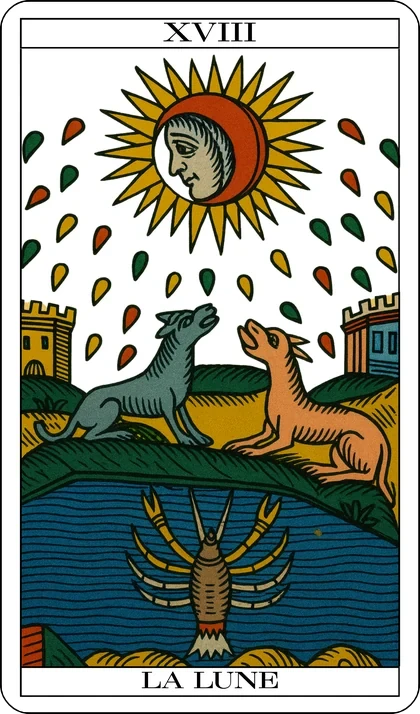
The card shows a crescent with a human face set inside a radiant disk. Drops fall all around it. Two dogs face each other and howl toward the crescent. Behind them stand two towers. In the foreground, a crayfish sits in water. The numeral XVIII is printed, written in the additive Roman form.
What the Card Says
La Lune signifies the inner world and the psyche, with its riches and its dangers. The image does not show a clear landscape: it shows a night scene where imagination and instinct rise from the depths. The crayfish in the water is a creature of the hidden, and the howling dogs are voices that answer the crescent. This is not a card of external action; it is a card of inner perception.
The imagination here is double edged. It can feed creation, art, and deep intuition, but it can also feed illusion and confusion. La Lune does not choose for the person; it shows that the same inner tide can become a source of evolution or a source of perdition. Intuition only holds value when it rests on a solid sense of realities. Perception must tend toward greater objectivity, otherwise the inner world swallows the outer one.
Water runs through this card: the drops, the crayfish, the moist night air. Water is the element of receptivity, of what is felt before it is named. La Lune signifies everything that moves below the surface, in dreams, in moods, in unspoken knowledge. But that knowledge needs grounding. Without a shore, water has no shape.
Upright
Upright, La Lune signifies the axis of imagination. It signifies first fertile imagination and creation, especially in the arts of composition: writing, music, image making, anything that builds a world from inner material. This is not a card of outward force; it signifies passive exterior calm while the inner life works intensely. A period of great calm on the plane of reality often accompanies this orientation.
Next comes sharpened intuition and deep receptivity. The person is porous to atmospheres, to unspoken signals, to the emotional weather of a place. Everything related to water is emphasized: the sea, rivers, rain, the body’s fluids, the pull of the tides. La Lune upright also signifies femininity, fecundity, and pregnancy as symbolic possibilities, not as biological predictions. As an accessory meaning, it can signify psychology, the study of the inner world itself.
Reversed
Reversed, La Lune does not cancel the imagination. It shows the same inner tide turning into trouble. The first meanings are sadness, melancholy, negativism, and pessimism. The person may feel affected or upset by what rises from within. This orientation can indicate total inertia or a flat calm where nothing moves, an involution that turns the gaze inward until the outer world fades.
Confusion and intellectual disorder follow: thoughts loop, images blur, the boundary between what is felt and what is real becomes porous. Difficulties in having a child and a sense of lack of femininity can also appear, always as symbolic readings. As accessory meanings, the reversed card can evoke a depressive state or mental trouble, never as a diagnosis, but as a sign that the inner tide has become heavy and unmanageable.
What Nuances This Reading
A single card never tells a whole story. La Lune depends on the position it occupies in a spread and on the cards around it. Next to an active card, its calm may mean a pause before movement; next to a card of rupture, its confusion may deepen. The question asked also shifts the weight: in a creative question, the upright imagination dominates; in a relational question, the reversed trouble may speak more loudly. The card itself has no deadline and no duration; only a spread position gives time.
Frequently Asked Questions
What does the crayfish mean on La Lune?
The crayfish sits in water at the foreground, a creature of the depths. It points to what moves beneath the surface of consciousness, hidden but active. It is not a lobster or a scorpion; it is a crayfish, tied to fresh water and slow, backward movement.
Is La Lune always a negative card?
No. Upright, it signifies fertile imagination, artistic talent, and deep receptivity. Reversed, it signifies trouble and confusion. Neither orientation is simply good or bad; each has its own axis.
Does La Lune predict pregnancy?
Upright, it can signify femininity, fecundity, and pregnancy as symbolic possibilities, but a single card never predicts a biological event. Its meaning depends on the question and the surrounding cards.
Why do the dogs howl at the crescent?
The two dogs face each other and howl toward the crescent, showing the pull between inner instinct and outer reality. They do not attack; they call, which suggests longing or warning rather than action.