La Roue de Fortune: The Wheel That Never Shows a Fixed Summit
In brief
- Perpetual motion is the life force itself: this card shows that resisting change breaks the vital dynamic, and any attempt to freeze yourself at a peak is an illusion.
- Upright, the wheel signals positive evolution and the natural rhythm of things: you reap what you have sown, so stay confident and do not fight the movement.
- Reversed, it reveals inertia and stagnation: a calm situation that does not budge, where the only honest response is patient waiting without forcing results.
- The central tension is a paradox: do not rush the process, yet do not refuse the change either, because the suffering comes precisely from saying no to what is already turning.
- La Roue de Fortune never acts on its own: it simply signifies that you stand inside a cycle, and your choice is not to stop it but to ride its momentum or endure its standstill.
Contents
La Roue de Fortune, the tenth of the twenty-two major arcana of the Marseille Tarot, shows a six-spoked wheel in perpetual motion. Upright it signifies positive change, progression, and the natural rhythm of life; reversed it signifies inertia, stagnation, and a necessary waiting. This card never describes a static reward, only the movement that keeps life alive.
| Numeral | Card |
|---|---|
| no numeral | The Fool |
| I | The Juggler |
| II | The Popess |
| III | The Empress |
| IIII | The Emperor |
| V | The Pope |
| VI | The Lover |
| VII | The Chariot |
| VIII | Justice |
| IX | The Hermit |
| X | The Wheel of Fortune |
| XI | Strength |
| XII | The Hanged Man |
| XIII | The Nameless Arcanum |
| XIIII | Temperance |
| XV | The Devil |
| XVI | The House of God |
| XVII | The Star |
| XVIII | The Moon |
| XIX | The Sun |
| XX | Judgement |
| XXI | The World |
Justice is VIII and Strength XI, the reverse of the Rider-Waite. Card XIII bears no name.
The Card
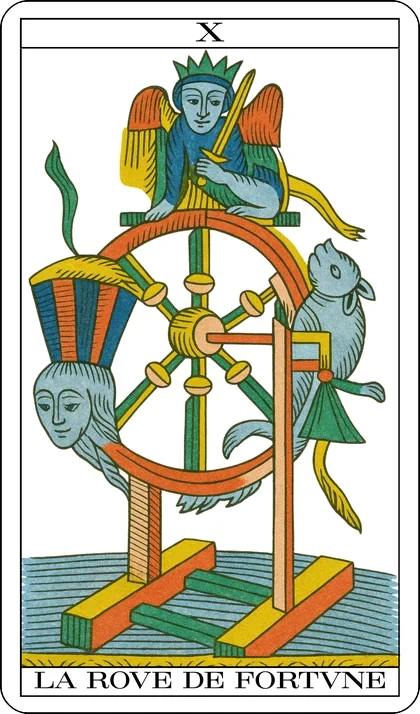
On the Marseille plate, La Roue de Fortune shows a wheel with six spokes mounted on an axle and a wooden frame. One animal climbs on one side of the wheel, another descends on the other side, and the descending animal wears a headdress. At the top of the wheel, a winged and crowned figure holds a sword. The numeral X is printed below, in the additive form proper to this deck. Nothing else appears on the card.
What the Card Signifies
The wheel is not a symbol of luck; it is the principle that founds the universe: perpetual movement. Life exists only because things turn, rise, fall, and turn again. To resist change is to break the vital dynamic. A person who tries to stop the wheel does not gain stability; they lose the very condition of being alive. The card shows that suffering arises from refusing this reality, not from the movement itself.
The climbing and descending animals make the paradox visible. Every ascent contains a future descent, and every descent prepares a future ascent. No position on the wheel is permanent. The winged crowned figure at the top holds a sword, not to cut the wheel, but to see the whole cycle from above. That figure signifies a sovereign perspective, one that accepts the rotation without clinging to a single point. Wanting to reach the summit and stay there is an illusion; the summit is only a moment in the turn.
The six spokes divide the circle into equal parts, suggesting rhythm, repetition, and order. The wheel does not spin chaotically; it follows a natural rhythm. The card therefore does not describe random events but the structured alternation of phases. A person who understands this does not fight the turn; they move with it.
Upright
Upright, La Roue de Fortune signifies positive change. It indicates evolution and progression, the natural rhythm of life asserting itself. A person who has made steady efforts now reaps the fruit of those efforts, not as a final prize but as a phase in the ongoing turn. The movement is innovative, and fighting it only creates friction. The upright orientation suggests a confident attitude: do not rush the wheel, but do not refuse the change that is present. Accept the turn, and the progression continues.
Reversed
Reversed, La Roue de Fortune signifies arrest. It shows a calm situation that does not move, an absence of progression and of visible results. This is not the upright meaning blocked or negated; it is a distinct state with its own logic. The wheel has stopped, and the person is held in a necessary waiting. Patience is the only appropriate response. Forcing the wheel to turn again would only break the mechanism. The reversed orientation indicates that the stillness is a phase, not a final state, and it lasts only as long as the rhythm requires.
What Nuances This Reading
A single card never delivers a complete answer. Its position in a spread frames the domain and the temporal scope. The cards around La Roue de Fortune specify what is turning or what is blocked: a neighboring major arcanum can show the area of life concerned, while a minor arcanum can show the concrete detail. The question asked determines whether the movement concerns work, relationship, inner growth, or something else. Without that context, La Roue de Fortune remains a principle, not a prediction. It does not say when, how fast, or for whom; it only says that movement or arrest is present.
Frequently Asked Questions
Does La Roue de Fortune always mean good luck?
No. It signifies movement, not luck. Upright it indicates favorable change and progression; reversed it indicates stagnation and waiting. The card does not indicate a happy outcome, only the presence of a turn or an arrest.
What is the difference between upright and reversed?
Upright carries the axis of movement: change, evolution, natural rhythm. Reversed carries the axis of arrest: inertia, calm without progression, necessary patience. They are two independent meanings, not one meaning and its opposite.
Why is the numeral written as X and not 10?
The Marseille Tarot uses additive Roman numerals. X is the tenth major arcanum, printed in that form on the card. It is not a modern subtraction like IX or IV.
What does the winged crowned figure with the sword mean?
It shows a sovereign perspective above the wheel. The figure sees the whole cycle without being fixed to any single point. The sword does not cut the wheel; it signifies clear sight over the movement.