L’Impératrice: Arcanum III and the Illusion of Ruling
In brief
- L’Impératrice signifies that external power is a noble-looking ambition, but self-command is the only true authority.
- Upright, it signifies taking a leading role or gaining responsibilities, yet the real test is whether you can govern your own desires.
- Reversed, it points to submission or a struggle to assert yourself, exposing a disconnect from inner sovereignty.
- The card holds a paradox: any domination over others is temporary and illusory, unless it flows from mastery over yourself.
Contents
L’Impératrice, the third major arcanum of the Marseille Tarot, shows a crowned woman seated in full authority. Upright, the card signifies power to act, accession to a directing position, and full possession of one’s means. Reversed, it carries an autonomous meaning: power absent, submission, and difficulty asserting oneself. Beneath both orientations lies a single core: the desire to govern is noble in appearance but vain unless the only real power, power over oneself, is exercised.
| Numeral | Card |
|---|---|
| no numeral | The Fool |
| I | The Juggler |
| II | The Popess |
| III | The Empress |
| IIII | The Emperor |
| V | The Pope |
| VI | The Lover |
| VII | The Chariot |
| VIII | Justice |
| IX | The Hermit |
| X | The Wheel of Fortune |
| XI | Strength |
| XII | The Hanged Man |
| XIII | The Nameless Arcanum |
| XIIII | Temperance |
| XV | The Devil |
| XVI | The House of God |
| XVII | The Star |
| XVIII | The Moon |
| XIX | The Sun |
| XX | Judgement |
| XXI | The World |
Justice is VIII and Strength XI, the reverse of the Rider-Waite. Card XIII bears no name.
The Card
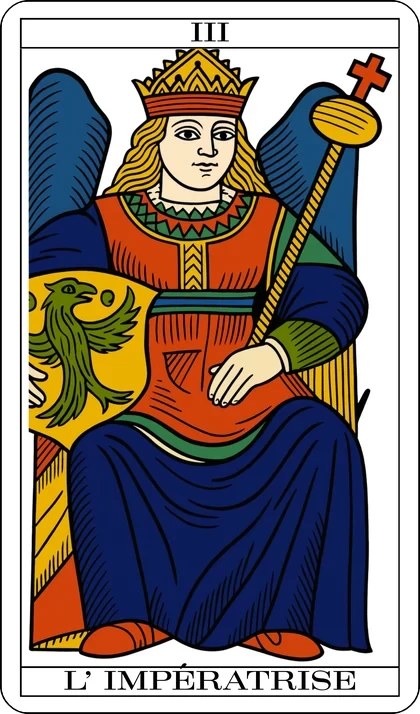
On the Marseille card, L’Impératrice is seated facing forward. She wears a crown with points, and her long hair is loose. In one hand she holds a scepter topped with a globe and a cross. Against her other side rests a shield bearing an eagle. The numeral III is printed in additive form, marking her as the third of the twenty-two major arcana. No other element appears on the card.
What the Card Says
L’Impératrice signifies worldly authority and the desire to govern. The crown, the scepter, and the eagle shield all point to sovereignty, rank, and command. Yet the card does not present these emblems without reserve. It shows a person seated, not advancing. The posture is stable, but it is also fixed. The power displayed is real in its trappings, yet the deeper meaning of the card is that domination over others remains illusory and temporary when it is not grounded in self-mastery.
The scepter with its globe and cross suggests authority that claims a spiritual or universal dimension. The eagle on the shield suggests force, vigilance, and empire. But these are external signs. L’Impératrice does not signify that such signs are worthless. It signifies that they are insufficient by themselves. A person may hold a high position, command others, and still lack the only power that endures: the power exercised over one’s own impulses, fears, and desires.
This is the specific tension of the card. It is not a simple promise of success, nor a simple warning against ambition. It holds both: the visible majesty of command and the hidden vanity of command without inner rule. The card does not resolve this tension. It shows it as the very material of the arcanum.
Upright
Upright, L’Impératrice signifies the axis of power to act. The first meaning is power itself: the capacity to decide, to direct, to impose a will. Then comes accession to a directing position, the moment when a person is placed in charge. The card also points to full possession of one’s means, the state of having one’s faculties, resources, and authority available and coordinated. It can signify obtaining an elevated post, and with it an increase of responsibilities.
As an accessory meaning, dissociated from the main axis, the card can point to excellent vitality. It may also designate a person: an active, strong, self-assured woman. These accessory meanings do not replace the central sense. They accompany it, and their weight depends on the question and the surrounding cards.
Reversed
Reversed, L’Impératrice does not mean the failure of the upright sense. It has its own axis: power absent. The first meaning is absence or loss of power. This is not a blocked power waiting to be released. It is a state in which authority is not held, or has been relinquished, or has been taken away. The card then points to a position of submission, where the person is under another’s rule or unable to claim a place of command.
This axis also includes a self-effacing nature, difficulty asserting oneself, and lack of self-confidence. These are not simply the reverse of strength. They describe a distinct condition: a person whose presence is diminished, whose voice is low, whose will does not take shape in the world. As an accessory meaning, the card can point to physical or psychological weakness. It may also designate a person: a woman in a difficult position.
What Nuances This Reading
A single card never constitutes a spread. L’Impératrice is timeless by itself. Only its position in a layout can frame a duration, a past, a present, or a future. The surrounding cards specify the field where the power or its absence plays out: a relationship, a work, a material situation, an inner conflict. The question asked also matters. If the question concerns a person, the card may designate a woman. If it concerns a state, the card points to authority or submission. None of this can be fixed without seeing the actual spread.
Frequently Asked Questions
Does L’Impératrice always mean a woman?
No. The card can designate a woman, especially upright an active and self-assured woman, and reversed a woman in a difficult position. But its primary meaning concerns power, authority, and self-command, which are not tied to any gender.
Is reversed L’Impératrice the opposite of upright?
No. In the Marseille Tarot, the two orientations carry two independent meanings. Upright signifies power to act. Reversed signifies power absent. The reversed is not a blocked version of the upright; it is a distinct axis with its own coherence.
What does the eagle shield mean?
The eagle on the shield is an emblem of force, vigilance, and sovereignty. It reinforces the card’s theme of worldly command. But like the crown and the scepter, it remains an external sign. The card does not indicate these signs are meaningless; it indicates they are not enough without power over oneself.
Can L’Impératrice indicate health?
As an accessory meaning, upright it can point to excellent vitality, and reversed to physical or psychological weakness. These are not diagnoses or prognoses. They are secondary indications that only a full spread and a precise question can clarify.