Le Diable, Arcanum XV: The Cord, the Pedestal, and the Two Faces of Matter
In brief
- Le Diable names the raw force of material life: money, pleasure, sensuality, and vitality, all concrete and desirable in themselves.
- The real trap is not the thing you enjoy, it is the attachment that turns enjoyment into servitude, the moment a pleasure becomes your master.
- Upright, the card points to abundance and appetite: financial gains, erotic connection, charm, and an epicurean zest for living, all flowing without shame.
- Reversed, it signals deprivation and blockage: money that shrinks, desire that goes unmet, and sometimes the physical cost of having overindulged.
- Hold the paradox: the same force that enriches you can enslave you, and the card never tells you which side you stand on, it only shows you the chain.
Contents
Le Diable is the fifteenth major arcanum of the Marseille Tarot, numbered XV in additive form. It does not point to a demon outside you; it points to the way a person can become tied to matter, pleasure, and possession. Upright, the card carries abundance; reversed, it carries penury, and these are two independent meanings, not a single energy blocked.
| Numeral | Card |
|---|---|
| no numeral | The Fool |
| I | The Juggler |
| II | The Popess |
| III | The Empress |
| IIII | The Emperor |
| V | The Pope |
| VI | The Lover |
| VII | The Chariot |
| VIII | Justice |
| IX | The Hermit |
| X | The Wheel of Fortune |
| XI | Strength |
| XII | The Hanged Man |
| XIII | The Nameless Arcanum |
| XIIII | Temperance |
| XV | The Devil |
| XVI | The House of God |
| XVII | The Star |
| XVIII | The Moon |
| XIX | The Sun |
| XX | Judgement |
| XXI | The World |
Justice is VIII and Strength XI, the reverse of the Rider-Waite. Card XIII bears no name.
The plate
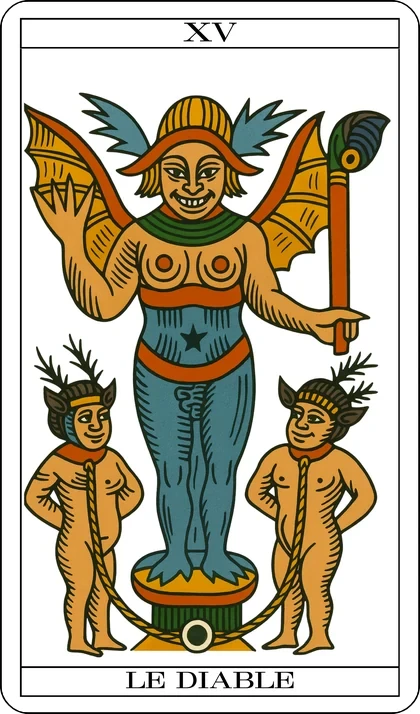
On the Marseille plate, a winged and horned figure stands on a pedestal. One hand raises a torch, the other remains open. Two smaller horned figures stand on either side of the pedestal, each attached to it by a cord. The numeral XV appears in additive form. Nothing else is drawn: no chains, no flames beyond the torch, no extra symbols.
What the card says
The image does not show a monster holding prisoners. The two small figures are not tied to the central figure; they are tied to the pedestal, the material base. That detail is the heart of the card. A person can become attached to matter, to pleasure, to possessions, and that attachment can turn into an alienation. The cord is not around their necks or wrists in a violent grip; it is simply fixed to the base they stand near.
The raised torch and the open hand show two possible relations to this material fire. The torch can warm or burn. The open hand neither grabs nor forces. The temptation described here is to make pleasure the sole purpose of existence, to overvalue what can be touched, owned, and consumed. Possessions and pleasures are not dangerous in themselves. What binds a person is the subjection to them, the inability to stand without the pedestal.
Le Diable therefore does not designate evil as a supernatural enemy. It signifies a way of living in which matter becomes the center. The two small figures mirror each other, each tied to the same base. The image points to the risk of confusing having with being, and of mistaking intensity for freedom.
Upright
Upright, Le Diable carries the axis of abundance. The most concrete meaning is material: gains, financial improvement, increased income, and money arriving from several directions. This is not a card of sudden ruin; it is a card of worldly comfort, of resources that flow more easily.
The same current runs through the body and intimate life. Sensuality is heightened, and there is often good sexual understanding in a couple. A friendship can shift toward romantic attraction. Vitality, magnetism, and charm are strong. A person may feel more epicurean, more willing to enjoy food, touch, and pleasure without guilt. The upright position describes a state of pleasure, not as a trap, but as a lived experience.
Reversed
Reversed, Le Diable carries a different axis: penury. Where the upright position shows inflow, the reversed position shows economic difficulty. Money leaks, income shrinks, and the material base feels unstable. This is not the upright meaning blocked; it is a distinct condition of scarcity, with its own weight.
In intimate life, the reversed card points to absence of physical relations or a poor sexual understanding between partners. The warmth of the upright position is not present, not because it is repressed, but because the situation itself is cold or disconnected. Separately, and only as an accessory meaning, the reversed card can point to health problems following excess. This is not a medical prediction; it is a reminder that overindulgence has consequences, and it stands apart from the main axis of penury.
What nuances this reading
Le Diable, through its iconography, insists on material attachment. The meaning of Le Diable depends on where it falls in a spread. In a position about the past, it may describe a state of pleasure or scarcity that has already shaped the present. In a position about obstacles, it may point to an attachment that needs to be seen. The card itself carries no date and no duration; only the position gives it time.
The cards around it indicate which axis of Le Diable, abundance or penury, is emphasized. Next to a card of movement, Le Diable may show that material abundance supports a departure. Next to a card of structure, it may show that the structure is built on pleasure or on lack. The question asked specifies which domain of Le Diable is foregrounded: a question about work will foreground money, a question about love will foreground sensuality or its absence. The two orientations are independent, so a reversed Le Diable is not a failed upright Le Diable; it is another room in the same house.
Frequent questions
Does Le Diable mean evil or a curse?
No. It describes attachment to matter and pleasure, not a supernatural enemy. The two small figures are tied to a pedestal, not tortured by the central figure.
Is the reversed card just the opposite of the upright?
No. Upright carries abundance; reversed carries penury. They are two independent meanings, not one energy blocked or negated.
Does Le Diable predict financial ruin or illness?
No card predicts. Upright can point to gains; reversed can point to economic difficulty or, as an accessory, health problems after excess. A spread and a question are needed to know what is being described.
Why are the two small figures tied to the pedestal and not to the central figure?
The cord is tied to the material base. The attachment is to matter, pleasure, and possession, not to a demon. That is the core of the card.