La Force, Arcanum XI: Opening the Lion’s Mouth Without Killing It
In brief
- « La Force » marks the shift from being a passive object of your desires to becoming an active subject, since desires themselves never block you, only your enslavement to them does.
- Mastery here means uniting divergent forces rather than crushing them, so you stop serving your impulses without needing to suppress them.
- Upright, the card shows full possession of your means, vitality, and a dominant position that equips you to face any situation.
- Reversed, it reveals fatigue and fragility, a weakened stance where you lack power to act and drift toward submission.
- The central paradox holds: true strength is not violent will but the integration of opposing energies within yourself.
Contents
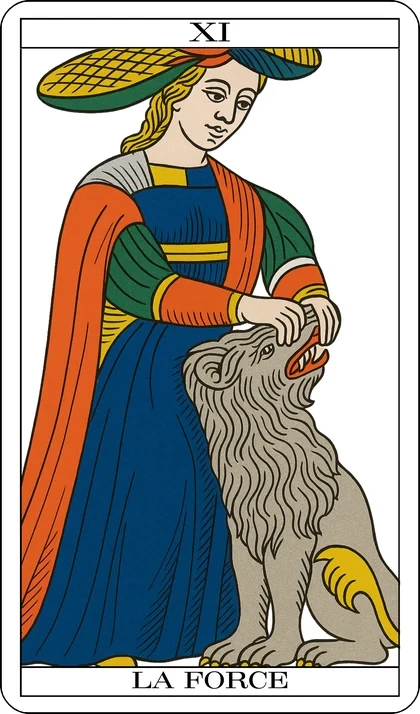
La Force is the eleventh major arcanum of the Marseille Tarot. It depicts a woman opening a lion’s mouth with her bare hands, and it signifies the passage from being an object of one’s impulses to being their subject. Upright, it carries the axis of mastery; reversed, it carries the axis of powerlessness, a distinct meaning in its own right.
| Numeral | Card |
|---|---|
| no numeral | The Fool |
| I | The Juggler |
| II | The Popess |
| III | The Empress |
| IIII | The Emperor |
| V | The Pope |
| VI | The Lover |
| VII | The Chariot |
| VIII | Justice |
| IX | The Hermit |
| X | The Wheel of Fortune |
| XI | Strength |
| XII | The Hanged Man |
| XIII | The Nameless Arcanum |
| XIIII | Temperance |
| XV | The Devil |
| XVI | The House of God |
| XVII | The Star |
| XVIII | The Moon |
| XIX | The Sun |
| XX | Judgement |
| XXI | The World |
Justice is VIII and Strength XI, the reverse of the Rider-Waite. Card XIII bears no name.
The Board
On the board, a woman stands upright. She wears a hat with a wide, wavy brim. With both hands, she opens the jaws of a lion seated at her feet. The lion is not standing, not attacking; it is seated, and its mouth is held open by the woman’s grip. The numeral XI is printed in additive form. No other figure, object, or landscape element appears on the card.
What the Card Says
La Force signifies a passage from object to subject. A person who lives as an object is moved by desires, fears, and reactions without choosing them. A person who lives as a subject feels the same impulses but is not defined by them. The card does not show the woman killing the lion or closing its mouth; she holds it open. That gesture is the core: the impulse remains alive, but it no longer dictates.
The lion seated at her feet is not an enemy to destroy. It is the raw force of appetite, anger, or vital energy. The woman’s two hands do not crush the jaws; they direct them. Mastery here is not violent willpower. It is the union of divergent forces: the human intention and the animal energy work in the same gesture. To master is not to suppress the impulses, but to cease being their slave.
This is why La Force does not signify victory over external enemies. It signifies an internal arrangement. The person who embodies this card has stopped fighting against themselves. They have found a way to hold their own intensity without being torn apart by it.
Upright
When La Force appears upright, it signifies, in decreasing order of importance: good health, vitality, and physical strength; full possession of one’s means; a dominant position; responsibilities; power; and the capacity to direct one’s impulses without suppressing them. The person is not necessarily aggressive. They are equipped, steady, and able to act without being overwhelmed. The upright card points to a state where the woman’s gesture is realized: the person holds their own lion, their own intensity, with both hands.
Reversed
Reversed, La Force signifies the axis of powerlessness. This is not the upright meaning blocked or delayed; it is a distinct configuration. In decreasing order of importance, it points to fatigue, a drop in energy, health problems, psychological fragility, a timid or unsure nature, a position of weakness, a lack of means or power to act, and submission. Here the person experiences themselves as the object of forces they cannot direct. The lion’s jaws are no longer held open by a steady grip; the impulse has the upper hand, or the hands have let go. The person may feel emptied, overrun, or reduced to obeying what they did not choose.
What Nuances This Reading
A single card never makes a spread. The position in a layout frames the time and situation for La Force, not the card itself. The surrounding cards also modulate the reading: next to a card of rupture, La Force can indicate the inner resources available to face a break; next to a card of passivity, it can point to a power that is present but not yet claimed. The reversed meaning is equally modulated: it does not become the upright meaning if the neighboring cards are favorable, but its weight can shift from physical fatigue to social submission.
Frequently Asked Questions
Why is La Force numbered XI and not VIII?
In the Marseille Tarot, Justice is arcanum VIII and La Force is arcanum XI. The Rider-Waite-Smith deck, following a different system, reversed these two numbers. On the Marseille board, the numeral XI is printed in additive form, never as IX or IV.
Does La Force mean I should suppress my desires?
No. The image shows the woman opening the lion’s mouth, not killing the lion or sewing its jaws shut. The card signifies ceasing to be enslaved by one’s impulses, not eliminating them. The desire remains; the person is no longer its object.
What is the difference between upright and reversed La Force?
Upright, La Force carries the axis of mastery: vitality, full possession of one’s means, a dominant position, power. Reversed, it carries the axis of powerlessness: fatigue, fragility, a position of weakness, submission. These are two independent meanings, not one meaning and its negation.
Does La Force predict good health?
Upright, La Force signifies vitality and physical strength as a present state. It is not a medical prognosis and does not replace a clinical assessment. Reversed, it can point to fatigue or a drop in energy, again as a signification, not a diagnosis.