L’Empereur: The Fourth Major Arcanum of the Marseille Tarot, Upright and Reversed
In brief
- L’Empereur depicts a person who has won the battle against their own weaknesses, and the empire they rule is themselves, not a territory.
- The central tension is the same trait read two ways: stability versus movement, certainty versus a taste for risk, and neither side is a fault.
- Upright, the card signifies a settled situation, professional or emotional, with commitment and calm, the end of doubt and a quiet mind.
- Reversed, it signifies instability, precariousness, and an adventurous spirit, but that spirit is not a mistake, it is the same energy seen from the side of motion.
- The card never acts, it signifies: you are the one who stabilizes, hesitates, or takes the risk, and the outcome is yours to own.
Contents
L’Empereur is the fourth of the twenty-two major arcana in the Marseille Tarot, numbered IIII in additive form. Upright, it signifies stability, security, and the quiet that follows inner victory. Reversed, it carries its own axis: instability, precarity, and a taste for risk, never a simple negation of the upright.
| Numeral | Card |
|---|---|
| no numeral | The Fool |
| I | The Juggler |
| II | The Popess |
| III | The Empress |
| IIII | The Emperor |
| V | The Pope |
| VI | The Lover |
| VII | The Chariot |
| VIII | Justice |
| IX | The Hermit |
| X | The Wheel of Fortune |
| XI | Strength |
| XII | The Hanged Man |
| XIII | The Nameless Arcanum |
| XIIII | Temperance |
| XV | The Devil |
| XVI | The House of God |
| XVII | The Star |
| XVIII | The Moon |
| XIX | The Sun |
| XX | Judgement |
| XXI | The World |
Justice is VIII and Strength XI, the reverse of the Rider-Waite. Card XIII bears no name.
The plate
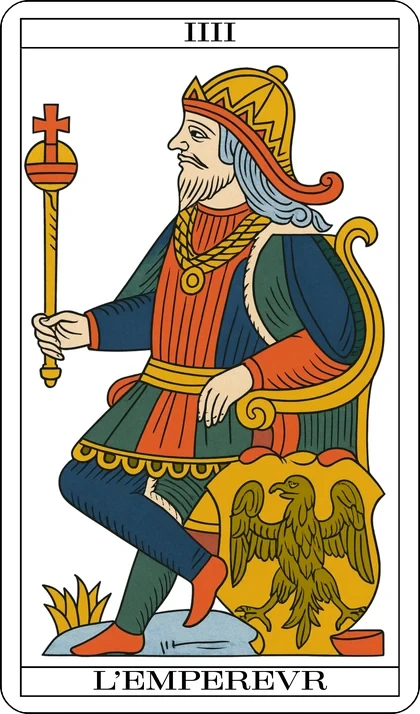
The card shows a figure seated in profile, legs crossed, wearing a crowned helmet. A scepter topped with a globe and cross is held raised. Against the seat, on the ground, rests a shield bearing an eagle. The numeral IIII is printed on the card in additive form, not the subtractive IV. No other element appears on the Marseille plate.
What the card says
The core of L’Empereur is self-mastery after an inner battle. The figure does not fight; the crossed legs and the raised scepter show a person who has already faced their own weaknesses and now presides over the extinction of conflict and doubt. The Empire this card signifies is not a territory: it is the self, ordered and quiet.
The shield with the eagle resting on the ground is not raised for defense. It signals the end of defensive struggle. What once required protection now stands at rest, because the inner war is over. The crowned helmet indicates sovereignty over one’s own thoughts, not domination over others.
This card does not indicate external power. It points to mental mastery and quietude. The seated posture, legs crossed, suggests containment and stability, a state in which certitudes replace hesitation. L’Empereur signifies a person who has become their own ruler.
Upright
Upright, L’Empereur signifies stability first. This stability brings security: a situation well in place, whether professional or emotional, an engagement that lasts, and certitudes that put an end to doubt. The upright axis also carries determination and a calm, quiet period. When the card designates a person, it can point to a stable man with a solid position.
Reversed
Reversed, L’Empereur does not mean the absence of stability. It carries its own axis: instability. This instability appears as precarity, a situation that feels unsure and not reassuring, marked by doubts and uncertainties. At the same time, the reversed axis includes a taste for risk and an adventurous spirit. This is not a fault: it is the same trait read from the side of movement, where the need for security gives way to the pull of the unknown. When the card designates a person, it can indicate an unstable or weakened man.
What nuances this reading
A single card never makes a spread. The meaning of L’Empereur shifts according to its position, the cards around it, and the question asked. In a position about an obstacle, upright stability may point to something too fixed, a structure that resists change. In a position about a resource, the same stability may indicate a solid base. Neighboring cards can sharpen or soften the axis: a card of movement next to L’Empereur upright may show stability that allows action, while a card of rupture may show a structure under pressure. The reversed axis also depends on context: surrounded by cards of caution, the taste for risk may read as recklessness; surrounded by cards of openness, it may read as necessary adventure.
Frequent questions
Why is the numeral written IIII and not IV?
The Marseille Tarot prints this card with the additive numeral IIII, never the subtractive IV. The plate shows the numeral exactly as IIII.
Does L’Empereur always represent a man?
It can designate a person: upright, a stable man with a good situation; reversed, an unstable or weakened man. But as a major arcanum, its primary meaning is a state of self-mastery or instability, not a gender.
Is the reversed L’Empereur just the opposite of the upright?
No. In the Marseille tradition, the two orientations carry independent meanings. Reversed, L’Empereur signifies the axis of instability, precarity, doubt, risk, and adventurous spirit. It is not the negation of stability but a different register altogether.
How does L’Empereur differ from the Rider-Waite Emperor?
The Marseille card shows a seated profile with crossed legs, a crowned helmet, a raised scepter with globe and cross, and an eagle shield on the ground. It does not use the iconography of the Rider-Waite deck. The Marseille numbering also places Justice as VIII and Strength as XI, unlike the Rider-Waite order.