L’Hermite: The Lantern That Turns Solitude into a Path
In brief
- L’Hermite’s essential force is that withdrawal and silence are constructive, they let you seek the causes of today’s effects in the past and prepare a just present.
- The central tension opposes solitude and encounter as two valid paths, not as good and evil, so neither state is inherently better.
- When the card is upright, you are advised to act alone and stay independent, favoring interiorization and spiritual evolution.
- When reversed, you are advised to break isolation and unite with others to realize your projects, and this side is equally favorable.
Contents
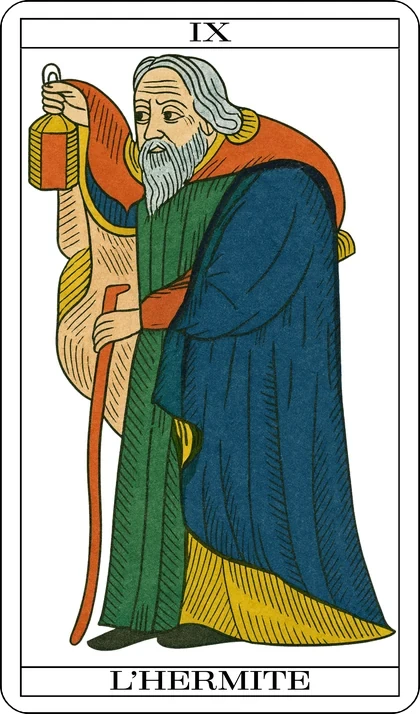
L’Hermite, the ninth major of the Marseilles Tarot, shows an old hooded figure with a raised lantern and a long staff. Upright, this card speaks of chosen or endured solitude, slow inner work, and the need to step back from noise. Reversed, it shifts to encounters, being sought out, and breaking isolation. This guide reads the plate, the upright axis, the reversed axis, and what modulates their meaning in a spread.
| Numeral | Card |
|---|---|
| no numeral | The Fool |
| I | The Juggler |
| II | The Popess |
| III | The Empress |
| IIII | The Emperor |
| V | The Pope |
| VI | The Lover |
| VII | The Chariot |
| VIII | Justice |
| IX | The Hermit |
| X | The Wheel of Fortune |
| XI | Strength |
| XII | The Hanged Man |
| XIII | The Nameless Arcanum |
| XIIII | Temperance |
| XV | The Devil |
| XVI | The House of God |
| XVII | The Star |
| XVIII | The Moon |
| XIX | The Sun |
| XX | Judgement |
| XXI | The World |
Justice is VIII and Strength XI, the reverse of the Rider-Waite. Card XIII bears no name.
The card face
On the plate, a bearded old man stands in profile, wrapped in a hooded cloak. One hand raises a lantern, the other holds a long staff. He does not stride; he stands still, his body turned to one side. The numeral for nine appears in its additive form, VIIII, not the later subtractive IX. Nothing else is drawn: no landscape, no second figure, no door, no animal. The image is deliberately spare, reduced to a person, a light, and a support.
What the card means
L’Hermite points to a truth that is easy to say and hard to live: withdrawal and silence can be constructive. The figure does not flee the world out of fear; he steps aside to see more clearly. The raised lantern is a small, deliberate light, not a flood. It suggests that a person can move forward without seeing the whole road, one step at a time. The long staff is not a weapon; it is a third point of contact, a way to keep balance on uneven ground.
This card follows the demand for justice and balance. It asks a person to look backward, not to dwell, but to find in the past the causes of present effects. That retrospective glance is not nostalgia. It is a form of slow discernment. L’Hermite does not indicate speed. It indicates that some questions cannot be answered in company, that some decisions need a quiet room, a lowered voice, a pause before the next move.
The hooded cloak matters. It hides the body, but not the face. The person remains visible enough to be recognized, yet wrapped enough to be alone. L’Hermite therefore speaks of a solitude that can be worn like a cloak: sometimes heavy, sometimes protective, always a condition of inner work. The card does not say solitude is good or bad. It says solitude is a place where something can be heard that noise would cover.
Upright
Upright, L’Hermite carries the axis of solitude, real or felt. A person may be physically alone, or surrounded by people and still feel apart. The card does not carry a judgment on that state. It indicates that isolation is present, and that it can be lived well or badly. The same solitude can be a prison or a workshop, depending on what the person does with it.
This orientation often points to taking distance. Someone steps back from a group, a relationship, a job, a family pattern. The withdrawal is not necessarily permanent, but it is necessary. L’Hermite upright signifies that it is advisable to act alone, staying independent, not waiting for permission or company. It favors interiorization: turning attention inward, examining motives, sorting what belongs to the self from what was borrowed from others.
In this sense, the upright L’Hermite is linked with spiritual evolution, not as an escape, but as a slow maturation. The lantern is raised, which means the person chooses to carry a light into the dark. The staff is held, which means the person accepts support that is not another human being. Solitude here is not emptiness; it is a container for a question that has not yet found its answer.
Reversed
Reversed, L’Hermite carries the axis of encounter. This is not the negation of solitude; it is another meaning entirely. Where the upright figure stands apart, the reversed figure turns toward others. The card indicates a period of meetings, amorous or friendly, in which a person is sought out, called, invited, remembered. The isolation that once seemed fixed begins to open.
This orientation advises associating and uniting to realize projects. A person does not have to carry the lantern alone. Others appear, not as distractions, but as partners. The reversed L’Hermite says it is time to break isolation, to answer the door, to accept help, to speak. It also points to action: throwing oneself into the battle, not waiting for perfect clarity before moving. The light is still there, but now it can be shared.
This reversed meaning is favorable. It opposes being alone to being accompanied, not good to bad. A person who has spent too long in the upright solitude may find the reversed encounter a relief. A person who fears dependence may find it a challenge. Either way, the card does not carry a warning; it shows an opening.
What nuances this reading
A single card never makes a spread. The meaning of L’Hermite is modulated by its position, the cards around it, and the question asked. In a past position, it may point to a retreat already lived, a period of withdrawal that shaped the present. In a future position, it may indicate a need to slow down before acting, but it does not say when. Only the position carries time; the card itself is timeless.
Surrounding cards also modulate the meaning. Next to a card of movement, L’Hermite upright can mean solitude as preparation, not as an end. Next to a card of relationship, the reversed encounter takes a specific shape: a friendship, a love, a collaboration. The question asked changes the emphasis. A question about work reads withdrawal differently from a question about love. The same lantern can light a desk or a bedroom.
No card predicts a fixed outcome. L’Hermite describes a quality of movement: slow, deliberate, sometimes alone, sometimes accompanied. The rest of the spread tells whether that quality is already present, still to come, or being resisted.
Frequently asked questions
Does L’Hermite always mean loneliness?
No. Upright it can mean chosen solitude, independence, or felt isolation. Reversed it points to encounters and being sought out. The card shows an axis, not a fixed feeling.
Is the reversed L’Hermite the opposite of the upright?
Not as a negation. In the Marseilles Tarot, orientations carry independent meanings. Upright carries the axis of solitude, reversed carries the axis of encounter. Reversed is favorable, not a blocked upright.
What does the lantern mean on the plate?
The raised lantern shows a small, deliberate light carried by the person. It points to inner clarity, slow discernment, and the ability to see one step at a time rather than the whole road.
Does L’Hermite predict a specific time?
No card carries a duration by itself. Only the position in a spread can suggest past, present, or future. L’Hermite is timeless: it describes a quality of movement, not a date.