L’Étoile, Arcanum XVII: The Naked Grace That Rebuilds After Ruin
In brief
- After ruin, L’Étoile shows nature rebuilding in its own rhythm, and you are called to align with that flow rather than force it.
- Upright, the card speaks of grace and reception: help arrives, obstacles dissolve, and your talent or inspiration finds its channel.
- Reversed, it demands effort without rescue: no providential aid, only your own work, yet hope stays fully intact.
- The tension is real: receiving is a skill, and progress depends on how you use what is given, whether it comes as ease or as struggle.
Contents
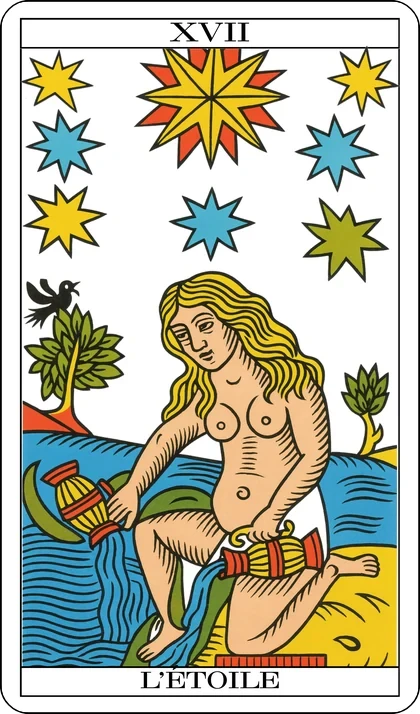
L’Étoile is the seventeenth major arcanum of the Marseille Tarot, numbered XVII in additive form. Upright, it points to grace, providential help, inspiration, and ease; reversed, it points to effort, self-reliance, and hope that must be fought for. The card face shows a nude woman pouring water from two vessels beneath a large eight-pointed star.
| Numeral | Card |
|---|---|
| no numeral | The Fool |
| I | The Juggler |
| II | The Popess |
| III | The Empress |
| IIII | The Emperor |
| V | The Pope |
| VI | The Lover |
| VII | The Chariot |
| VIII | Justice |
| IX | The Hermit |
| X | The Wheel of Fortune |
| XI | Strength |
| XII | The Hanged Man |
| XIII | The Nameless Arcanum |
| XIIII | Temperance |
| XV | The Devil |
| XVI | The House of God |
| XVII | The Star |
| XVIII | The Moon |
| XIX | The Sun |
| XX | Judgement |
| XXI | The World |
Justice is VIII and Strength XI, the reverse of the Rider-Waite. Card XIII bears no name.
The card face
On the Marseille plate, a nude woman kneels at the edge of water. She pours two vessels: one into the river, the other onto the earth. Above her, a large eight-pointed star is surrounded by seven smaller stars. A bird sits on a tree. The numeral XVII appears in additive form, never as a modern subtractive numeral. This is the seventeenth of the twenty-two major arcana; the fifty-six minor arcana exist but do not enter this description.
What the card means
L’Étoile signifies a state after loss and destruction. It does not indicate a return to what was; it points to a rebuilding in harmony with rhythms larger than the individual will. The two vessels show a double distribution: one flow returns to the water, the other nourishes the earth. Nothing is hoarded. The person who receives this card is invited to do the same: to let what has been given move through them, not to grip it.
The large star above is a fixed point of orientation. The seven smaller stars around it suggest that order is already present, even when the ground has been torn open. The bird on the tree watches without intervening. Nature continues its work without being diverted, and the human task is to do the same. Knowing how to receive is a path, not a passive state. From the good use of what is given depends all progression.
Upright
The upright axis is grace. In order of importance, the person may encounter chance, providential help, and protection. Situations that seemed blocked become easy. Clarity arrives, along with inspiration and even a stroke of genius. Artistic talents, especially in the performing arts, find favorable ground. Fertility, in its broad sense, is also indicated.
As accessory notes, good health and healing can appear, understood as symbolic qualities rather than medical predictions. These are secondary to the main register of grace and ease.
Reversed
The reversed orientation carries its own axis: effort. The person must not hope for help from fate. They must rely only on their work. All hopes remain permitted, but they must be fought for. This is not a simple lack of grace; it is a call to self-reliance under conditions that do not bend easily. The reversed meaning is not a single tendency: it holds effort and hope together, just as the upright holds ease and inspiration.
This orientation is demanding rather than unfavorable. Hope remains whole, but it is a hope that requires combat. The person builds with their own hands, without waiting for a providential opening. The two vessels in the image, poured freely, become here a reminder that distribution must be earned, not received.
What nuances this reading
A single card never indicates a duration or a specific event. Only its position in a spread does that. The same L’Étoile upright can point to a stroke of inspiration in a creative question, or to providential help in a relational question, depending on the neighboring cards. If the surrounding cards show destruction, the rebuilding quality becomes more central. If they show effort, the reversed meaning may echo differently. The question asked also selects which part of the semantic field is active: a question about work will not activate the same register as a question about art.
Frequent questions
Is L’Étoile always a positive card?
No. Upright it leans toward grace, but reversed it is demanding. Neither orientation is simply good or bad; each points to a quality of relation to events.
Does L’Étoile indicate a specific outcome?
No. It indicates a register of experience: ease and inspiration upright, effort and self-reliance reversed. The outcome depends on the person’s use of what is given or built.
Why does the reversed orientation not mean bad luck?
In Marseille Tarot, orientations are independent, not opposites. Reversed L’Étoile carries the axis of effort, where hope remains but must be fought for, not a cancellation of grace.
Can L’Étoile indicate artistic talent?
Yes, upright it often points to inspiration and performing arts, but only as one register among others, not as a fixed identity.