Le Soleil, Arcanum XVIIII: The Marseille Tarot’s Measured Sun
In brief
- Le Soleil shows a happiness that is real but temporary, because its light comes from the world around you, not from your inner state, so the joy it signifies depends on external conditions.
- Upright, it points to satisfactions and successful projects, a warm, relaxed well-being, but always as a passing moment, like a sunny day that ends, never as a permanent accomplishment.
- Reversed, it points to dissatisfaction and disappointment, often because you expect the sun to shine constantly, or because your nature is hard to please and lacks inner warmth.
- The card’s core lesson is to cultivate contentment and enjoy the pleasant moments, but to remember that only inner happiness is constant, so do not anchor your peace to what the outside world gives you.
Contents
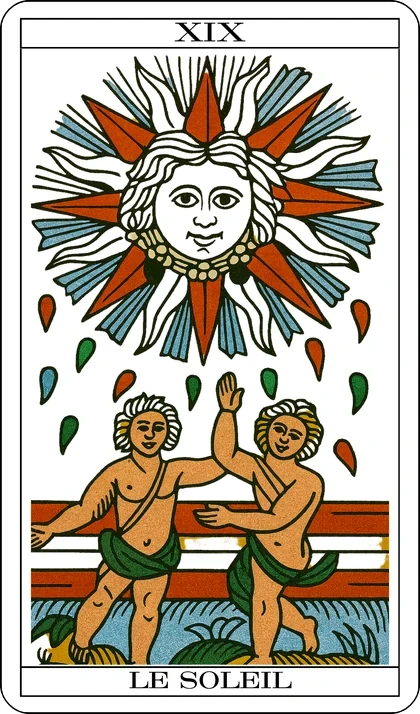
Le Soleil is the nineteenth major arcanum of the Marseille Tarot, printed with the additive numeral XVIIII. It shows two naked children beneath a radiant face, and it signifies a privileged but limited contentment. Upright, it signifies the axis of satisfaction; reversed, it signifies the distinct axis of dissatisfaction.
| Numeral | Card |
|---|---|
| no numeral | The Fool |
| I | The Juggler |
| II | The Popess |
| III | The Empress |
| IIII | The Emperor |
| V | The Pope |
| VI | The Lover |
| VII | The Chariot |
| VIII | Justice |
| IX | The Hermit |
| X | The Wheel of Fortune |
| XI | Strength |
| XII | The Hanged Man |
| XIII | The Nameless Arcanum |
| XIIII | Temperance |
| XV | The Devil |
| XVI | The House of God |
| XVII | The Star |
| XVIII | The Moon |
| XIX | The Sun |
| XX | Judgement |
| XXI | The World |
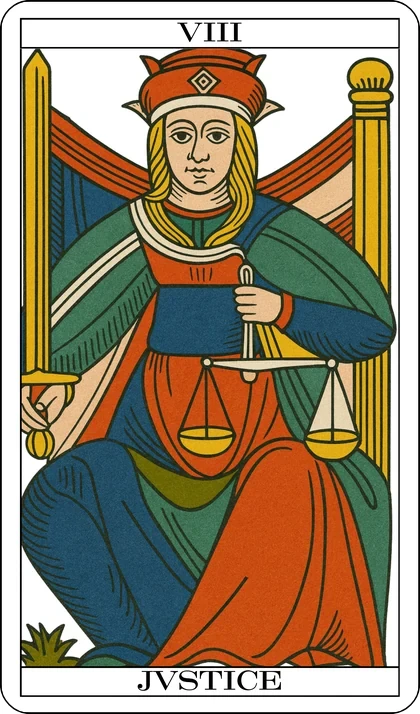
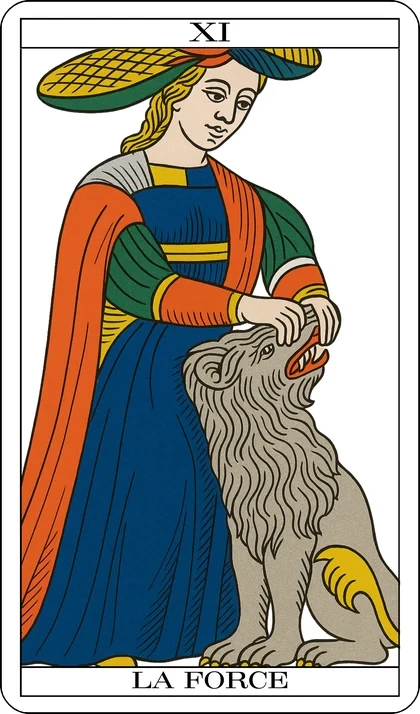
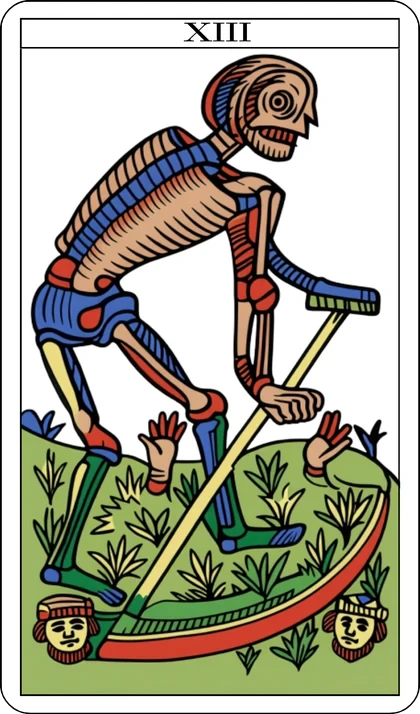
Justice is VIII and Strength XI, the reverse of the Rider-Waite. Card XIII bears no name.
The plate
On the Marseille plate, a face sits inside a disk with alternating straight and wavy rays. Drops fall from the disk all around it. Two naked children stand at the foot of a low wall; one child places a hand on the other. The numeral XVIIII appears in additive form, marking Le Soleil as the nineteenth of the twenty-two major arcana. No other element is drawn on this card.
What the card signifies
Le Soleil signifies a privileged but limited moment. The face in the disk is not a permanent sun; it is a source of warmth that depends on external conditions. The drops falling around it suggest that this radiance is measured, not total. A person may feel a genuine contentment, but that contentment remains tied to circumstances, to a project that succeeds, to a place that feels warm, to a moment that passes.
The two children stand naked, without armor or disguise. They show openness and mutual support, one hand resting on the other. The low wall behind them marks a boundary, but it is not high: the moment of warmth has edges, yet those edges are visible and manageable. Le Soleil does not describe total accomplishment; it describes a measured effect, a principle of life that sustains without overwhelming.
Only inner happiness is constant. The external sun, the one drawn on the plate, does not shine permanently. Le Soleil therefore signifies a distinction: the contentment that comes from outside is real but temporary, while the contentment a person builds inside does not depend on the weather, the place, or the outcome. This is the core tension of the card: warmth is available, but it is not guaranteed to last.
Upright
Upright, Le Soleil signifies the axis of contentment. The person may experience varied satisfactions, success in projects, and the positive outcome of a long effort. This is not a vague optimism; it is the concrete feeling that things are working, that a plan has reached its goal, that a relationship or a work has found its right temperature.
The upright orientation also signifies warmth, relaxation, and well-being. The person is invited to cultivate contentment, to enjoy pleasant moments without guilt, and to seek the sun, literally or figuratively, in the South or in any place that brings light. This is a card of measured pleasure, not excess: the wall is low, the children are calm, the drops fall gently.
Reversed
Reversed, Le Soleil does not simply signify the opposite of the upright. It signifies its own axis: dissatisfaction. The person may feel that nothing goes as desired, that outcomes fall short, that the warmth expected from a situation is missing. This is not a blocked happiness; it is a distinct state where the gap between expectation and reality becomes visible.
This orientation often signifies a demanding nature, difficult to please. The person may experience disappointment, a sense that things do not unfold as they should, and a lack of warmth in exchanges or surroundings. The reversed Le Soleil does not mean failure; it means that the current measure of satisfaction is low, and that the person’s own standards may be part of that low measure.
What nuances this reading
A single card never frames a duration or a date. Le Soleil itself is intemporal; only its position in a spread can indicate past, present, future, or advice. The same card read as an obstacle will not have the same weight as read as an outcome.
Frequently asked questions
Does Le Soleil always mean a happy ending?
No. Le Soleil signifies a measured, temporary contentment that depends on external conditions. Only inner happiness is constant, and this card does not point to a permanent outcome.
What is the difference between Le Soleil upright and reversed?
Upright, Le Soleil signifies the axis of contentment: satisfaction, success, warmth. Reversed, it signifies the axis of dissatisfaction: disappointment, lack of warmth, a demanding nature. These are two independent meanings, not one meaning and its negation.
Why are there two children and a low wall on the card?
The two naked children show openness and mutual support, one hand on the other. The low wall marks a visible but manageable boundary, suggesting that the warmth of Le Soleil has edges and does not last forever.
Is Le Soleil the same as the corresponding card in other tarot decks?
No. The Marseille Le Soleil shows only the face in the disk, the drops, the two children, and the low wall. It follows the Marseille numbering, with La Justice as VIII and La Force as XI, and L’Arcane sans nom. Later decks add banners, horses, or sunflowers that are not on the Marseille plate.
 La Justice
 La Force
 L'Arcane sans nom