Le Pape: The Seated Authority Signifying Blessing or Refusal
In brief
- To obtain a response, you must ask for it: the strength of this card lies in the demand you address to authority, not in the authority itself.
- The central tension opposes the external sanction (agreement, approval, refusal) to the recognition of your own value, for you cannot receive another’s accord without first acknowledging yours.
- Upright, Le Pape means a concrete green light, an approval given by an influential person, often tied to a ritual (baptism, marriage); reversed, it means a refusal, an opposition from authority, or a context without sacred dimension.
- The guiding line is a paradox: wisdom consists in recognizing another’s worth without denying your own, and this mutual recognition is the key, but it does not dissolve the tension between the individual and the institution, whether that institution is a mature man, a father, or an authority in difficulty.
Contents
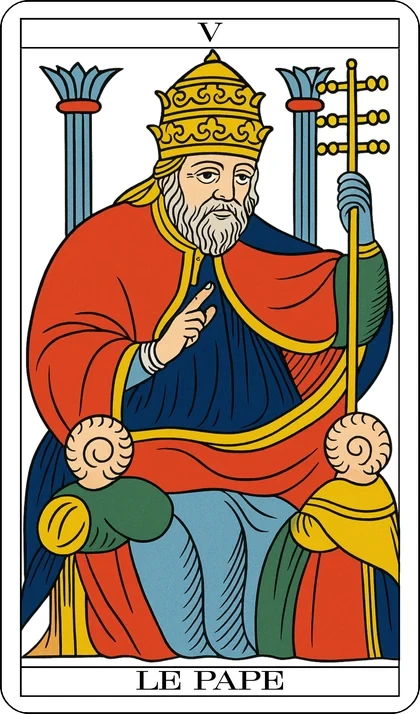
Le Pape, the fifth major arcanum of the Marseille Tarot, shows a seated figure with a three-tiered tiara, one hand raised in a two-fingered gesture, the other holding a triple cross. The card signifies seeking before finding, asking before receiving, and the weight of approval or refusal that comes from authority. Upright it points to favorable sanction; reversed it points to unfavorable sanction, each as a distinct meaning.
| Numeral | Card |
|---|---|
| no numeral | The Fool |
| I | The Juggler |
| II | The Popess |
| III | The Empress |
| IIII | The Emperor |
| V | The Pope |
| VI | The Lover |
| VII | The Chariot |
| VIII | Justice |
| IX | The Hermit |
| X | The Wheel of Fortune |
| XI | Strength |
| XII | The Hanged Man |
| XIII | The Nameless Arcanum |
| XIIII | Temperance |
| XV | The Devil |
| XVI | The House of God |
| XVII | The Star |
| XVIII | The Moon |
| XIX | The Sun |
| XX | Judgement |
| XXI | The World |
Justice is VIII and Strength XI, the reverse of the Rider-Waite. Card XIII bears no name.
The Card
The numeral V, printed in additive Roman form, places Le Pape as the fifth of the twenty-two major arcana. The figure sits facing forward, wearing a three-tiered tiara. One hand is raised with two fingers extended; the other hand holds a cross with a triple crossbar. In the foreground, two smaller figures are seen from the back, their faces turned away from the viewer. Behind the seated figure stand two columns. The composition is frontal and symmetrical, with the columns framing the seated figure.
What the Card Means
The meaning of Le Pape does not include effortless discovery. The image of a raised hand and a listening audience shows a basic condition: to find, one must seek; to obtain an answer, one must ask. The card does not signify a handing over of knowledge; it indicates a structure in which a request meets a response.
The triple cross and the tiara are not decorative. They mark a form of authority that is both institutional and spiritual, a power that can validate or invalidate. The two figures seen from the back suggest reception: they stand before someone who holds the right to approve or refuse. True strength, in this image, combines individual effort with a larger framework, a collective or traditional activity that exceeds the person alone.
The card also points to a relational wisdom. Recognizing the value of another without denying your own worth is the key to maturity. Le Pape shows a hierarchy, but not a crushing one: the seated figure and the two standing figures share the same space, and the columns give the scene a stable architecture. The lesson is not submission for its own sake, but the ability to ask, to receive, and to acknowledge what comes from outside oneself.
Upright
Upright, Le Pape signifies favorable sanction. The first meaning is accord: a request meets a yes, a project receives a green light. Then comes authorization, the formal permission that allows something to proceed. Endorsement follows: a person of influence, someone who holds authority, gives their approval. This can be a parent, an employer, an institution, or any figure whose word carries weight.
The card also signifies religious rituals, especially baptism and marriage, where a community formally recognizes a passage or a bond. In a reading, the upright card can point to a mature man or a father figure, but this is secondary to the meaning of approval.
Reversed
Reversed, Le Pape does not mean a weak blessing or a delayed yes. It signifies its own axis: unfavorable sanction. The first meaning is refusal: a door stays closed, a request is denied. Then comes opposition, an active resistance from the entourage or from an authority figure. Disapproval follows, often voiced by those whose opinion matters, whether a parent, a superior, or a collective body. The reversed card can also indicate the absence of religious character in a situation: a ceremony loses its sacred frame, a commitment lacks institutional recognition, or a decision is made without any blessing.
As a person, the reversed Le Pape can point to a man in a difficult position, someone under pressure or facing rejection. This is not the same as the upright father figure; it is a man caught in a bind, perhaps stripped of authority or struggling against a refusal.
What Nuances This Reading
A single major arcanum never tells the whole story. The meaning of Le Pape gains precision from its position in a spread: a past position may show an approval already given, a future position may show a decision yet to be made, but the card itself has no date and no duration. The surrounding cards modulate its tone: next to a card of movement, the accord may concern travel or change; next to a card of stability, it may concern a lasting institution. The question asked also matters: a question about work activates the axis of authorization and endorsement; a question about family activates the axis of father figures and rituals.
 La Maison-Dieu
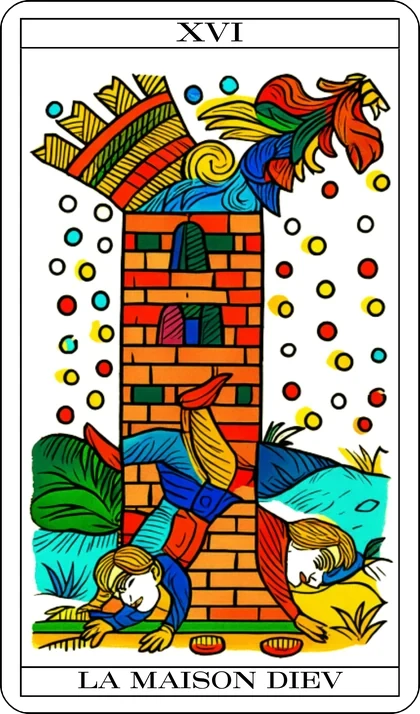
Because this is the Marseille Tarot, not the Rider-Waite-Smith, the numbering and names differ. Justice is VIII and Strength is XI; the thirteenth arcanum bears no name on the plate; the sixteenth is La Maison-Dieu, not The Tower. These differences matter when comparing decks, but they do not change the meaning of Le Pape itself.
Frequently Asked Questions
Does Le Pape always indicate a religious ceremony or a priest?
No. The card points to any authority that can approve or refuse, and to rituals or institutional frameworks. A baptism or marriage is one possible expression, but a work contract, a parental blessing, or an official authorization can carry the same weight.
Is the reversed Le Pape just the opposite of the upright?
No. In the Marseille Tarot, each orientation carries an independent meaning. Reversed Le Pape signifies refusal, opposition, or the absence of a sacred or institutional frame. It is not a weakened yes; it is a distinct no or a situation stripped of blessing.
Can Le Pape represent a specific person?
Upright, it can point to a mature man or a father figure. Reversed, it can point to a man in a difficult position. But only the surrounding cards and the question can confirm whether the card designates a person or a situation.
Why does the numeral on the card look like V and not something else?
The Marseille plates use additive Roman numerals. Le Pape is the fifth of the twenty-two major arcana, so it bears the numeral V. You will not find subtractive forms like IV or IX on these plates.