Le Jugement, Arcanum XX: The Trumpet That Splits Past from Future
In brief
- Le Jugement holds a central tension: you reconcile with your past, return, reactualize an old situation, yet you also turn the page and start a new life, and both movements remain valid at once.
- The upright side carries the past as content, not as polarity: return, reconciliation, faithful temperament, perseverance, and religious practice, and whether this favors you depends on the surrounding cards.
- The reversed side is favorable: you orient yourself toward the future, modernism, progress, new projects and creations, and it opposes past to future without dissolving the paradox.
- The core meaning: everything is possible to you who believes, and this belief concerns yourself and human perfectibility, confidence without destructive doubts, which guarantees realization.
Contents
Le Jugement is the twentieth major arcanum of the Marseille Tarot. Its image shows a trumpet call over an open tomb, and its two orientations do not oppose each other: upright carries the axis of the past, reversed carries the axis of the future. This page explains what is drawn, what the card signifies, and how to read both directions without a specific spread.
| Numeral | Card |
|---|---|
| no numeral | The Fool |
| I | The Juggler |
| II | The Popess |
| III | The Empress |
| IIII | The Emperor |
| V | The Pope |
| VI | The Lover |
| VII | The Chariot |
| VIII | Justice |
| IX | The Hermit |
| X | The Wheel of Fortune |
| XI | Strength |
| XII | The Hanged Man |
| XIII | The Nameless Arcanum |
| XIIII | Temperance |
| XV | The Devil |
| XVI | The House of God |
| XVII | The Star |
| XVIII | The Moon |
| XIX | The Sun |
| XX | Judgement |
| XXI | The World |
Justice is VIII and Strength XI, the reverse of the Rider-Waite. Card XIII bears no name.
La planche
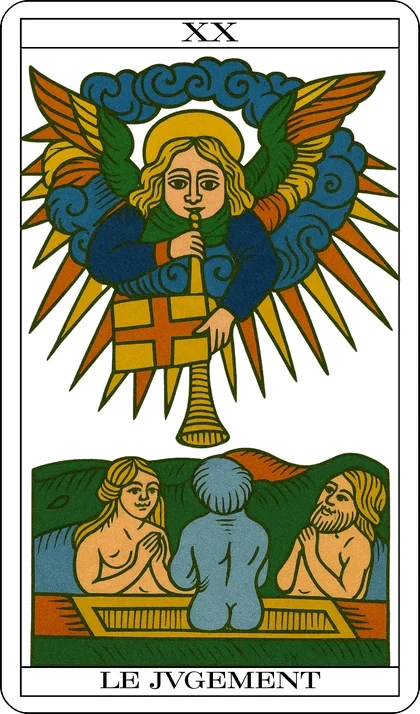
The numeral XX appears in additive form, marking this as the twentieth of the twenty-two major arcana. A winged figure emerges from clouds and sounds a trumpet; from the trumpet hangs a banner bearing a cross. Below, three naked figures rise from an open tomb, the middle one seen from the back. That is the full inventory of the Marseille plate: no other element is drawn.
Ce que dit la lame
The scene condenses a single idea: everything is possible for the one who believes. The trumpet does not announce a verdict; it calls attention to a limit that has just lost its power. The open tomb is not a literal resurrection but a sign that what seemed closed can open again. Faith here is not only trust in a divine principle; it is also trust in oneself and in the perfectible nature of being human.
The banner with the cross points to a confidence that does not feed on destructive doubt. When a person acts with that kind of assurance, obstacles that looked real begin to dissolve. The image does not promise a miracle; it signifies that confidence without self-sabotage is the condition for realization. The three figures rising together also suggest that this movement is not solitary: it can involve a return to others, a shared reactivation, or a collective turning point.
À l’endroit
When Le Jugement appears upright, it carries the axis of the past. This orientation points to everything that connects a person to what has already been: a return, a reconciliation, the reactualization of an old situation. It favors a faithful temperament, perseverance, and regularity in action. It can also indicate a religious belief and practice, not as a moral judgment but as a lived relation to the past.
The upright orientation is not automatically favorable. It carries a content, the past, and not a polarity. A return or a reconciliation is favorable or not depending on the surrounding cards. The same reactualization can mean a solid foundation or a closed loop; the neighbors decide.
À l’envers
Reversed, Le Jugement does not negate the upright. It carries its own axis: the future. This orientation points to a new direction, modernism, progress. The person turns resolutely toward what is ahead, turns a page, begins a new life. It favors projects, new activities, and creations.
This reversed orientation is favorable. It opposes the past and the future, and it chooses the future. Where the upright reactivates what was, the reversed opens what has not yet been. It is not a blocked energy; it is a deliberate orientation toward the new.
Ce qui nuance cette lecture
A single card never makes a reading. Le Jugement is especially sensitive to its position in a spread and to the cards around it. Its meaning is not univocal: the same upright return can read as a healing reconciliation or as a repetitive trap, depending on whether the neighboring cards speak of stability or rupture.
The question asked also modulates the card. If the question concerns work, the past axis may point to a former project or a return to a known method; if it concerns a relationship, the same axis may point to a reconciliation or to an old pattern. The reversed future axis likewise takes its concrete color from the surrounding cards and from what the person is actually asking.
Questions fréquentes
Does Le Jugement always indicate a religious event or a divine judgment?
No. The faith shown by this card includes trust in oneself and in the perfectible nature of being human. A religious belief and practice can appear on the upright axis, but the core is confidence without destructive doubt, not a verdict from above.
Is the reversed card simply the opposite of the upright?
No. In the Marseille Tarot, each orientation carries an independent meaning. Upright carries the axis of the past; reversed carries the axis of the future. The reversed is not a blocked or negated upright; it is a favorable orientation toward the new.
Does the open tomb predict a literal return from the dead or a physical resurrection?
No. The image is symbolic. The open tomb signifies that what seemed closed can open again: a return, a reconciliation, a reactualization, or a new beginning. It does not describe a literal event.
How much do the surrounding cards change Le Jugement?
A great deal. This card is explicitly modulated by its neighbors. The same upright return can be favorable or not depending on whether the surrounding cards speak of stability or rupture. The reversed future axis also takes its concrete meaning from the cards next to it and from the question asked.