L’Amoureux, Arcanum VI: The Weight of Choosing
In brief
- L’Amoureux is the existential choice that makes you an adult, and it holds the paradox that the same decision both hurts and frees you, elevating you if you make it and degrading you if you dodge it.
- Upright, it points to a positive love life and a possible meeting, but the real demand is a decision and an engagement that you must own completely.
- Reversed, it shows an avoided choice, surfacing as discord, lack of reciprocity, and a refusal to commit, which keeps you in a sentimental storm.
- The card never acts for you, it only signifies a fork in the road, and your own free will, assumed with its consequences, is the sole force that turns the pain into liberation, while hesitation degrades your position.
Contents
L’Amoureux is the sixth major arcanum of the Marseille Tarot, and it signifies one thing above all: the existential choice that both wounds and liberates. This card does not signify romance as a passive state; it signifies the moment when a person must exercise free will and accept what that decision engages. To understand this card is to understand that adulthood begins where avoidance ends.
| Numeral | Card |
|---|---|
| no numeral | The Fool |
| I | The Juggler |
| II | The Popess |
| III | The Empress |
| IIII | The Emperor |
| V | The Pope |
| VI | The Lover |
| VII | The Chariot |
| VIII | Justice |
| IX | The Hermit |
| X | The Wheel of Fortune |
| XI | Strength |
| XII | The Hanged Man |
| XIII | The Nameless Arcanum |
| XIIII | Temperance |
| XV | The Devil |
| XVI | The House of God |
| XVII | The Star |
| XVIII | The Moon |
| XIX | The Sun |
| XX | Judgement |
| XXI | The World |
Justice is VIII and Strength XI, the reverse of the Rider-Waite. Card XIII bears no name.
The Card
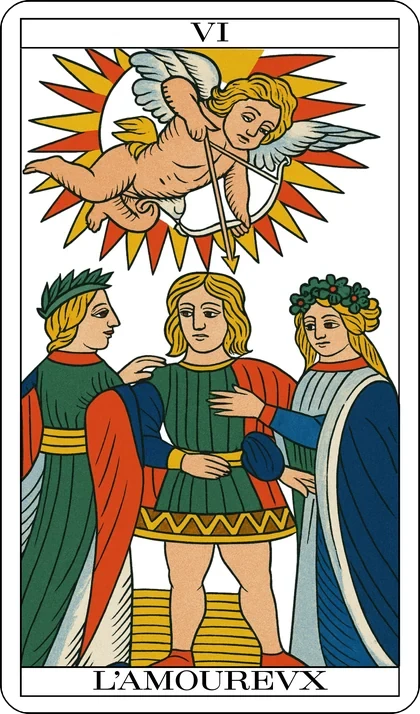
On the Marseille plate, three figures stand upright. The central figure is between the other two, with the head turned toward one of them. Above, in a radiant disc, a winged figure bends a bow, the arrow pointing downward.
What the Card Signifies
L’Amoureux signifies the existential choice, painful and liberating. It elevates the person who makes it and lowers the person who avoids it. One becomes adult only by exercising free will and assuming what it engages.
The central figure’s head is already turned toward one of the other two, signifying that the choice is underway. The winged figure above bends a bow with the arrow pointing downward, signifying that the choice is unavoidable.
Upright
When L’Amoureux appears upright, it signifies the axis of choice assumed. The person is in a position where the emotional life is present and active, not as a passive state but as a field where free will is exercised. The card indicates that the capacity to choose is intact and that the person is ready to commit. The choice may be difficult, but the person has the inner resources to make it and to stand by it.
Engagement follows from this position: the upright L’Amoureux signifies a commitment that the person is willing to enter and to maintain, not because everything is easy, but because the person no longer avoids the weight of their own decisions.
Reversed
When L’Amoureux appears reversed, it signifies the axis of choice avoided. This is not the opposite of the upright card; it is a distinct signification. The person is in a situation where the emotional life is troubled, marked by discord or by the absence of reciprocity. The reversed card signifies a refusal to choose: the person hesitates, not because the options are unclear, but because choosing would mean accepting the consequences. There is a difficulty in committing, a tendency to keep possibilities open, to wait for a sign that does not arrive. The emotional plane is tormented, and the torment comes less from the situation itself than from the refusal to take a position within it.
Lack of determination is the signature of this orientation. The person knows that a decision is required, but postpones it, hoping that circumstances will decide for them. The reversed L’Amoureux signifies what happens when the arrow is ignored: the pressure signified by the arrow does not disappear; it becomes internalized as anxiety, hesitation, and a growing sense of being stuck.
What Nuances This Reading
The meaning of L’Amoureux is fixed by the card itself. It does not change according to any external circumstance. The upright axis is choice assumed; the reversed axis is choice avoided. No other factor alters this signification.
Frequently Asked Questions
Does L’Amoureux always mean romantic love?
No. The card signifies choice, commitment, and the exercise of free will. Romantic love is one field where these forces appear, but the card can also signify a professional decision, a moral choice, or any situation where a person must take a position and accept the consequences.
Is the reversed card a bad omen?
Not necessarily. The reversed L’Amoureux signifies a difficulty, but it also signifies that the difficulty is located in the person’s own hesitation. This is not a fate imposed from outside; it is a pattern that can be recognized and changed. The card is uncomfortable, but it is not hopeless.
What does the winged figure with the bow mean?
The winged figure above the three persons signifies the pressure that makes the choice unavoidable. The arrow is aimed downward, toward the scene, and it does not signify punishment or reward. It signifies the fact that some decisions cannot be postponed without consequence. The moment of choice is not optional.
How is this card different from the Rider-Waite-Smith Lovers?
The Marseille L’Amoureux shows three standing figures and a winged archer above. It does not show a garden, a serpent, or the specific iconography of the Rider-Waite-Smith deck. The two traditions are distinct, and this card belongs to the Marseille lineage.