La Papesse: The Silent Threshold of Thought
In brief
- La Papesse signifies the mind’s conquest over matter: a long apprenticeship that makes thought genuinely usable, not a sudden flash.
- Upright, it points to a phase of intellectual elaboration: you develop your faculties, succeed in studies, and stay concretely passive while your mental activity intensifies.
- Reversed, it flips the axis: you must stop over-questioning and pass to action, putting knowledge into practice, yet this same side also carries the risk of study failure or cultural deficiency.
- The central tension is a paradox: the card holds both the need to reflect and the need to act without dissolving either, and it may designate a gentle woman, a student, or a wife upright, or a woman in difficulty reversed.
Contents
La Papesse is the second major arcanum of the Marseille Tarot, numbered II in the additive form painted on the card. She speaks of the mind’s slow conquest over raw matter, the long apprenticeship that makes thought genuinely usable. This page describes what the card means in itself, upright and reversed, without reference to any particular spread or question.
| Numeral | Card |
|---|---|
| no numeral | The Fool |
| I | The Juggler |
| II | The Popess |
| III | The Empress |
| IIII | The Emperor |
| V | The Pope |
| VI | The Lover |
| VII | The Chariot |
| VIII | Justice |
| IX | The Hermit |
| X | The Wheel of Fortune |
| XI | Strength |
| XII | The Hanged Man |
| XIII | The Nameless Arcanum |
| XIIII | Temperance |
| XV | The Devil |
| XVI | The House of God |
| XVII | The Star |
| XVIII | The Moon |
| XIX | The Sun |
| XX | Judgement |
| XXI | The World |
Justice is VIII and Strength XI, the reverse of the Rider-Waite. Card XIII bears no name.
The card
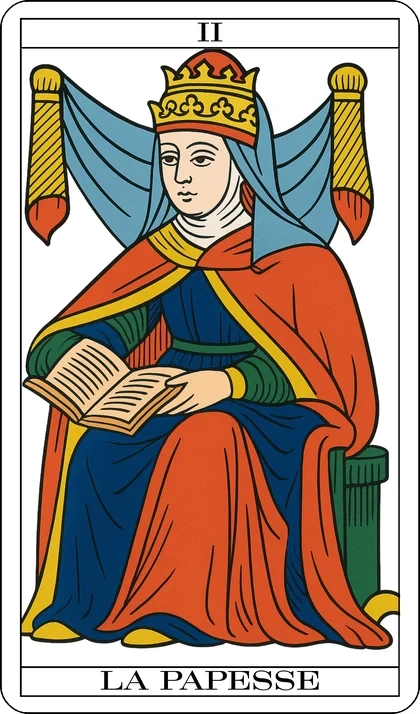
What you see on the Marseille plate is precise and verifiable. A seated figure wears a tiered crown, and a veil falls on both sides of her face, framing it without hiding it. She holds an open book with both hands, resting it on her knees. Behind her stand two columns, one on each side. Nothing else is drawn. No gesture, no gaze directed outward, no object beyond the crown, the veil, the book, and the columns. The numeral II appears on the card in its additive form, never as a modern subtractive variant.
What the card says
La Papesse glorifies the faculty of the mind over the weight of matter. She represents the second conquest of the human being: developing thought, making the effort to understand, wanting to rise. This is not a flash of intuition. It is a long apprenticeship, the patient work that makes the spirit genuinely usable. The book on her knees is not closed, not sealed, not mysterious. It is open, held, and being read. The card points to the discipline of study, the slow accumulation of knowledge, the willingness to sit still long enough for understanding to take root.
The two columns behind her frame a threshold. They do not imprison her. They mark the boundary between what is known and what remains to be learned. The veil suggests that some things stay partially hidden, not because they are forbidden, but because understanding takes time. The crown indicates a form of sovereignty, but it is a sovereignty of the mind, not of the body or of action. La Papesse does not move. She signifies the phase where movement is internal, where the real work happens in thought.
Upright
Upright, La Papesse carries the axis of elaboration. She points first to the development of intellectual faculties, the strengthening of the ability to think clearly and rigorously. She signals the necessity of reflection before any decision, the need to understand before acting. Success in studies undertaken is a central meaning here: formation that succeeds, learning that bears fruit, knowledge that becomes solid and usable.
On the concrete plane, this card indicates a certain passivity. Nothing moves outward. No action is taken, no decision is forced. But this passivity is not emptiness. It is the stillness of a mind at work, the quiet of someone who is reading, comparing, weighing. The activity is entirely mental. La Papesse upright can also designate a person: a gentle woman, a student, a spouse. These are secondary meanings, but they belong to the card’s field.
Reversed
Reversed, La Papesse carries the axis of passage to action. This is not the negation of the upright meaning. It is a distinct orientation with its own logic. The card now points to the necessity of acting, of ceasing to question endlessly and moving from thought to deed. Knowledge that has been accumulated must now be put into practice. This is a phase of realization and concretization, where what was learned becomes something done.
But this reversed orientation also carries a second, opposite register. It can signify failure in studies, a lack of intellectual or cultural foundation, a mind that has not been trained or has not done the work. These two movements coexist in the reversed card: passing to action is favorable, while failure in studies is not. The card does not resolve this tension. It holds both possibilities, and only the surrounding cards and the position in a spread can indicate which register is active. Reversed, La Papesse can also designate a woman in a difficult position.
What nuances this reading
A single card never makes a reading. La Papesse takes on different weight depending on where she falls in a spread. In a position that speaks of the past, she may indicate a formation already completed. In a position that speaks of obstacles, she may point to excessive hesitation or a refusal to act. The cards around her also modulate her meaning. Next to a card of action, she may signal the need to think before moving. Next to a card of material concern, she may indicate that the real issue is intellectual, not practical.
The question asked also shapes what La Papesse says. Asked about a relationship, she may point to a partner who is a student, a gentle woman, or someone whose inner life is rich but whose outer life is still. Asked about work, she may indicate a period of training, a need for study, or a success in an examination. The card itself remains the same. What changes is the angle of reading, the specific facet that the question illuminates.
Frequently asked questions
Does La Papesse mean secrecy or hidden knowledge?
No. The book on her knees is open, not closed. The veil does not hide her face. La Papesse does not signify secrets, occult knowledge, or things deliberately concealed. She signifies the effort of understanding, the slow work of study, the development of the mind. What is not yet known is simply not yet learned, not forbidden.
Is La Papesse the same as the High Priestess in other decks?
No. La Papesse belongs to the Marseille Tarot, and her iconography is specific: a tiered crown, a veil, an open book, two columns. She does not carry the symbols found in other traditions. The Marseille card is read from what is actually painted on the plate, nothing more.
Does the reversed card mean the opposite of the upright card?
No. In the Marseille tradition, the two orientations carry independent meanings. Upright, La Papesse speaks of elaboration, study, and mental work. Reversed, she speaks of passage to action, the need to stop questioning and start doing, and also of failure in studies. The reversed card is not the upright card blocked or negated. It is its own field of meaning.
Can La Papesse predict success in an exam?
Upright, La Papesse can indicate success in studies undertaken, including examinations. But a single card does not predict an outcome. It describes a quality of the situation: the presence of real intellectual work, the capacity to understand, the fruit of a long apprenticeship. Whether that fruit is harvested depends on the whole spread, the position of the card, and the question asked.