Two of Swords: The Marseille Card of Suspended Decision
In brief
- The Two of Swords signals a rich intellectual phase, a time to think, organize, and plan rather than act.
- Your mind is sharp and creative, with strong analytical skills and good general knowledge, but this alone does not guarantee results.
- The central tension: reflection can turn into a loop, planning endlessly without ever passing to the act.
- Professional associations are favored, but they may remain intentions if you do not move forward.
- The card’s guiding line: thinking must lead to action, otherwise the mind spins on nothing.
Contents
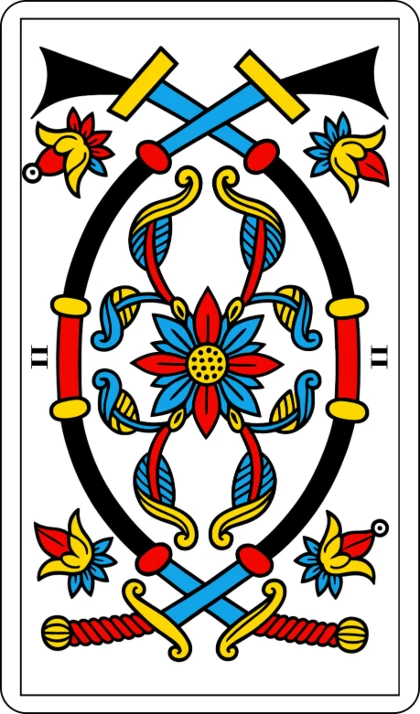
The Two of Swords in the Marseille Tarot shows two curved blades forming a double oval around a many-petaled rosette, with the numeral II printed on both sides. Upright, it signifies a rich, inventive mind that plans and analyzes before acting. Reversed, it signifies that same reflection turning in circles, planning without ever moving into action.
| Suit | What it covers | Cards | Symmetrical plates |
|---|---|---|---|
| Batons | feeling, mood and the quality of emotions | 14 | 9 |
| Cups | affective life and matters of the heart | 14 | 0 |
| Swords | working life and the field of activity | 14 | 2 |
| Coins | material life and money matters | 14 | 7 |
| Total | 56 | 18 |
This axis is not the Golden Dawn's elemental grid: this school places feeling on the batons and working life on the swords.
La planche
Two swords with curved blades stand upright, their edges forming a double oval. At the center sits a radial rosette with many petals, without stem, without top or bottom. The numeral II appears laterally on both sides, printed in additive form. No person, no scene, no landscape. The card is perfectly symmetrical: placed on the table, nothing on the face indicates which side is up.
Ce que dit la lame
The image of two blades enclosing a rosette points to a mind that holds two edges at once. The double oval is a closed form, a container for thought. The rosette at the center has no orientation, no stem, no direction: it is a pure pattern, a sign of mental activity that does not yet need to choose a path. This is not a card of conflict, but of suspended judgment.
As a numeral of the Swords suit, the Two of Swords carries the quality of the number two: duality, comparison, weighing. The two blades do not cross, they curve around a shared center. That shared center is not a wound, not a target, but an ornamental flower. The card signifies a state where intellectual richness can grow without immediate pressure to act. The mind is lively, quick, and capable of holding opposing ideas without collapsing.
This card does not show a person thinking. It shows the structure of thought itself: two edges, one center, no outside. The absence of any figure means the meaning is not about a specific event or relationship. It is about a quality of mind: imaginative, creative, ingenious, and well stocked with general culture. The Two of Swords indicates a state where analysis and planning are the natural first moves.
À l’endroit
Upright, the Two of Swords signifies intellectual richness and a state favorable to reflection. The person is imaginative, creative, and ingenious. The mind is vivid and rapid, with a good sense of analysis and a solid general culture. Acting is not the priority here: the upright meaning points to a phase of thinking, organizing, and planning. The double oval is a protected space where ideas can be arranged before any outward step.
This orientation also carries the possibility of uniting forces. The two blades curve toward the same center, which can indicate a search for collaborators or a favorable disposition toward professional associations. However, this part of the meaning is conditional: it depends on the surrounding cards in a spread. On its own, the upright Two of Swords does not guarantee a partnership. It only shows that the quality of joining strengths is present in the field of thought.
À l’envers
Reversed, the Two of Swords does not mean the opposite of the upright. It carries its own axis: reflection without act. The same double oval becomes a loop, not a container. The mind turns, plans, organizes, but never lands on a decision. The rosette at the center remains ornamental, untouched by any real consequence. The person may produce many ideas, but none of them settle into a concrete step.
This orientation signifies planning that spins in place. The association remains an intention, never a formed alliance. The vivacity of mind does not attach to anything durable. The two blades still curve, but they no longer hold a center: they circle around an empty pattern. The reversed Two of Swords points to a state where mental quickness becomes its own obstacle, because it never commits to a single edge.
Ce qui nuance cette lecture
A single card never makes a reading. The Two of Swords takes its full meaning from its position in a spread, the cards around it, and the question asked. Its upright sense of association, for example, only activates when neighboring cards support a partnership. Without that support, the card remains a sign of individual reflection, not a promise of collaboration.
The card also never sets a duration or a date. Only a position in a spread can frame time. On its own, the Two of Swords is intemporal: it describes a quality of mind, not a schedule. The same card can appear in a past, present, or future position without changing its core meaning. What changes is how that quality interacts with the rest of the reading.
Questions fréquentes
Does the Two of Swords mean I should never act?
No. Upright, it signifies a state where planning and analysis take priority, but action is not forbidden. It simply indicates that the central quality of this card is reflection, not immediate movement.
Is the reversed Two of Swords just the upright blocked?
No. The reversed orientation is an independent meaning: reflection without act. It is not a negation of the upright, but a different axis where the mind circles without landing on anything.
Why does the card have no person or scene?
Marseille numeral cards are ornamental. They show the suit repeated as many times as the rank, surrounded by floral motifs, and nothing else. The Two of Swords shows two swords and a rosette, not a narrative image.
Does the Two of Swords predict a partnership?
Only if the surrounding cards support it. On its own, the card signifies the quality of uniting forces, not a guaranteed outcome. The association part of the meaning is always conditional on the rest of the spread.