King of Swords: The Crowned Mind and the Separate Weight of Procedure
In brief
- The King of Swords holds his power in inner richness, not outward display, his authority comes from balance, serenity, and the quiet realization of what he has set out to achieve.
- The central tension is that the upright card speaks of fulfillment and knowledge, while the reversed card shifts to a different register entirely, the world of justice, procedures, and administrative matters, without ever overturning the first meaning.
- When reversed, this card points to legal and procedural ground, lawsuits, inheritance, divorce, and administrative careers, but it does not negate the upright sense, it simply opens another field of action.
- The person this card can designate is an intellectual worker, a man whose activity is mental, and in the reversed position, he is the same man but facing difficulty within that domain.
- The guiding line is to hold both orientations together as a paradox, the serene sovereign of thought and the man entangled in paperwork, without dissolving one into the other.
Contents
The King of Swords is a minor honor from the Swords suit, one of sixteen court figures in the Marseille Tarot. Upright, it speaks to inner fullness, balance, and achieved knowledge; reversed, it opens a distinct register of justice, administration, and formal process. This guide describes the card itself, not any particular spread.
| Suit | What it covers | Cards | Symmetrical plates |
|---|---|---|---|
| Batons | feeling, mood and the quality of emotions | 14 | 9 |
| Cups | affective life and matters of the heart | 14 | 0 |
| Swords | working life and the field of activity | 14 | 2 |
| Coins | material life and money matters | 14 | 7 |
| Total | 56 | 18 |
This axis is not the Golden Dawn's elemental grid: this school places feeling on the batons and working life on the swords.
La planche
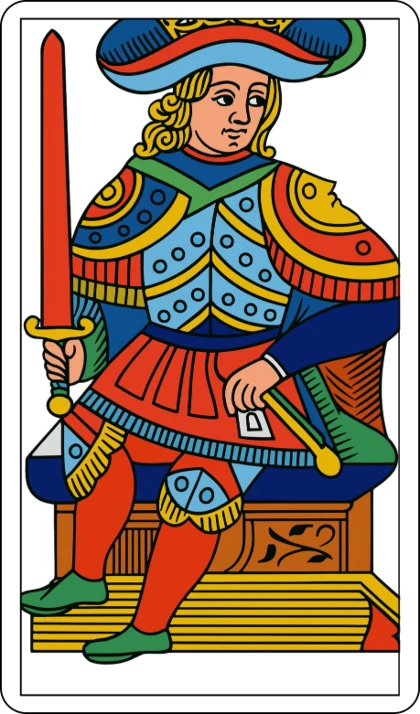
On the Marseille card, a crowned king sits on a stepped throne. He wears a wide hat and armor. He holds a sword upright at his side. No legend or numeral appears on the card. That is all the image shows: a seated sovereign, a crown, a hat, armor, a sword, a throne with steps. No other figure, no landscape, no object beyond these. The sword is not raised in attack; it stands vertical, close to the body.
Ce que dit la lame
The King of Swords condenses the Swords suit’s mental edge into a figure of seated authority. The upright sword suggests a mind that has been sharpened but is now held still, not swinging. The crown and armor point to a sovereignty earned through clarity, not through force. This card does not show a warrior charging; it shows a ruler who has already thought, decided, and taken a position. The stepped throne adds elevation: the person has climbed to a place where the view is wider.
The wide hat and armor together create a tension. The hat can suggest a public role, a title, a function that covers the head. The armor suggests protection, but also a certain distance from raw emotion. The King of Swords is not a card of tenderness. It speaks to a form of power that is cool, structured, and articulate. The sword at the side, vertical, is a tool kept ready but not in motion. That stillness is central: the card points to a state where thought has become stable, not restless.
À l’endroit
Upright, the King of Swords points first to inner wealth. This is not money or property; it is a richness of understanding, a store of experience that has been sorted and made usable. The card speaks to balance: the person has found a way to hold opposing thoughts without being torn apart. That balance produces serenity, a calm that comes from having faced complexity and not flinched.
The upright meaning also includes the realization of desires and the reaching of set goals. The seated king has arrived. He is not still climbing; he occupies the throne. This is a card of fulfillment, of accession to a position that was deliberately chosen. Knowledge is the foundation: not raw information, but knowledge that has been tested and integrated. When this card appears upright, it can designate a man whose activity is intellectual: a teacher, a judge, a writer, a strategist, or anyone whose work is done with the mind.
À l’envers
Reversed, the King of Swords does not become weak or cruel. It opens a different field: procedure. The card points to justice, administrative steps, lawsuits, inheritance, divorce, and careers in law or public administration. This is not a punishment or a failure; it is a register of formal process, of rules and documents, of decisions made through institutions. The reversed orientation says: the matter at hand is not about inner fullness but about the machinery of law and administration.
The reversed King of Swords can also designate a man engaged in intellectual work who is in difficulty: a professional facing a setback, a legal dispute, a bureaucratic obstacle, or a loss of standing. But the card does not predict a specific outcome. It names a domain. The sword, still upright in the image, now reads as the instrument of judgment, the tool of the court, the signature on a decree. The throne becomes the bench, the office, the registry. The crown becomes the authority of the state or the institution. This reversed meaning is not the negation of the upright. It is an autonomous axis: where the upright King of Swords speaks of plenitude, the reversed King of Swords speaks of procedure.
Ce qui nuance cette lecture
A single card never makes a reading. The King of Swords takes its color from its position in a spread, the cards around it, and the question asked. If it appears upright next to cards of material concern, the inner wealth may point to a professional achievement. If it appears reversed next to cards of home or partnership, the procedural register may concern inheritance or divorce. The same card can name a person, a state, or a field; only the surrounding context shows which. No duration is attached to this card. Time belongs to the position in the spread, not to the image itself.
Questions fréquentes
Does the King of Swords always represent a man?
Not always. It can designate a man engaged in intellectual work, but it also names an inner attitude of clarity and authority. The card may point to a quality in any person, regardless of gender.
Is the reversed King of Swords the opposite of the upright?
No. In the Marseille tradition, the two orientations carry independent meanings. Upright speaks to fullness, balance, and achieved knowledge. Reversed speaks to procedure, law, administration, and formal process. One is not the failure of the other.
Why does the card have no number?
The King of Swords is an honor, one of sixteen court figures. Only the forty numeral cards carry printed numbers. The honors show a person instead of a repeated suit symbol.
Can this card predict a lawsuit or a divorce?
It does not predict. Reversed, it can point to legal or administrative matters, but only a full spread and the specific question can show whether such a matter is active, past, or symbolic. The card names a domain, not a verdict.