Ten of Swords: The Marseille Numeral of Completion and Collapse
In brief
- The Ten of Swords is the absolute final point of a mental battle, where victory and collapse are the same stroke.
- Upright, it signifies a complete accomplishment, a goal reached where you are well in your own skin after a long struggle.
- Reversed, it signifies a total deterioration, a real or felt failure that makes everything seem wrong and broken.
- This card holds the core paradox: the final blow that ends the conflict is the blow that brings closure and certainty.
- It is a card of definitive closure, not of process: it tells you what has ended, for better or worse, with no middle ground.
Contents
The Ten of Swords is a minor numeral from the suit of Swords in the Marseille Tarot. Upright, it signifies accomplishment and fulfillment, the realization of a whole cycle. Reversed, it carries an independent meaning of regression and deterioration.
| Suit | What it covers | Cards | Symmetrical plates |
|---|---|---|---|
| Batons | feeling, mood and the quality of emotions | 14 | 9 |
| Cups | affective life and matters of the heart | 14 | 0 |
| Swords | working life and the field of activity | 14 | 2 |
| Coins | material life and money matters | 14 | 7 |
| Total | 56 | 18 |
This axis is not the Golden Dawn's elemental grid: this school places feeling on the batons and working life on the swords.
The card
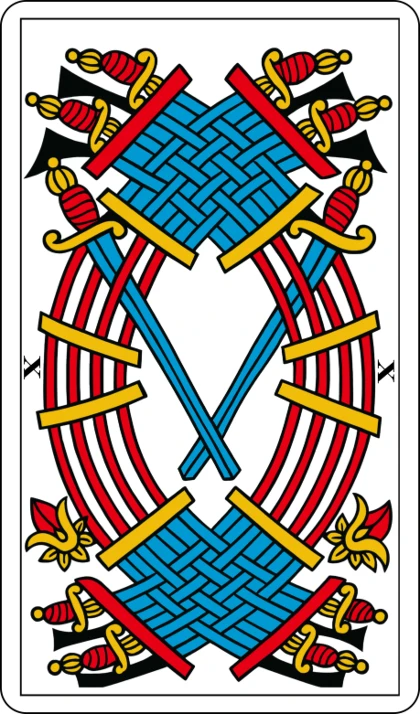
On the Marseille Ten of Swords, you see ten curved sword blades arranged in a double oval. The interior of that oval is left completely empty: no straight sword, no flower, no central emblem. The numeral X is printed laterally, on both sides of the design. There is no person, no scene, no landscape. Like all Marseille numerals, this card is purely ornamental. It repeats the suit symbol ten times, surrounded by the usual rinceaux and floral flourishes, and nothing else.
What the card says
The Ten of Swords is the highest numeral in its suit. It marks the point where a count reaches its full number, where the cycle of ten is complete. The double oval of curved blades encloses an empty center. That emptiness is not a flaw: it is the cleared space left after the work is done. Upright, this empty center reads as a result achieved, a field cleared of obstacles. Reversed, the same empty center can read as a hollow outcome, a sense that the effort has left nothing worth keeping.
Because the suit of Swords carries the quality of mind, decision, and cutting through, the Ten of Swords speaks to a completion that is mental as much as external. A person who draws this card upright may recognize that a long process of thought, negotiation, or effort has reached its natural end. The card does not act; it signifies that the person has arrived at a point of full realization.
Upright
Upright, the Ten of Swords signifies accomplishment in the broadest sense. It points to an aboutissement, a bringing to term of something that has been built over time. This is not a partial success or a lucky break: it is the realization of desires on a global level, the sense that the whole picture has come together. The person who draws this card upright may feel fulfilled and content, at ease in their own skin, no longer fighting to prove anything.
This orientation also indicates the attainment of objectives that were fixed in advance. Victory and success are present, but they are not flashy: they are the quiet satisfaction of a job completed, a cycle closed, a question answered. The empty center of the card becomes a sign of inner peace, not absence.
Reversed
Reversed, the Ten of Swords carries an independent meaning: regression. It does not mean "accomplishment blocked" or "success delayed". It signifies a deterioration of one’s general situation, a movement backward from a previously held position. The person who draws this card reversed may experience a real or felt failure, a sense that things are falling apart, that the ground is giving way.
This orientation points to degradation and degeneration, a negative bilan, an insatisfaction that colors everything. The empty center of the card now reads as depletion: the work has been done, but the result feels hollow, or the effort has cost more than it returned. A person in this state may feel that everything goes wrong, that no move leads forward, and may slide into depression or deep discouragement.
What nuances this reading
A single card never sets a time frame, a date, or a duration. The Ten of Swords is timeless on its own. Only its position in a spread can suggest when or how its meaning applies. The cards around it also modulate the reading: a neighboring card of stability may soften the reversed meaning, while a card of rupture may sharpen the upright one. The question asked shapes which axis is read first. A question about a completed project will foreground the upright sense of accomplishment; a question about a deteriorating relationship will foreground the reversed sense of regression. No card acts on a person; the person acts, and the card signifies the quality of that action.
Frequently asked questions
Does the Ten of Swords predict a literal death or physical harm?
No. This is a numeral card with no person, no scene, and no death imagery. It signifies completion or regression, not a physical event. The Marseille Tarot does not use this card to predict death.
Is the reversed Ten of Swords just the opposite of the upright?
No. In the Marseille tradition, the two orientations carry two independent meanings. Upright is accomplishment; reversed is regression. Reversed is not "accomplishment blocked" or "success denied". It is its own axis, with its own weight.
Why does this card look so different from the Rider-Waite Ten of Swords?
The Marseille Tarot keeps its minor numerals ornamental. They show only the suit symbol repeated, with floral flourishes. The Rider-Waite deck added illustrated scenes to its minors, including a figure with ten swords in the back. That image does not exist on any Marseille planche.
Can this card tell me when something will happen?
No. A card is intemporal. Only a position in a tirage can frame time, and this page describes no tirage. The Ten of Swords signifies a quality of completion or regression, not a date or a deadline.