The Five of Swords: When Merit Finds Its Reward or Meets Its Wall
In brief
- The upright Five of Swords signifies a step upward, a promotion or a salary increase, but the blade in your hand is a price that this evolution comes from overtaking another position.
- The reversed Five of Swords signifies a stall, the absence of advancing, and it does not say you are stuck, it says your merits are not yet recognized and you are not yet wielding your own sword.
- The central tension is a paradox of movement: the same card that announces a beneficial change or a painful conflict, and the stagnation is not a failure but a pause you have not yet chosen.
Contents
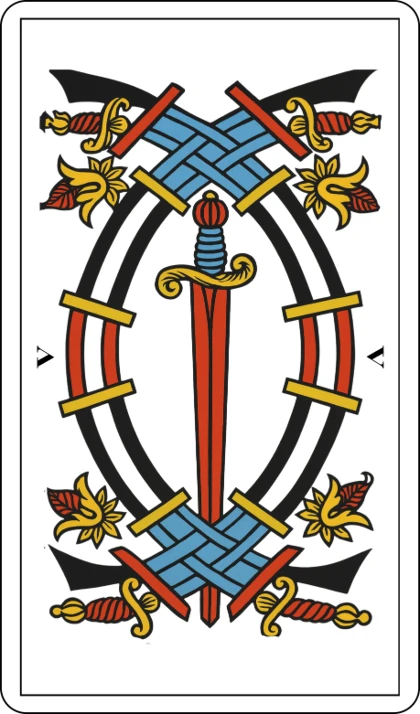
The Five of Swords is a minor numeral card from the Marseille Tarot, belonging to the suit of Swords. It shows five curved blades arranged in a double oval around a central straight sword pointing downward, with the numeral V printed on both sides. Upright, it speaks of promotion and professional evolution; reversed, it describes stagnation and the feeling of not advancing.
| Suit | What it covers | Cards | Symmetrical plates |
|---|---|---|---|
| Batons | feeling, mood and the quality of emotions | 14 | 9 |
| Cups | affective life and matters of the heart | 14 | 0 |
| Swords | working life and the field of activity | 14 | 2 |
| Coins | material life and money matters | 14 | 7 |
| Total | 56 | 18 |
This axis is not the Golden Dawn's elemental grid: this school places feeling on the batons and working life on the swords.
The Card
On the Marseille plate, the Five of Swords presents five curved blades arranged in a double oval formation. At the center, a straight sword points downward, its hilt raised toward the top of the card. The numeral V appears laterally on both sides of the composition. No figure, no scene, no landscape: only the five swords surrounded by the ornamental scrollwork and floral motifs typical of Marseille numeral cards. The arrangement is entirely decorative, yet the geometry is precise. The double oval creates a sense of containment, while the central downward-pointing blade anchors the composition with a clear vertical axis.
What the Card Signifies
The Five of Swords carries the tension between movement and containment. Five is a number of passage, a midpoint between the stability of four and the harmony of six. In the suit of Swords, which speaks of intellect, action, and communication, this midpoint concerns professional life and the recognition of effort. The double oval suggests a structure that holds, a framework within which something can rise. The central sword, pointing down, indicates direction: not a scattered energy, but a force that knows where it is going. This card speaks of what happens when work meets opportunity, when competence is seen and rewarded. It also speaks of what happens when that recognition does not come, when the structure holds too tightly and nothing moves.
The Five of Swords is not a card of conflict, despite its blades. It is a card of position within a structure. The swords are not crossed or clashing; they are arranged, ordered, contained. This is the geometry of a career, a role, a place in an organization. The question this card poses is simple: does the structure allow movement, or does it hold everything in place?
Upright
Upright, the Five of Swords signifies promotion and professional evolution. A person who draws this card in this orientation may experience an increase in salary, a rise in responsibility, or a progression within the same field of activity. The key here is that the evolution happens within the existing structure: the person does not change careers, does not start over. They advance where they already are. The double oval of the card reflects this: the framework remains, but the person’s position within it improves.
This is a beneficial and happy change. It is not a rupture, not a dramatic upheaval. It is the quiet satisfaction of being recognized, of seeing effort translate into tangible advancement. The central downward-pointing sword suggests that this promotion is grounded, earned, not accidental. The person has worked for this, and the work is now acknowledged.
Reversed
Reversed, the Five of Swords carries its own meaning, distinct from the upright. It speaks of stagnation and inertia. A person who draws this card in this orientation may feel that they are not evolving, that nothing moves, that their efforts go unnoticed. The structure that once held promise now feels like a cage. The double oval, which upright suggested containment and order, reversed suggests confinement and rigidity.
This is not the opposite of promotion. It is not demotion, not loss, not failure. It is the absence of evolution. The person remains where they are, but the movement they hoped for does not come. Obstacles appear, progress slows, and merits go unrecognized. The feeling is one of not advancing, of being stuck in place while time passes. The central sword, which upright pointed toward a clear direction, reversed suggests a blade driven into the ground: fixed, immobile, unable to rise.
Frequently Asked Questions
Does the Five of Swords always indicate a promotion at work?
Upright, it points strongly toward professional advancement, but the card speaks to any situation where effort meets recognition. It can describe evolution in a creative project, a personal goal, or any structured endeavor where a person hopes to progress.
What is the difference between the Five of Swords upright and reversed?
Upright, it signifies promotion, evolution, and beneficial change within an existing structure. Reversed, it signifies stagnation, inertia, and the feeling of not advancing. The reversed is not the negation of the upright; it is its own state, a distinct experience of being held in place.
How does the Five of Swords relate to the other Swords cards?
The Swords suit traces a progression of intellect and action. The Five sits at the midpoint, where the energy of the suit meets the question of position and recognition. It is less about conflict than the higher numbers, and more about structure than the lower ones.