Le Neuf d’Épée: The Marseille Tarot’s Sharp Edge Between Study and Stagnation
In brief
- This card is about intellectual effort as a concrete path: studying, training, and passing exams are the situations where it speaks clearly.
- The central tension is discipline versus laziness: upright it rewards the work you put in, reversed it exposes a refusal to question yourself or make any mental effort.
- Its specific angle is the mind and its habits: what you choose to learn or ignore, the cultural gaps you leave unfilled, and the self-examination you avoid.
- Reversed, the card points to intellectual stagnation: a tendency to let go, a lack of effort, and a schooling or exam path that turns laborious.
- The card never acts on its own, it only signifies a state: you either train your intellect or let it rust, and this card shows which side you stand on.
Contents
Le Neuf d’Épée is a minor numeral card from the Swords suit in the Marseille Tarot. Upright, it signifies learning and exam success, the value of training and structured study. Reversed, it signifies intellectual laziness, refusal to question oneself, and a slide into mental slackness.
| Suit | What it covers | Cards | Symmetrical plates |
|---|---|---|---|
| Batons | feeling, mood and the quality of emotions | 14 | 9 |
| Cups | affective life and matters of the heart | 14 | 0 |
| Swords | working life and the field of activity | 14 | 2 |
| Coins | material life and money matters | 14 | 7 |
| Total | 56 | 18 |
This axis is not the Golden Dawn's elemental grid: this school places feeling on the batons and working life on the swords.
The Card
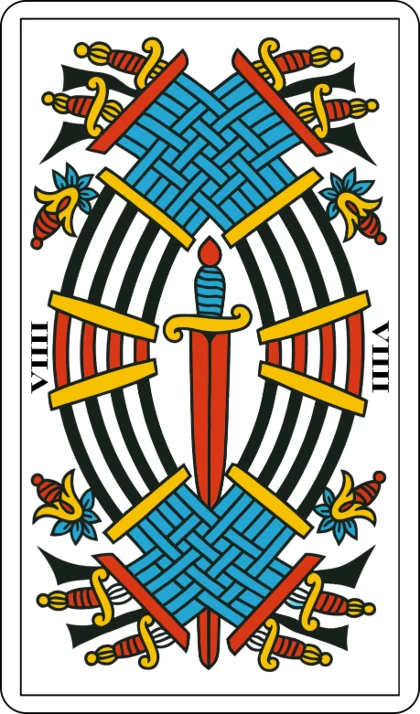
On the Marseille plate, Le Neuf d’Épée shows nine swords arranged in a double oval: eight curved blades form the outer ring, their points and hilts alternating, while the ninth stands straight in the center, point down, hilt up. The numeral VIIII is printed laterally on both sides, using the additive Roman form. There is no person, no scene, no landscape. The card is purely ornamental, like all Marseille numeral minors: the suit symbol repeated nine times, framed by simple floral or scrollwork lines. Every element is verifiable with the card in front of one’s eyes.
What the Card Signifies
This card carries a tension between mental discipline and mental drift. The nine swords are not a battlefield; they are a pattern, a structure. The central sword, point down, suggests a tool at rest or a challenge that has been set aside. The double oval of curved blades creates a closed loop, a container for thought. The question the card poses is not whether thought will occur, but whether thought will be shaped or allowed to scatter.
Le Neuf d’Épée does not predict an event. It describes a posture toward knowledge. Upright, that posture is active: engagement with material, practice, repetition until the pattern becomes one’s own. Reversed, that posture is passive: avoidance of effort, repetition of old conclusions, blades left to rust in their oval. The card’s ornamentation matters here. The swords are not drawn as weapons in use; they are displayed, almost ceremonial. That display can signify earned mastery or empty decoration, depending on orientation.
Upright
Upright, Le Neuf d’Épée signifies first of all study and training. This is a card of favorable conditions for exams, courses, internships, and any structured learning. The material can be absorbed, repetition pays off, and the effort of sitting with a difficult text is not wasted. The central sword, point down, suggests a mind that has stopped swinging and started focusing.
Beyond formal education, the upright Neuf d’Épée signifies the decision to learn. The card does not guarantee a diploma; it shows that the path of study is open. The nine blades, all identical, remind that mastery comes from repeated, unglamorous practice. A secondary meaning, separate from the main axis, concerns children’s schooling: for a young person, this card can indicate a good academic year, a period when lessons stick and grades reflect real understanding.
Reversed
Reversed, Le Neuf d’Épée carries its own weight, not the opposite of upright. Here the axis is intellectual laziness. The pattern of nine swords becomes a cage of habit: refusal to question what is already thought, avoidance of any effort that might disturb mental comfort. The central sword, point down, now suggests a mind stuck into the ground like a tent peg, immobile. This is not a card of failure imposed from outside; it is a card of self-chosen stagnation.
The reversed Neuf d’Épée also signifies a refusal to update one’s knowledge. Opinions may be repeated without examination, or new information dismissed because it would require work. The double oval of blades, which upright looked like a training ground, now looks like a closed loop: the same thoughts circling, no entry for anything unfamiliar. A secondary meaning, distinct from the main axis, concerns exam failure or a difficult, laborious school period. This is not a punishment; it is the natural result of the laziness the card describes. The blades are still there, but no one is sharpening them.
What Nuances This Reading
A single card never makes a reading. Le Neuf d’Épée is colored by its position in the spread. The card itself remains the same nine blades; the context tells which edge is facing.
The surrounding cards also matter. Next to a court card, Le Neuf d’Épée can describe a teacher, a student, or a colleague whose intellectual habits affect the situation. Next to a major arcana, it shows whether that larger force is being integrated through learning or blocked through laziness. The question brought to the table changes the emphasis. Asked about work, the upright card favors retraining or a new qualification. Asked about a relationship, it may point to the need to learn how the other person thinks, not just how one feels.
Frequently Asked Questions
Does Le Neuf d’Épée predict a specific exam result?
No. The card describes a favorable climate for study and preparation, not a guaranteed grade. Effort remains the deciding factor.
Is the reversed Neuf d’Épée always about laziness?
It is the main axis, but it can also point to a difficult school period or an exam failure as a secondary meaning. The core is a refusal to make intellectual effort, which may or may not show up in formal results.
Why are there no people on this card?
Marseille numeral minors are ornamental. They show the suit symbol repeated as many times as the card’s rank, with no scenes or characters. Le Neuf d’Épée is nine swords, nothing else.
Can this card indicate a need for rest instead of study?
Upright, it emphasizes active learning, but a surrounding card like the Four of Swords or a major arcana of pause can shift the reading toward rest before study. Le Neuf d’Épée alone does not prescribe rest; it shows the structure of mental work.