Four of Swords: The Marseille Tarot’s Quiet Architecture of Stability and Stillness
In brief
- The upright Four of Swords is a card of deliberate stabilization, its core strength is the person’s persistence in the current path, a phase that favors administrative and civil service roles.
- The central tension is between chosen stability (upright) and situational inactivity (reversed), the difference is whether the pause is a decision or a circumstance.
- The reversed side is not a failure, it is a status of non-engagement (unemployed, retired, housewife, student), a state to be read as a specific context, not a judgment.
- The card’s specific angle is the quality of the pause, it never advises a change, it only asks you to look at the reason for your stillness.
- The guiding line is that staying still is a paradox, the person is the one who holds the line, the card only signifies the meaning of that hold.
Contents
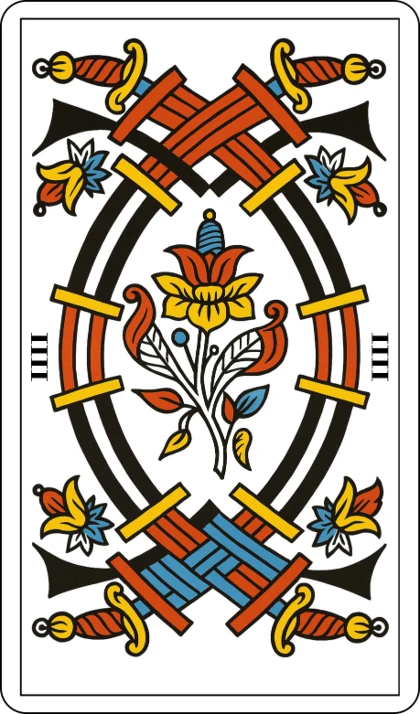
The Four of Swords is a minor numeral card from the Swords suit in the Marseille Tarot. Its face shows four curved blades arranged around a central flower, with the numeral IIII printed on both sides. Upright, it signifies stabilization and perseverance; reversed, it has its own distinct meaning of inactivity and precarious professional states.
| Suit | What it covers | Cards | Symmetrical plates |
|---|---|---|---|
| Batons | feeling, mood and the quality of emotions | 14 | 9 |
| Cups | affective life and matters of the heart | 14 | 0 |
| Swords | working life and the field of activity | 14 | 2 |
| Coins | material life and money matters | 14 | 7 |
| Total | 56 | 18 |
This axis is not the Golden Dawn's elemental grid: this school places feeling on the batons and working life on the swords.
The Card
On the Marseille card, you see four curved swords standing upright. Their blades form a double oval around a central stem. At the center of that oval is a large flower on a stem, with the corolla at the top and leaves at the bottom. The numeral IIII is printed laterally, on both sides of the design, in its additive Roman form. There is no person, no scene, no landscape, and no object other than the swords and the flower. Like all Marseille numeral cards, this one is ornamental, not narrative.
What the Card Says
The Four of Swords does not show a battle, a rest, or a decision. It shows a geometry: four blades locked around a single organic center. That arrangement is the whole meaning. The swords are not raised or crossed in conflict; they are placed as a frame. The flower inside is the only living element, and it is completely surrounded by metal. This tension between containment and growth is what the card signifies.
Because this is a numeral card, the number four matters. Four is a number of structure, of corners, of a frame that holds something in place. In the Swords suit, which deals with thought, language, and social position, that frame often becomes a professional or institutional structure. The card does not depict an event. It signifies a condition in which a person is either held by a stable frame or caught inside one that no longer moves.
The absence of any human figure is important. The numeral is purely structural. The person is not shown, because the person is the one looking at the card. The question is whether the frame around the flower is a support or a cage.
Upright
Upright, the Four of Swords signifies a phase of stabilization. The person is often in a position where the structure holds, and the main emphasis falls on security of employment. This is not a card of expansion or risk. It signifies that the current framework, however rigid, is doing its job. The four blades around the stem suggest that the person is protected by an established order.
In this orientation, change is not recommended. The image does not suggest movement. The person does better to continue and persevere in the approach already begun. The card indicates an affinity with administrative careers, public sector work, and any role where continuity matters more than novelty. It is a card of tenure, of seniority, of a position that has been secured through time and repetition.
Reversed
Reversed, the Four of Swords does not mean the opposite of stability. It has its own axis: inactivity. This is not a failure of the upright meaning; it is a different condition. The person may be without employment or in a precarious professional situation. The same four blades that once held a structure now appear as a closed frame with no movement inside. The central flower is still there, but the surrounding metal no longer supports growth; it simply contains it.
Alongside this main sense, the reversed card can indicate specific social or professional states. These are secondary readings, not interchangeable with the core meaning of inactivity. They include a period of unemployment, a homemaker, a retired person, a temporary worker, or a student. Each of these describes a person whose professional activity is paused, external, or not defined by a permanent contract. The card signifies the absence of judgment; it simply names a condition of stillness in the social field.
What Nuances This Reading
A single card never constitutes a reading. The meaning of the Four of Swords varies according to its position in a spread. In a past position, the stabilization or inactivity may indicate what has already occurred. In a future position, it indicates a tendency, not a fixed outcome. The surrounding cards also matter. Next to a court card, the reversed Four may indicate a specific person’s professional status, such as a student or a retiree. Next to a major arcana, the upright Four can indicate whether the structure is worth preserving or has become too rigid.
The question changes the weight as well. Asked about work, the upright Four indicates directly job security or its absence. Asked about love, it may indicate a stable but emotionally quiet arrangement, where the frame holds but the flower inside has little room to move. None of this can be fixed without seeing the actual spread, the position, and the question that brought the person to the table.
Frequently Asked Questions
Does the Four of Swords show a person resting or sleeping?
No. The Marseille numeral shows only four curved swords and a central flower, with no human figure, no bed, and no tomb.
Is the reversed Four of Swords just the opposite of the upright?
No. The reversed card has its own axis: inactivity. It can indicate unemployment, retirement, homemaking, temporary work, or study. It is not the negation of stability; it is a different condition altogether.
Does the upright Four of Swords always mean job security?
It signifies stabilization and perseverance, and it indicates an affinity with administrative or civil service roles. But the surrounding cards and the position in the spread determine whether that stability is current, desired, or fading.
Can the Four of Swords predict how long a period of unemployment will last?
No. A single card has no duration. Only the position in a spread and the question can frame time, and this page describes no spread.