The Three of Swords: When Change Cuts Through
In brief
- This card signifies a radical professional shift, a rapid and beneficial change that brings a new orientation and ascension.
- The central tension is the reversed position: the same positive change is delayed but never cancelled, so you keep its beneficial nature.
- The reversed also carries accessory meanings, such as health issues, overwork, or surgery, which are separate from the main theme of transformation.
- This card never acts, you are the one who moves through the change, whether it arrives quickly or at a slower pace.
Contents
The Three of Swords is a minor numeral card from the Marseille Tarot, belonging to the suit of Swords. It speaks of professional transformation, the kind that arrives swiftly and reshapes everything in its path. Whether upright or reversed, this card carries the same core message: change is coming, and it is fundamentally positive, even when it takes longer than expected.
| Suit | What it covers | Cards | Symmetrical plates |
|---|---|---|---|
| Batons | feeling, mood and the quality of emotions | 14 | 9 |
| Cups | affective life and matters of the heart | 14 | 0 |
| Swords | working life and the field of activity | 14 | 2 |
| Coins | material life and money matters | 14 | 7 |
| Total | 56 | 18 |
This axis is not the Golden Dawn's elemental grid: this school places feeling on the batons and working life on the swords.
The Card
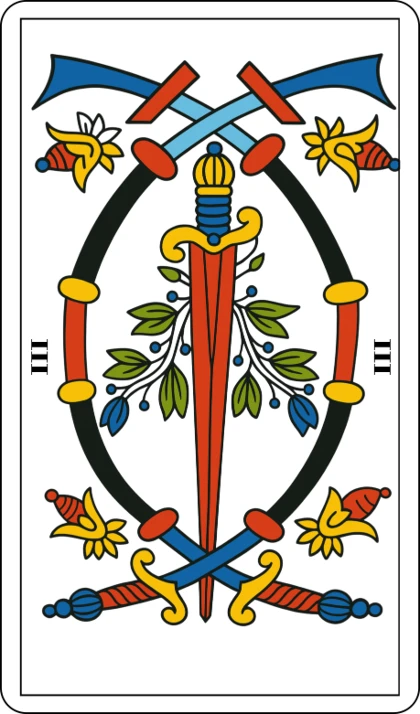
Look at the card and you will see exactly this: three curved swords arranged in a double oval formation, their blades bending outward to create a symmetrical frame. In the center stands a single straight sword, its point facing downward, its hilt rising toward the top of the card. This central blade is surrounded by foliage, leaves and stems that wrap around the weapon without obscuring it. The numeral III appears laterally, printed on both sides of the card in the additive Roman form. There is no figure, no scene, no landscape. The card is purely ornamental, as all Marseille numeral cards are: the suit symbol repeated as many times as the rank, framed by decorative flourishes and nothing more.
What the Card Says
The Three of Swords belongs to the suit of Swords, the suit of intellect, decision, and action. Where the Two of Swords often shows a standstill, a weighing of options, the Three shows what happens when the decision finally lands. The central sword, point down, surrounded by foliage, suggests a cutting through that is not destructive but generative. The foliage does not wither around the blade; it grows. The three curved swords form a protective oval, a container for the central action. This is not a card of violence or loss, despite what other traditions might suggest. In the Marseille system, the Three of Swords speaks of movement that clears the ground, a decisive shift that opens a new path.
The double oval formed by the curved swords is significant. It creates a space, a threshold. The central sword passes through that space, point downward, as if planting itself in new soil. The foliage reinforces this: growth, vitality, organic unfolding. The card does not show a wound; it shows a breakthrough. The numeral III, printed twice, emphasizes the stability of the number three, the first number that creates a structure, a triangle, a foundation. This is change that builds something, not change that merely destroys.
Upright
Upright, the Three of Swords carries the axis of change, and it is change of a specific kind: professional, rapid, radical, and beneficial. This is not a slow evolution or a gradual adjustment. It is a phase of action, a moment when the situation shifts decisively and without hesitation. The card points to a new orientation, one that is positive and forward-moving. It speaks of ascension, of rising to a new level of responsibility or visibility. The transformation is total: the old configuration gives way to something entirely new, and the person who experiences this change finds themselves in a new position, often a new job or a new role that better reflects their capacities.
The Three of Swords upright does not suggest struggle or resistance. The change it describes is one that arrives with clarity, as if a decision has been made and the path forward is now obvious. The central sword, point down, indicates that this change is grounded, practical, rooted in the real world. It is not a fantasy or a wish; it is a concrete shift in the professional sphere. The foliage around the blade suggests that this change is nourishing, that it supports growth rather than cutting it off. The person who draws this card upright is in a moment of decisive forward motion, and the direction is favorable.
Reversed
Reversed, the Three of Swords does not become a card of stagnation or failure. It carries the same fundamental meaning: change, professional transformation, a new orientation. But the reversed position introduces a notion of delay. The change is still coming, still positive, still radical in its implications, but it is slowed down. The momentum that the upright card shows so clearly is, in the reversed position, held back by circumstances, by timing, by factors that are not yet aligned. The change is not cancelled; it is postponed. The person who draws this card reversed is not facing a negative outcome, but a longer road. The transformation will still arrive, and it will still be beneficial, but it requires patience.
There are also accessory meanings associated with the reversed Three of Swords, meanings that are dissociated from the main axis of delayed change. These include health problems, particularly those related to overwork or exhaustion. The reversed card can point to a period of surmenage, of pushing too hard without adequate rest. It can also indicate a surgical operation, a physical intervention that is necessary and ultimately beneficial, but that requires a period of recovery. These accessory meanings are not the core of the card, but they are part of its reversed vocabulary, and they should be considered when the context of a reading supports them.
What Nuances This Reading
A single card never tells the whole story. The Three of Swords, like any Marseille numeral, takes its full meaning from its position in a spread, the cards that surround it, and the question that was asked. In a position that speaks of the past, the Three of Swords may indicate a change that has already occurred, a transformation that is now complete. In a position that speaks of the future, it points to a change that is still to come. The surrounding cards modulate the tone: a Major Arcana card placed next to the Three of Swords can amplify or redirect its meaning, while other Swords cards can reinforce the intellectual or decisive quality of the change. The question asked also matters. A question about career will draw out the professional dimension of the card; a question about a relationship may point to a change in the dynamic between two people, even though the card’s primary axis is professional. The Three of Swords is not a fixed answer; it is a signifier that adapts to the context in which it appears.
Frequent Questions
Does the Three of Swords mean heartbreak or betrayal?
No. That association comes from the Rider-Waite-Smith tradition, which illustrates its minor cards with scenes. The Marseille Three of Swords shows only three swords and foliage. It speaks of professional change, not emotional pain.
Is the reversed Three of Swords a bad card?
No. The reversed card carries the same positive meaning as the upright card, but with a delay. The change is still coming, and it is still beneficial. The reversed position simply indicates that the timing is slower than expected.
What does the foliage around the central sword mean?
The foliage is part of the ornamental design of Marseille numeral cards. It suggests growth and vitality surrounding the central blade, reinforcing the idea that the change this card signifies is nourishing rather than destructive.
Can the Three of Swords indicate a health issue?
Only in the reversed position, and only as an accessory meaning. The reversed card can point to overwork, exhaustion, or a surgical operation. These meanings are secondary to the main axis of delayed change and should be considered only when the context of a reading supports them.