The Six d’Épée: A Marseille Tarot Guide to Creative Recognition and Disappointment
In brief
- The card shows a rise in income that does not require changing your job, meaning your current position suddenly yields more financial reward.
- It specifically favors artistic and creative careers, giving you a surge of talent that lets you realize yourself in your craft.
- The central tension is that the reversed card flips this exact axis: the same work that could bring a raise now brings a disappointing refusal or torments in business.
- The guiding line is that this card is about the value of your output, whether it is recognized with a reward or rejected with a negative answer.
Contents
The Six d’Épée is a minor numeral card from the Marseille Tarot, bearing the rank VI. Upright, it signifies creative recognition and the flowering of talent. Reversed, it carries its own independent meaning: disappointment in work.
| Suit | What it covers | Cards | Symmetrical plates |
|---|---|---|---|
| Batons | feeling, mood and the quality of emotions | 14 | 9 |
| Cups | affective life and matters of the heart | 14 | 0 |
| Swords | working life and the field of activity | 14 | 2 |
| Coins | material life and money matters | 14 | 7 |
| Total | 56 | 18 |
This axis is not the Golden Dawn's elemental grid: this school places feeling on the batons and working life on the swords.
The card face
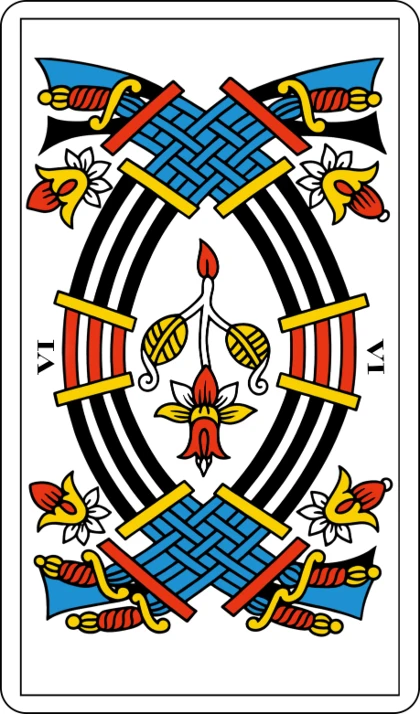
The card shows six curved swords arranged in a double oval. At the center, a flower hangs from a stem, its corolla turned downward. The numeral VI is printed laterally on both sides. There are no figures, no scenes.
What the card says
This is a card about work that bears fruit. The six swords form a protective enclosure around the central flower, which hangs downward, suggesting something that has matured and now bends under its own fullness. The double oval of blades creates a contained space, a kind of workshop or studio where creative work happens. The flower at the center is not upright and striving; it is pendulous, heavy with accomplishment. This is not a card of beginnings or of struggle. It is a card of recognition, of work that has reached a point where it is seen and valued.
The number six in the Marseille system carries the weight of harmony after effort. Five is the number of conflict and instability; six is the number of resolution, of things settling into a pattern that works. In the suit of Swords, which deals with intellect, communication, and the cutting edge of thought, the Six shows a moment when mental labor has produced something tangible. The swords are not crossed in battle; they are arranged in a deliberate, ornamental pattern. This is the mind at rest after a period of intense work, surveying what it has made.
Upright
Upright, the Six d’Épée signifies creative recognition. This is the card of the artist, the craftsperson, the writer, the designer, anyone whose work involves making something that did not exist before. It points to talent and genius, to the kind of work that comes from a deep place and is recognized by others as valuable. This is not a promise of fame; the promise is that the work itself will be seen for what it is.
This card also signifies support for artistic careers. It is one of the most favorable cards in the deck for anyone engaged in creative work. It suggests that the work itself is the reward. The flower at the center of the card hangs downward, heavy with its own fullness. This is the image of work that has ripened.
Reversed
Reversed, the Six d’Épée carries its own independent meaning: disappointment in work. This is not the absence of recognition; it is the active experience of being overlooked, undervalued, or passed over. The flower that hung heavy with accomplishment now seems to droop with exhaustion. The enclosure of swords that once protected the creative space now feels like a cage.
What nuances this reading
A single card never tells the whole story. The Six d’Épée takes its meaning from its position in a spread and from the cards that surround it. In a position that speaks of the past, it may point to a period of recognition that has already occurred. In a position that speaks of the future, it may point to recognition that is still to come. The same card, in the same orientation, can mean different things depending on where it falls.
The cards that surround the Six d’Épée also matter. Next to a card of stability, the Six may point to recognition that is secure and lasting. Next to a card of upheaval, it may point to recognition that is threatened or unstable. The question asked also shapes the reading. A question about work will bring out the card’s professional meanings. A question about creative projects will bring out its artistic meanings. A question about relationships may bring out something else entirely.