The Ace of Swords: A Blade That Cuts Through Fog
In brief
- The Ace of Swords is the blade of the mind, its core force is intellectual clarity and the power to create a new project, a professional change, or a clear start.
- The central tension is the paradox of the blade: the same cut that opens a path becomes when reversed, violence and aggression, making the person the author or the victim of a painful conflict.
- The guiding line is that the sword is a tool, so you are the one who wields it, the action is always yours, never the card’s.
- The accessory meanings, like pregnancy or fertility problems, are secondary and dissociated, a side note to the main theme of the sword.
- The Ace of Swords holds a paradox: it is a tool of precision and creation, but also of danger and conflict, and the outcome depends entirely on your hand.
Contents
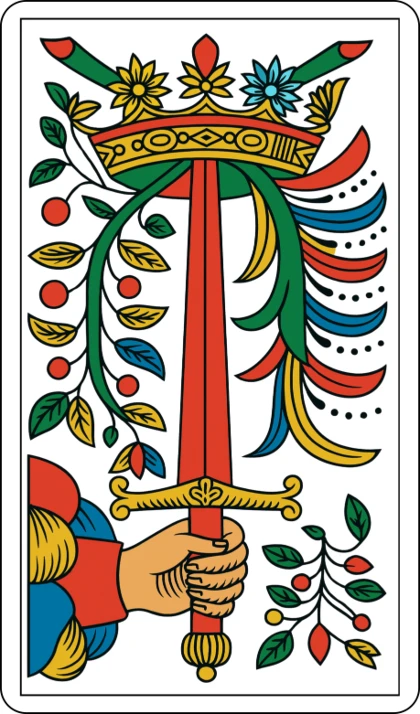
The Ace of Swords is a minor numeral card from the Marseille Tarot, belonging to the Swords suit. It shows a hand gripping an upright sword that pierces a crown, and it speaks of creation and intellectual clarity when upright, and of conflict and aggression when reversed.
| Suit | What it covers | Cards | Symmetrical plates |
|---|---|---|---|
| Batons | feeling, mood and the quality of emotions | 14 | 9 |
| Cups | affective life and matters of the heart | 14 | 0 |
| Swords | working life and the field of activity | 14 | 2 |
| Coins | material life and money matters | 14 | 7 |
| Total | 56 | 18 |
This axis is not the Golden Dawn's elemental grid: this school places feeling on the batons and working life on the swords.
The Card
What you actually see on the Marseille card: a hand emerges from the bottom edge of the card and grips an upright sword, its point raised. The sword passes through a crown, from which palms and ribbons hang. Foliage appears on both sides. There is no numeral on the side of the card; the rank is read from the single sword itself. No person, no scene, no landscape. Just the sword, the crown, the hand, and the ornamental foliage.
What the Card Says
The Ace of Swords is the first impulse of the mind. It is the blade that separates what matters from what does not. The sword is not a weapon here; it is a tool of discernment. The hand shows human agency: someone grips the blade, someone directs it. The crown suggests a goal, a recognition, or an authority that the blade must reach. The foliage on both sides shows that life continues around the act of cutting.
This card speaks of precision. Not the precision of a machine, but the precision of a mind that has learned to distinguish. It is the moment when a thought becomes clear enough to act upon. The sword does not waver; it is held upright, point up, aimed at something.
The crown is important. The sword passes through it, which means the blade is not stopped by authority or convention. It cuts through what others accept without question. But the crown is not destroyed; it is pierced, which suggests that the blade does not demolish, it opens a passage.
Upright
When the Ace of Swords appears upright, it speaks of creation. Not creation in the abstract, but creation as a concrete act: a project that can be carried through to completion. The mind is clear, the goal is visible, and the hand is steady.
This card points to intellectual clarity. The person sees what needs to be done and does not confuse it with what merely seems urgent. There is a precision here that allows for decisive action.
It also speaks of professional change. A new job, an entry into working life, a shift in direction. The sword cuts away what is no longer useful, and what remains is a path forward.
As an accessory meaning, the Ace of Swords upright can point to pregnancy. This is not the primary sense, but it is a recognized secondary reading: the beginning of a new life, the first stirring of something that will grow.
Reversed
When the Ace of Swords appears reversed, it speaks of conflict. Not the productive conflict of debate, but conflict that wounds. The blade is no longer a tool of discernment; it has become a weapon.
This card points to violence and aggression. The person may be the author of this aggression, or the victim of it. Either way, the situation is painful and dangerous. The sword that should cut through fog now cuts through flesh.
The reversed Ace of Swords shows a situation where clarity has been lost. The mind is no longer precise; it is reactive. The crown is no longer a goal; it is a target. The hand no longer directs the blade; it merely holds it.
As an accessory meaning, the reversed Ace of Swords can point to fertility problems or concerns about a pregnancy. This is not the primary sense, but it is a recognized secondary reading: the beginning that does not take, the first stirring that falters.
What Nuances This Reading
A card never stands alone. The Ace of Swords means different things depending on where it falls in a spread, what cards surround it, and what question was asked.
If the Ace of Swords appears in a position that speaks of the past, it may point to a decision that was made, a cut that was clean. If it appears in a position that speaks of the future, it may point to a decision that is coming, a cut that will need to be made.
The cards around it matter. If the Ace of Swords is surrounded by cards of abundance, the creation it points to may be material. If it is surrounded by cards of difficulty, the creation may be internal: a clarity won through struggle.
The question asked also matters. The same card means something different in a reading about work than in a reading about love. The Ace of Swords is not a fixed meaning; it is a meaning that takes shape in context.
Frequent Questions
Does the Ace of Swords always mean a new job?
No. The Ace of Swords can point to professional change, but it can also point to any act of creation, any moment of intellectual clarity, any project that can be carried through. The context of the reading determines what kind of creation is at stake.
Is the reversed Ace of Swords always about violence?
No. The reversed Ace of Swords points to conflict and aggression, but this can take many forms. It may be a conflict with another person, a conflict within oneself, or a situation that is simply painful and dangerous. The person may be the author or the victim.
Can the Ace of Swords predict a pregnancy?
The Ace of Swords upright can point to pregnancy as an accessory meaning, and the reversed Ace of Swords can point to fertility problems or concerns about a pregnancy. But a single card never predicts anything. It points to a possibility, a tendency, a direction. Only a full reading can say more.
What is the difference between the Ace of Swords and the other Swords cards?
The Ace is the first impulse, the initial cut. The other Swords cards develop this impulse: they show what happens after the cut, how the blade is used, what it costs. The Ace is the beginning; the others are the consequences.