Le Cavalier d’Épée: The Charging Victory in the Marseille Tarot
In brief
- The Knight of Swords signifies a victory that is earned through a fight, the person wins the battle they have engaged in.
- The central tension is that the triumph is total, but it requires a struggle, the cause is worth the fight.
- Reversed, the card does not reverse the meaning, it attenuates it: the fight is harder, and the victory is less decisive.
- Reversed also opposes movement, the person stays put, but the victory is still possible, just more difficult.
Contents
Le Cavalier d’Épée is a minor honor in the suit of Swords, one of the sixteen figured court cards in the Marseille Tarot. It shows a rider on horseback, not a numbered scene. Upright, it signifies victory in a fight worth waging; reversed, it signifies a harder, more contested victory.
| Suit | What it covers | Cards | Symmetrical plates |
|---|---|---|---|
| Batons | feeling, mood and the quality of emotions | 14 | 9 |
| Cups | affective life and matters of the heart | 14 | 0 |
| Swords | working life and the field of activity | 14 | 2 |
| Coins | material life and money matters | 14 | 7 |
| Total | 56 | 18 |
This axis is not the Golden Dawn's elemental grid: this school places feeling on the batons and working life on the swords.
The Card Face
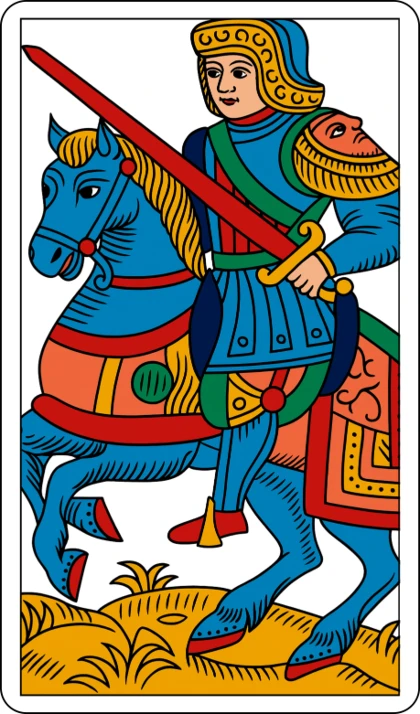
A helmeted rider sits on a blue horse. The rider holds a sword raised diagonally above the shoulder, as if ready to strike or signal a charge. The horse wears a red caparison, and the ground beneath is ochre. The card carries no printed numeral and no legend, as is true for all sixteen honors in this deck. Unlike the numbered Swords cards, which show only repeated sword symbols and ornamental foliage, this card shows a full human figure on horseback. That single fact matters: Le Cavalier d’Épée is a person in motion, not an abstract count.
What the Card Means
Le Cavalier d’Épée is not about idle aggression. The raised sword and the forward-facing horse point to a person who has already committed to a fight. The cause is clear enough to justify the charge. This card often appears when a struggle has been engaged, not merely imagined. The victory it signifies is not a passive gift; it is the result of effort, confrontation, and the willingness to keep moving toward a goal. The red caparison adds heat and urgency, but the blue horse keeps the image from becoming pure fury. There is direction here, not chaos.
Upright
Upright, Le Cavalier d’Épée signifies first victory. The person who draws this card in an upright position may be in a position to win a fight that has already been engaged. This is not a vague hope; it is a triumph that follows sustained effort. A project that required struggle can succeed. The efforts are rewarded, and the win can feel total. The card also carries a clear instruction: the cause is worth the battle. If a person has been hesitating to fight for something, this card signifies that the fight itself has value.
Reversed
Reversed, Le Cavalier d’Épée does not mean defeat. It carries its own axis: a victory that is disputed. The same kind of win is possible, but the fight is harder, the outcome less clean, and the triumph may feel partial or delayed. The person may still win, but the cost is higher and the opposition is stronger. This is not the upright meaning blocked; it is a distinct reading where the battle is more grueling and the result less total.
What Nuances This Reading
Le Cavalier d’Épée does not by itself indicate a time frame or target; its signification depends on the position it occupies and the cards around it. In a past position, the victory may already be won; in a future position, it may still be ahead. The card signifies victory or contested victory without reference to any date or duration. Surrounding cards can also shift the emphasis. Next to a card of stability, the reversed Knight’s contested victory may feel more entrenched. Next to a card of conflict, the upright Knight’s victory may appear more decisive. The question asked matters just as much: a question about a personal conflict will foreground the fight and its outcome, while a question about a project will foreground the effort and its result. No reading of this card should pretend to know a specific person’s situation without seeing the full spread.
Frequently Asked Questions
Is the reversed Le Cavalier d’Épée the opposite of the upright?
No. The reversed card is not defeat or blocked energy. It is a distinct meaning: a more difficult, contested victory. It does not negate the upright; it offers a different axis.
Why does this card show a person when other Swords cards show only swords?
Because it is an honor, one of the sixteen court figures in the Marseille Tarot. The numbered Swords cards are ornamental and show only repeated sword symbols. Only the honors show human figures.
Does Le Cavalier d’Épée predict a specific time frame?
No. Le Cavalier d’Épée is timeless. Only its position in a spread can indicate past, present, or future. This page describes the card’s meaning, not a particular reading.