Seven of Swords: The Double Oval of Work, Authority, and Adversity in the Marseille Tarot
In brief
- This blade centers on mastery and authority, it speaks of a person who reaches a position of responsibility through skill and effort, not luck.
- The core tension is a paradox: the same blade that marks professional success and social growth also carries the weight of adversity, a sudden stop, or a loss of work.
- Its meaning is a pivot, the outcome depends entirely on the orientation, yet both sides reveal a single truth about how you handle power and obstacles.
- You are the one who acts, the blade only signifies the stakes of your choices, it does not predict your fate.
- It is a card of concrete results, it asks you to look at your work, your position, and the real consequences of your ambition.
Contents
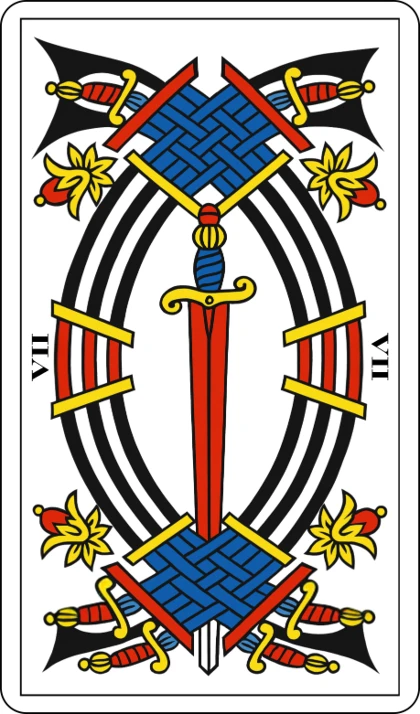
The Seven of Swords is a minor numeral of the Marseille Tarot, one of the forty cards ranked one to ten in the suit of Swords. Upright, it points to success, realization, and new responsibilities in work; reversed, it carries its own meaning of adversity, professional tension, and abrupt stoppage. On the card face, seven curved blades form a double oval around a single downward-pointing sword, with the numeral VII printed on both sides.
| Suit | What it covers | Cards | Symmetrical plates |
|---|---|---|---|
| Batons | feeling, mood and the quality of emotions | 14 | 9 |
| Cups | affective life and matters of the heart | 14 | 0 |
| Swords | working life and the field of activity | 14 | 2 |
| Coins | material life and money matters | 14 | 7 |
| Total | 56 | 18 |
This axis is not the Golden Dawn's elemental grid: this school places feeling on the batons and working life on the swords.
The Card Face
The Marseille Seven of Swords shows no person, no scene, no landscape. Seven swords with curved blades stand arranged in a double oval, a closed perimeter of steel. In the center, one sword stands alone, point down, hilt up, like a vertical axis. The numeral VII appears laterally on both sides, printed in the additive form. Nothing else is drawn: no rinceaux, no flowers, no additional ornament beyond the repeated suit symbols. This is typical of Marseille minors, which are ornamental rather than narrative.
What the Card Says
The Seven of Swords speaks of work as a structure. The double oval of blades is not a random decoration; it forms a closed container, a protected field. The central sword, point down, anchors that field. It does not threaten; it stabilizes. A person who draws this card is often dealing with a professional situation that has taken a definite shape, a role, a project, a position. The card points to the moment when effort becomes visible and recognized.
Seven is a number of completion in the Marseille system, but not of rest. The seven blades are all active, all upright, all part of the same arrangement. This card does not describe a solitary victory; it describes a success that involves others. The double oval suggests a social perimeter, a team, a network, a public role. The central sword, point down, indicates that authority is grounded, not floating. A person in this position holds responsibility without losing contact with the ground.
The card also carries a warning hidden in its geometry. A closed oval can protect, but it can also confine. The central sword points down, toward the earth, toward what is already built. This is not a card of reckless expansion; it is a card of consolidation. Progress here is real, but it requires maintenance. Growth happens inside a defined structure, not by breaking it.
Upright
Upright, the Seven of Swords points first to success and realization in work. This is not a vague hope; it is a concrete outcome, a project completed, a goal reached, a skill recognized. The person who draws this card upright is often in a position where their labor has produced a visible result. The double oval of blades becomes a crown of achievement, and the central sword becomes a scepter of authority.
From that success comes accession to authority and new responsibilities. The card indicates a promotion, a leadership role, a mandate to direct others. The seven swords are not scattered; they are ordered. A person under this influence is asked to hold a structure together, to be the central axis. This is not a burden; it is a natural consequence of prior work. The card favors activities with a strong social and relational character: public speaking, negotiation, team coordination, client relations. Progress and growth follow, but they follow the person who accepts the role.
Reversed
Reversed, the Seven of Swords carries its own axis: adversity. The same double oval that once protected now reads as a closed loop, a trap. The central sword, point down, no longer anchors; it cuts the ground away. A person who draws this card reversed is often facing professional difficulty, not as a temporary setback but as a structural tension. The work that once held together begins to pull apart.
This reversed meaning includes tensions in the workplace, conflicts with colleagues or superiors, and a sense that the rules have turned against the person. It can point to loss of employment, dismissal, or an abrupt halt to one’s activity. The seven blades, still arranged, now suggest a cage rather than a crown. The person is not necessarily at fault; the structure itself has become hostile. The card does not predict a date or a duration; it describes a quality of experience in which work becomes a source of friction and instability.
What Nuances This Reading
A single card never tells the whole story. The Seven of Swords takes its color from its position in a spread, the surrounding cards, and the question asked. In a past position, it may describe a success already achieved or an adversity already passed. In a future position, it may point to a responsibility to come or a professional rupture to prepare for. Surrounding cards can sharpen or soften the meaning: a Major arcana of stability may reinforce the upright sense, while a card of conflict may deepen the reversed sense. The question also matters. Asked about love, the Seven of Swords speaks less of romance and more of the social and professional roles that shape a relationship. Asked about work, it speaks directly to authority, progress, or rupture.
Frequently Asked Questions
Does the Seven of Swords predict a promotion?
It points to success and accession to authority in work, but no card predicts a specific event. It describes a quality of experience: a person is in a position where their labor is recognized and new responsibilities are likely. The actual outcome depends on the spread and the person’s choices.
Is the reversed Seven of Swords always about losing a job?
No. The reversed card carries the axis of adversity, which includes professional tensions, conflicts, and an abrupt halt to activity. Job loss or dismissal is one possible expression, but not the only one. The card can also describe a hostile work environment or a project that collapses without formal termination.
Why are there no people on this card?
Marseille minors are ornamental, not narrative. They show the suit symbol repeated as many times as the rank, surrounded by simple decorative elements. The Seven of Swords shows seven blades and the numeral VII, nothing else. The meaning comes from the arrangement, the number, and the suit, not from a scene.
Can this card indicate social success?
Upright, yes. The double oval of blades suggests a social perimeter, and the card favors activities with a relational character: networking, public roles, team leadership. It points to growth that happens through and with other people, not in isolation.