La Reine d’Épée: The Seated Edge of Decision and Betrayal
In brief
- The core force is decisive clarity: you must cut through doubt and commit to a choice, because the blade of judgment only works when fully drawn.
- The central tension is sharpness versus wounding: the same intellect that lets you cut can also turn into slander or betrayal, so you hold the sword without dissolving the paradox.
- When reversed, the sword signifies abuse of trust and malicious gossip: the person becomes the target of the very cutting edge they once wielded, often an intellectual woman in difficulty.
- The guiding line is the sword’s double edge: you cannot gain the power of decision without accepting the risk of cutting, and the card asks you to own that risk rather than avoid it.
Contents
La Reine d’Épée is a minor honor of the Marseille Tarot, one of the sixteen court figures that carry a person. Upright, she signifies decision, determination, and the need to cut through doubt. Reversed, she shows a different field: abuse of trust, slander, and betrayal.
| Suit | What it covers | Cards | Symmetrical plates |
|---|---|---|---|
| Batons | feeling, mood and the quality of emotions | 14 | 9 |
| Cups | affective life and matters of the heart | 14 | 0 |
| Swords | working life and the field of activity | 14 | 2 |
| Coins | material life and money matters | 14 | 7 |
| Total | 56 | 18 |
This axis is not the Golden Dawn's elemental grid: this school places feeling on the batons and working life on the swords.
The card
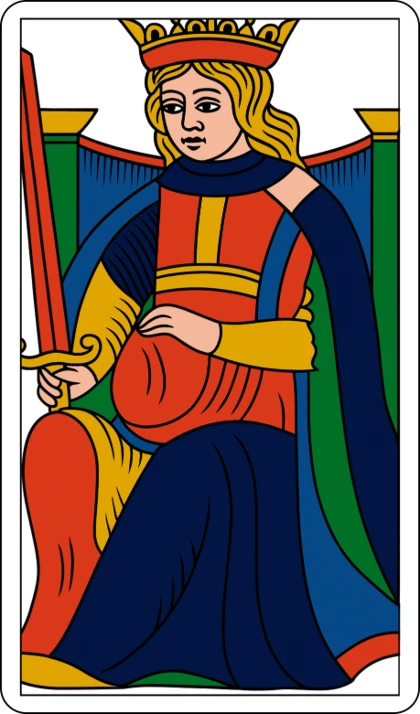
On the Marseille card, a crowned queen sits facing you, wearing a red robe and a blue mantle, before a hanging. She holds an upright sword at her side. The card carries no printed legend and no numeral, as is true for all sixteen honors.
What the card says
La Reine d’Épée is not a scene, it is a figure. Unlike the forty numeral cards of the minor suits, which show only repeated suit signs and ornament, this honor carries a person. That person sits, crowned, before a hanging, with a sword held upright. The posture is not aggressive: the sword is not raised, not pointed, not swung. It is held, ready, at the side. This shows a field of clear judgment, not combat. The red robe points to active will, the blue mantle to reflective distance. The hanging behind her suggests a private or protected space, a place where words and decisions carry weight.
The sword is the key. In the Swords suit, the blade is the instrument of separation: it cuts what is entangled, it divides true from false, it removes what no longer serves. The Queen holds this instrument without drama. Her authority is seated, not performative. She does not need to stand or strike. The decision she signifies is often an internal one: a line drawn inside yourself, a refusal to keep two incompatible things together. This is not about anger, it is about lucidity. La Reine d’Épée shows the moment when a person stops negotiating with confusion and names what is what.
Because this is an honor, not a numeral, the card can also point to a person, often a woman whose activity is intellectual: a writer, a judge, a teacher, an analyst, someone who works with words, law, or precise thought. But the card is not limited to a person. It can also name a quality you are asked to embody: the capacity to decide without cruelty, to speak without flinching, to hold your ground without raising your voice.
Upright
Upright, La Reine d’Épée signifies the axis of decision. The first meaning is a decision: a moment when a choice must be made, and made cleanly. The image does not promise ease, only necessity. The second meaning is determination and will: the person facing this card is asked to show firmness, to hold a line, to not let doubt dissolve what has been decided. The third meaning is the act of cutting: to cut through hesitation, through mixed signals, through the fear of being wrong. The sword is upright, so the cut is vertical, clean, separating. There is no room for half measures. If the card points to a person, it is often a woman with an intellectual activity, someone whose clarity is her main tool.
Reversed
Reversed, La Reine d’Épée shows a different field: betrayal. This is not indecision, not a blocked decision. It is the presence of abuse of trust, slander, and malicious speech. The first meaning is abuse of confidence: someone has used what was shared in private as a weapon. The second is slander and betrayal: words that wound from behind, a broken promise, a confidence turned against its owner. The third is aggression suffered: the person is not the one who attacks, but the one who receives calumnious remarks, negative criticism, or a campaign of denigration. The sword, which upright was a tool of clean separation, here becomes a blade in the mouth: words that cut without consent. If the card points to a person, it is often a woman with an intellectual activity who is in difficulty, perhaps discredited, isolated, or attacked precisely because of her clarity.
What nuances this reading
A single card never makes a reading. La Reine d’Épée is determined by its position in a spread: past, present, future, obstacle, resource. The card itself is timeless. Its meaning also shifts with the cards around it. Next to a coin card, the decision or the betrayal touches material security, work, or money. Next to a cup card, it touches emotional bonds, family, or intimate trust. Next to a major arcana, the field widens: the decision or the slander is not just personal, it is structural, tied to a larger pattern. The question asked also matters. If the question is about a relationship, the upright La Reine d’Épée points to the need for a clear boundary; the reversed La Reine d’Épée points to a breach of trust. If the question is about work, the upright La Reine d’Épée points to a professional decision or a woman in an intellectual role; the reversed La Reine d’Épée points to professional slander or a discredited colleague. None of this is fixed until the spread gives it a place.
Frequent questions
Does La Reine d’Épée always represent a woman?
No. As an honor, it can point to a person, often a woman with an intellectual activity, but it can also name a quality: the capacity for clear judgment, firm decision, or, reversed, the experience of being slandered. The gender is not the core of the card.
Is the reversed La Reine d’Épée just the upright meaning blocked?
No. In the Marseille Tarot, the two orientations carry independent meanings. Upright, the card signifies decision and determination. Reversed, it signifies betrayal, slander, and aggression suffered. One is not the failure of the other; they are two different fields.
Does the sword on the card mean physical violence?
No. The sword is held upright at the queen’s side, not raised or swung. It signifies discernment, the cut that separates true from false, and the authority of precise speech. Reversed, that same blade appears in words: calumny, negative criticism, abuse of confidence.
Can this card predict a betrayal?
A card does not predict, it signifies. The reversed La Reine d’Épée shows a field where abuse of trust or slander is present, but only the position in a spread and the surrounding cards can show whether that field is past, present, or potential. The card itself carries no date and no duration.