Eight of Swords: The Double Oval of Limitation in the Marseille Tarot
In brief
- The Eight of Swords reveals a self-imposed cage, a limitation that feels external but is actually a refusal to move.
- Upright, it points to a situation that is comfortable but hollow, a job or role that works for now yet offers no future, so you must act and seek novelty.
- Reversed, the same limitation tightens, the boredom is clear, but the call to change becomes paralysis, not progress.
- The central tension is between the need for movement and the comfort of staying, a paradox you must resolve by choosing the unknown.
- This card never acts, it only signifies: the person must decide whether to break the pattern or let the situation define them.
Contents
The Eight of Swords is a minor numeral card from the Swords suit in the Marseille Tarot. Upright, it points to limitation and the need to move toward change; reversed, it shows limitation closing in without movement. This guide describes the card face, the two axes, and what modulates its meaning.
| Suit | What it covers | Cards | Symmetrical plates |
|---|---|---|---|
| Batons | feeling, mood and the quality of emotions | 14 | 9 |
| Cups | affective life and matters of the heart | 14 | 0 |
| Swords | working life and the field of activity | 14 | 2 |
| Coins | material life and money matters | 14 | 7 |
| Total | 56 | 18 |
This axis is not the Golden Dawn's elemental grid: this school places feeling on the batons and working life on the swords.
The Card Face
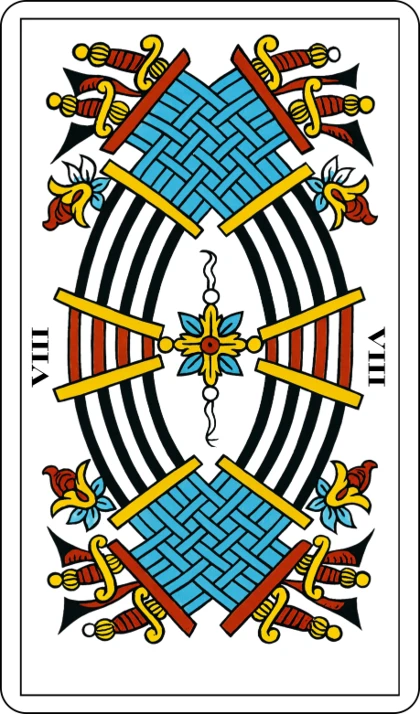
On the Marseille plate, eight curved swords stand in a double oval, their blades all turned inward. At the center sits a small cruciform rosette, without stem, without top, without bottom. The numeral VIII is printed laterally, on both sides, in its additive Roman form. No person, no scene, no landscape appears. The card is perfectly symmetrical: laid on the table, nothing on its face says which end is up. Like all Marseille numerals, it is ornamental, not narrative. It shows only its suit repeated eight times and a central motif, nothing else.
What the Card Means
The double oval of curved blades creates a closed loop. The central rosette is small, intact, and static. This visual pattern speaks to a state of being encircled by one’s own mental constructs, obligations, or routines. The limitation is not a wall but a ring of repeated blades, each one a thought or commitment that keeps the person in place. The rosette at the center is not wounded; it is simply still. That stillness is the core of the upright meaning: a limitation that is real but not absolute, because the center remains free to move if the person chooses.
In practical terms, the Eight of Swords often points to a professional or social situation that looks acceptable on the surface. The person may have a role, a routine, a set of duties that function well enough in the short term. But the card signals that this arrangement has no long-term interest. The satisfaction wears thin quickly. The eight blades are all similar, all curved inward, all repeating the same shape. That repetition is the source of the dissatisfaction: nothing new enters, nothing leaves. The person feels the weight of sameness.
The card does not predict a crisis. It indicates a threshold. The limitation is present, but the person is not pinned down. The central rosette has no stem, no top, no bottom, which means the situation has no inherent direction. It can be left. The need to act, to move toward novelty, to dare a change, is the upright call of this card. The eight swords are not locked; they are arranged. A person can step between them if they stop treating the pattern as permanent. This is not a card of despair; it is a card of quiet pressure.
Upright
Upright, the Eight of Swords speaks first of limitations. These are not external prisons but patterns of thought, habit, or obligation that keep a person circling the same center. A work situation may feel satisfying in the short term, enough to justify staying, but it proves to have no real interest in the long term. The person quickly senses the dissatisfaction, a low-grade restlessness that does not explode. The card points to the necessity of acting, of turning toward novelty. To progress, the person must dare the change, even if the current arrangement looks stable. The eight blades are not a cage; they are a perimeter that can be crossed.
Reversed
Reversed, the limitation closes in. The person experiences the limitation as something that happens to them, not something they maintain. The dissatisfaction is present, but no movement follows. The person remains in the place of boredom, feeling the call of novelty as a distant echo that never becomes a gesture. The central rosette, seen reversed, loses even its faint potential; it becomes a point of inertia. The eight swords no longer look like a perimeter to cross but like a ring that has closed. This is not the same energy blocked; it is a distinct state of being held by one’s own reluctance or by circumstances that feel immovable. The card does not say the person cannot move; it says the person does not move, and the limitation is suffered rather than chosen.
What Nuances This Reading
A single card never delivers a full sentence. The Eight of Swords takes its color from where it falls in a spread. In a position about the past, it may describe a limitation that has already shaped a habit; in a position about the present, it points to the current ring of repetition; in a position about the future, it suggests a threshold that will need to be crossed. The cards around it matter: a Major Arcana like The Star or The World can open the oval, while another Swords numeral can thicken the repetition. The question asked also shifts the weight: asked about work, the card leans toward professional routine; asked about a relationship, it leans toward emotional or communicative patterns. None of this is fixed by the card alone. The Eight of Swords is a pattern, not a verdict.
Frequently Asked Questions
Does the Eight of Swords mean I am trapped?
No. The card shows a ring of blades around a free center. It points to a limitation that feels enclosing, but the person is not physically pinned. The upright meaning calls for action; the reversed meaning shows the feeling of being trapped without movement.
Is the reversed Eight of Swords just the upright meaning blocked?
No. In the Marseille tradition, reversed cards carry their own axis. Here, upright is limitation as a pattern to cross; reversed is limitation suffered, where dissatisfaction exists but no gesture follows. They are two distinct states, not one energy with a brake.
Does this card predict a bad job or a breakup?
No. A single card does not predict events. It describes a quality of experience: short-term satisfaction without long-term interest, or staying in boredom. The actual outcome depends on the spread, the question, and the person’s choices.
Why does the card have no person on it?
Marseille numeral cards are ornamental, not narrative. The Eight of Swords shows only its suit repeated eight times and a central rosette. The absence of a figure is meaningful: the limitation is a pattern, not a scene with a victim.