Page of Swords in the Marseille Tarot: The Young Mind Sharpening Its Edge
In brief
- The upright Page of the Sword shows a preparation phase: the person builds a mental model, plans, and organizes before acting, and this intellectual groundwork is the card’s core strength.
- The central tension: the same card reversed means precipitation and disorganization, the person rushes forward without the plan, wanting to go too fast.
- The guiding line: the card asks whether you can accept the necessary learning phase or skip it, the difference between a solid foundation and a careless start.
- As a person, the card can point to a young or gifted student upright, or an irregular one in academic difficulty reversed.
Contents
- The Card Face
- What the Card Signifies
- Upright
- Reversed
- What Nuances This Reading
- Frequently Asked Questions
The Page of Swords, or Valet d’Épée, is a minor honor from the suit of Swords. Upright, it points to a phase of preparation, mental elaboration, and planning. Reversed, it carries an autonomous meaning of precipitation, disorganization, and a lack of reflection. This guide reads the actual Marseille card face, not an illustrated scene from another deck.
| Suit | What it covers | Cards | Symmetrical plates |
|---|---|---|---|
| Batons | feeling, mood and the quality of emotions | 14 | 9 |
| Cups | affective life and matters of the heart | 14 | 0 |
| Swords | working life and the field of activity | 14 | 2 |
| Coins | material life and money matters | 14 | 7 |
| Total | 56 | 18 |
This axis is not the Golden Dawn's elemental grid: this school places feeling on the batons and working life on the swords.
The Card Face
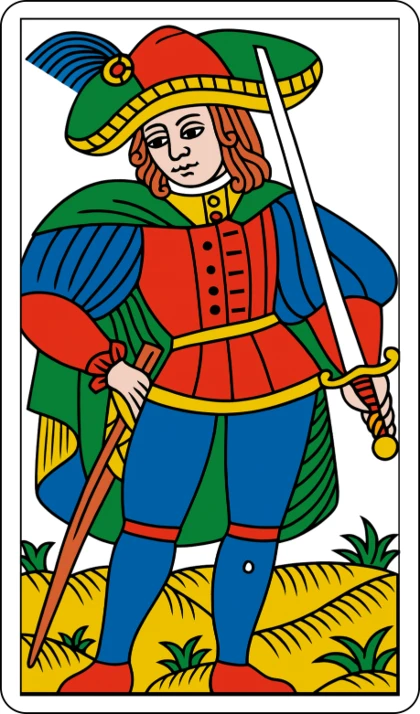
On the Burdel 1751 Marseille pattern, the card face shows a young man standing upright and facing forward. He wears a wide hat with a plume. In one hand he holds a sword raised vertically; in the other hand he holds a second blade lowered toward the ground. The ground beneath him is yellow, with a few tufts of grass. The card carries no printed legend and no numeral.
This is one of the sixteen honors of the Marseille Tarot, the only minor cards that bear a human figure. The forty numbered minors are purely ornamental, repeating their suit symbol among leaves and flowers. Here, the person is the whole image. The two swords, one up and one down, are the only objects that matter.
What the Card Signifies
The Page of Swords does not depict a battle or a finished decision. It shows a mind holding two positions at once. The raised sword is the idea being tested, the active thought. The lowered sword is the alternative kept in reserve, the unspoken observation. A person in this state is not yet committed to a single line. They are weighing two edges before choosing one.
The wide plumed hat suggests a young person still learning to wear authority. The yellow ground and sparse grass are bare but fertile, a training field rather than a battlefield. This card signifies a phase where a person builds the inner structure of a plan. It does not signify a promise of victory or defeat. It shows the need for rehearsal before action.
Because the Page is an honor, it can also point to a person, often a child or adolescent. But that is a secondary meaning. The core of the card is a mental posture: the careful, sometimes slow work of preparing a thought until it can stand on its own.
Upright
Upright, the Page of Swords points first to a phase of preparation. The person is not yet in the field. They are assembling the mental map, testing one idea against another. The raised sword is the plan being sharpened; the lowered sword is the fallback position. This is a time for planning and organization, not for final decisions.
The card also signifies mental elaboration and a necessary learning period. Intelligence here is not a flash of brilliance. It is the patient work of connecting details, checking assumptions, and building a sequence. A person may be studying, drafting, or rehearsing. The Page of Swords signifies a reward for those who accept that some things cannot be rushed.
As a person, the upright Page can designate a child or adolescent who is intelligent and gifted in studies. But the primary meaning remains the preparatory state itself: a mind that is organizing its own edge before it cuts.
Reversed
Reversed, the Page of Swords carries its own meaning, not the negation of the upright. It points to precipitation. The person moves before the plan is complete. One sword is grabbed too quickly; the other is forgotten. Speed replaces structure. This is not preparation blocked. It is a distinct state where haste becomes the method.
The reversed card also signifies inorganization and a lack of reflection. The person may skip the learning period, dismiss details, or act on a half-formed idea. Cultural and intellectual gaps appear not as a fixed trait but as a consequence of rushing. The mind wants to arrive before it has walked.
As a person, the reversed Page can designate a child or adolescent who is irregular or struggling in school. But that is secondary. The core meaning stands alone: a state of wanting to go too fast, where the goal is undermined by the very speed used to reach it.
What Nuances This Reading
A single card never makes a reading. Its position in a spread frames time and context. Surrounding cards color the meaning. Next to a numbered Sword card, the Page may show the mental work behind a specific number. Next to a major arcana, it may show how a larger force is being prepared for or rushed. The question asked also matters. A question about work reads the preparation as professional planning; a question about relationship reads it as emotional or communicative rehearsal. Without a spread, the Page of Swords remains a general signifier of mental posture, not a prediction.
Frequently Asked Questions
Does the Page of Swords mean a literal young person?
It can, but only as a secondary meaning. The primary meaning is a state of preparation or haste, depending on orientation. When it does point to a person, it is often a child or adolescent with qualities of intelligence or academic difficulty.
Is the reversed Page of Swords just the upright blocked?
No. In the Marseille Tarot, reversed is an independent meaning. Upright carries preparation; reversed carries precipitation. They are two distinct postures, not one energy frustrated.
What is the difference between the Page of Swords and the Knight of Swords?
The Page holds two blades, one raised and one lowered, showing a mind still weighing options. The Knight is mounted and in motion, showing a more committed direction. The Page is earlier in the learning curve.
Does this card predict a specific event?
No card predicts by itself. The Page of Swords signifies a mental state or phase. Only a spread position can suggest timing or outcome, and this page describes no spread.