Two of Batons: The Crossed Staves of Measured Thought
In brief
- Ponderation is the core strength here: you weigh the situation with rational analysis and common sense, keeping impulses in check.
- This intellectual calm draws a benevolent circle around you, so you can rely on supportive friends and positive contacts.
- The central tension is that control can become a rigid restraint, turning analysis into a cold barrier that keeps the same supportive circle at a distance.
- Hold the paradox: the pondering that protects you becomes a cold wall if you analyze instead of feeling, so the pause must keep the mind open to others.
Contents
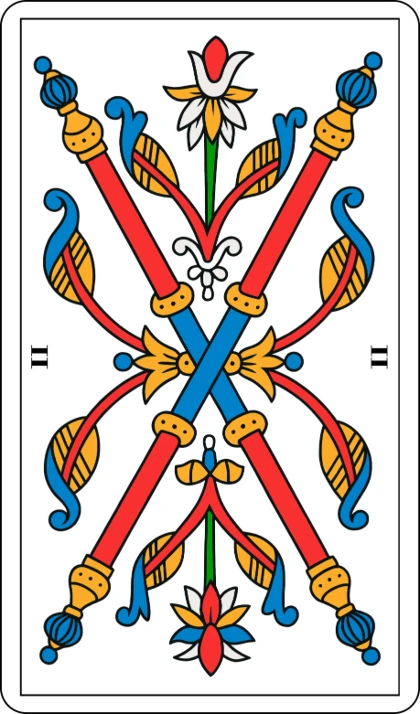
The Two of Batons is a minor numeral of the Batons suit in the Marseille Tarot. It shows two crossed batons framed by palms and scrolls, with no person and no scene. Upright, it signifies ponderation, intellectual richness, and rational analysis; reversed, it signifies a ponderation that closes into restraint and distance.
| Suit | What it covers | Cards | Symmetrical plates |
|---|---|---|---|
| Batons | feeling, mood and the quality of emotions | 14 | 9 |
| Cups | affective life and matters of the heart | 14 | 0 |
| Swords | working life and the field of activity | 14 | 2 |
| Coins | material life and money matters | 14 | 7 |
| Total | 56 | 18 |
This axis is not the Golden Dawn's elemental grid: this school places feeling on the batons and working life on the swords.
La planche
On the card, two upright batons with thickened ends cross each other in a spindle shape at the center. Palms and scrolls fill the sides, and the numeral II is printed laterally on both edges. There is no figure, no landscape, no action. The whole design is symmetrical: if you place the card on the table, nothing on its face tells you which end is up. This symmetry is a fact of the drawing, not a flaw. The card carries both orientations equally, and neither side of the table changes what is printed.
Ce que dit la lame
The Two of Batons speaks of a crossing point. Two separate staves meet and hold each other in a single frame, and the person who draws this card is often in a position of weighing two forces, two options, or two sides of a question. The crossing is not a collision; it is a knot, a point of contact that can be held or tightened. The palms and scrolls around the batons are ornamental, not narrative. They do not show a story; they frame the crossing with a sense of order and cultivation. This card is not about raw action. It is about the quality of attention a person brings to a situation.
Because the numeral is II, the card carries the weight of duality. One baton alone would be a single impulse. Two batons crossed show that the person is not acting on a single impulse. The person holds two things in relation: thought and feeling, self and other, plan and hesitation. The card does not say which one wins. It says the person is capable of holding both without letting either run away. That capacity is the heart of the card’s meaning.
The absence of any person on the card matters. In the Marseille Tarot, the minor numerals are ornamental, not illustrated scenes. The Two of Batons does not show a man looking out from a castle wall or holding a globe. It shows only the two staves and their frame. This means the card does not describe an event that happens to someone. It describes a stance, a way of standing in relation to a question. The person who draws this card is the one who does the weighing, the holding, the crossing.
À l’endroit
Upright, the Two of Batons signifies ponderation. The person weighs before acting. The crossed staves show two impulses held in a single frame, and the person does not let either one take over. This is not hesitation; it is a deliberate pause. The person considers the situation calmly and rationally, without yielding to impulse. The card points to a mind that can hold a question open long enough to see it clearly.
This ponderation is not empty. It carries intellectual richness and a good sense of analysis. The person is not just waiting; the person is thinking, comparing, sorting. The palms and scrolls on the card suggest refinement, a mind that has been cultivated and can use that cultivation in the moment. The card is favorable to reflection, to study, to any situation where a clear head matters more than a quick hand.
The upright Two of Batons also speaks of emotional control. The person does not let feelings dictate the next move. This is not coldness; it is the ability to feel and still think. Because of this, the card is favorable to friendships and contacts. The person can count on others, and is often surrounded by benevolent, positive people. The crossing of the two staves can be read as a meeting of two people, two minds, two wills, held in mutual respect.
À l’envers
Reversed, the Two of Batons does not become impulsiveness or chaos. It is not the opposite of ponderation. It is ponderation that closes. The same crossing of two staves now shows a knot pulled too tight. The person still weighs, still analyzes, still holds back, but the holding back becomes an end in itself. The pause becomes a wall.
In this orientation, control turns into restraint. The person analyzes instead of feeling. The mind keeps working, but it works in a loop, turning the same question over without ever stepping into it. The benevolent entourage that the upright card points to is still there, but the person keeps it at a distance. The crossed staves, which upright could mean a meeting, now mean a barrier. The palms and scrolls, which upright suggested cultivated exchange, now suggest formality, decorum, a fence around the self.
This is not a failure of thought. It is thought used as a shield. The person may be surrounded by well-meaning people, but the card reversed shows that the person does not let them in. The ponderation has become a closed loop, a way of staying safe by staying outside the crossing. The card does not say the person is wrong. It says the person is holding the two staves so tightly that no third thing can enter.
Ce qui nuance cette lecture
A single card never makes a spread. The Two of Batons takes its full meaning from where it falls and what surrounds it. In a position about the past, the upright card may point to a period of careful weighing that has already happened. In a position about an obstacle, the reversed card may point to a restraint that is currently keeping the person from moving. The surrounding cards also matter. If the Two of Batons sits next to active, fiery cards, its ponderation may be a pause before action. If it sits next to passive, watery cards, its ponderation may be a retreat. The question asked shapes the reading too. In a question about relationship, the upright card often points to a balanced friendship or a contact built on mutual respect. In a question about work, it points to careful analysis and a clear plan. The reversed card shifts accordingly: in relationship, it may point to a person who keeps others at arm’s length; in work, to overthinking that prevents a decision. None of this is fixed until the card is placed in a real spread.
Questions fréquentes
Does the Two of Batons show a person or a scene?
No. The Marseille minor numerals are ornamental. This card shows only two crossed batons, palms, scrolls, and the numeral II. There is no figure, no landscape, no action. Any image of a person on a Two of Wands comes from a different deck, not from the Marseille Tarot.
Is the reversed Two of Batons the opposite of the upright?
No. The reversed card is not impulsiveness or chaos. It is a distinct meaning: ponderation that closes, control that becomes restraint, analysis that replaces feeling. The person still weighs, but the weighing becomes a barrier instead of a meeting point.
Can this card predict a specific event or a date?
No. A card is timeless. The Two of Batons does not say when something will happen or how long it will last. Only a position in a spread can give a time frame, and this page describes no spread.
What is the difference between the Two of Batons and the Two of Wands in the Rider-Waite deck?
The Rider-Waite Two of Wands shows a man holding a globe and looking out from a castle wall. The Marseille Two of Batons shows no person and no scene. The Marseille numeral is purely ornamental, and its meaning comes from the crossing of the two staves, not from an illustrated story.