Four of Batons: The Quiet Architecture of Self-Possession
In brief
- Self-mastery is the core of this card: you can face any situation without being swept away by emotion or anxiety.
- The central tension is between genuine calm and rigid control: the same strength that steadies you can also lock you down.
- Upright, this is a quiet stability, a sense that nothing serious can happen to you, and a clear decision made from that security.
- Reversed, the mastery becomes a clamp: calm held at arm’s length, the decision postponed, and your strength used to let nothing pass.
- This card signifies your capacity to hold your own center, and the real question is whether that hold is a foundation or a cage.
Contents
The Four of Batons is a minor numeral of the Marseille Tarot whose four interlaced batons and lateral IIII speak to a person’s capacity for calm self-command. Upright, it points to mastery, stability of mood, and the ability to choose without being swept away. Reversed, it points to mastery hardened into a lock, where calm is held at arm’s length and decisions are postponed.
| Suit | What it covers | Cards | Symmetrical plates |
|---|---|---|---|
| Batons | feeling, mood and the quality of emotions | 14 | 9 |
| Cups | affective life and matters of the heart | 14 | 0 |
| Swords | working life and the field of activity | 14 | 2 |
| Coins | material life and money matters | 14 | 7 |
| Total | 56 | 18 |
This axis is not the Golden Dawn's elemental grid: this school places feeling on the batons and working life on the swords.
La planche
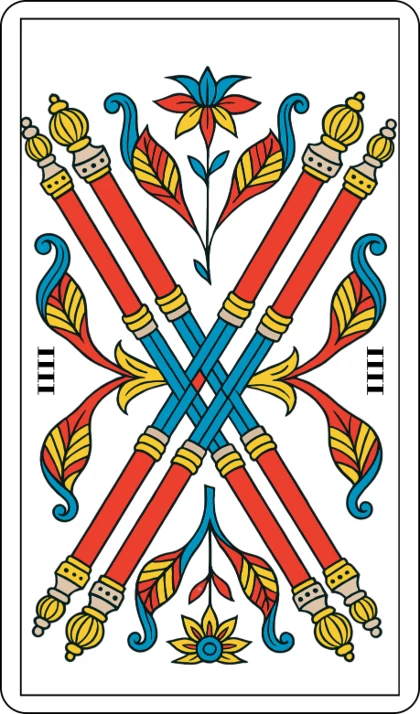
The Four of Batons is a minor numeral from the suit of Batons, one of the forty rank cards in the 78-card Marseille Tarot. On the card, four straight batons with swollen ends cross one another in the center, forming a tight spindle. Palms and scrollwork fill the side spaces. The numeral IIII is printed laterally on both sides, in the additive form. There is no person, no scene, no landscape. The whole composition is symmetrical: if you place the card on the table, nothing in the drawing tells you which end is up. That symmetry is a fact of the image, not a flaw, and it does not remove the card’s two orientations.
Ce que dit la lame
The interlaced batons create a central point where four lines meet and hold. This visual speaks to a person’s capacity to gather their forces into a stable inner structure. The card does not show an external event; it points to a quality of self-containment. The absence of any figure places the entire weight on the person’s own stance. The palms and scrollwork are ornamental, not narrative: they frame the central node without telling a story. In the Marseille system, numeral cards are ornamental by design, so this card does not depict a celebration or any scene from daily life.
The number four, repeated as IIII on both sides, carries a sense of completion within the suit. It is not the explosive start of the Ace, nor the crowded multiplicity of the Ten. It is a point of consolidation. The person who embodies this card has built something inside themselves that can hold. That something is not a wall against the world, but a center from which they can act without being thrown off course. The card’s symmetry reinforces this: the structure is self-supporting, balanced from any angle.
À l’endroit
Upright, the Four of Batons points first to mastery. This is not domination over others, but command over oneself. A person in this register can face what comes without being swept away by emotion. They do not deny what they feel; they simply do not let feeling decide for them. This mastery shows up as stability of mood and mental quietude. The person does not swing between extremes. They can sit with uncertainty without giving in to anxiety.
There is a sense of security here, but it is not a promise that nothing bad will happen. It is the inner certainty that the person can handle what happens. The upright Four of Batons also points to decision-making. Because the person is not at the mercy of their emotions, they can make a choice and stand by it. The four batons meet at a single center, like several lines converging on one point. That convergence is the act of choosing: gathering scattered impulses into a single direction. The strength of character here is quiet, not loud.
À l’envers
Reversed, the Four of Batons does not mean the absence of mastery. It means mastery that has turned into a lock. The same interlaced structure now reads as a knot pulled too tight. The person still holds themselves together, but the holding has become rigid. Calm is maintained at arm’s length, as if any loosening would cause collapse. This is not weakness; it is strength used to keep everything out.
In this orientation, the decision is postponed. The person has the capacity to choose, but they use that capacity to avoid choosing. They may gather information, weigh options, and hold the tension, yet refuse to let the knot close. The symmetry of the card becomes a kind of frozen balance: nothing moves, nothing resolves. The reversed Four of Batons also points to a strength of character that serves to let nothing pass. The person may be admired for their composure, but that composure costs them. They hold their breath, so to speak, and call it calm.
Ce qui nuance cette lecture
A single card never makes a reading. The Four of Batons takes its full meaning from the position it occupies in a spread and from the cards around it. If the position frames a past, present, or future, that position carries the temporal weight; the card itself remains intemporal. Surrounding cards shift the emphasis: next to other Batons, will and action sharpen; next to Cups, emotional cost becomes visible; next to Swords, mental tension comes forward; next to Coins, material security dominates. The question asked matters too: a relationship question reads the reversed card as guardedness, a project question as postponed decision. None of this is fixed by the card alone.
Questions fréquentes
Does the Four of Batons predict a celebration or a happy event?
No. In the Marseille Tarot, numeral cards are ornamental, not narrative. This card shows four interlaced batons and scrollwork, no people, no feast, no scene. It points to an inner stance of mastery, not to an external event.
Is the reversed Four of Batons just the upright meaning blocked?
No. The reversed orientation carries its own meaning. It points to mastery that has become a lock, calm held at arm’s length, and a decision postponed. It is not a failed version of the upright; it is a distinct register of self-control.
Why does the card have no person or scene?
Marseille numeral cards show only the suit repeated as many times as the rank, surrounded by ornament. The Four of Batons therefore shows four batons, palms, and scrollwork, and nothing else. The absence of a figure keeps the focus on the person’s own inner structure.