Le Cinq de Bâton: Contentment Woven from Five Crossed Staves
In brief
- The Five of Batons signifies a concrete harvest that follows a step you have already begun, so the contentment is a result of your own prior work, not a gift.
- The central tension lies in your variable moods, where your highs and lows are both a strength for adaptation and a source of instability, and this paradox is the card’s core.
- When reversed, the card means a delayed reward, not a lost one, and your own emotional swings take precedence, making the expected outcome wait longer.
- The guiding line is to hold confidence and flexibility as one, the card asks you to accept that your assurance and your changeable nature are the same thing, without dissolving the tension.
Contents
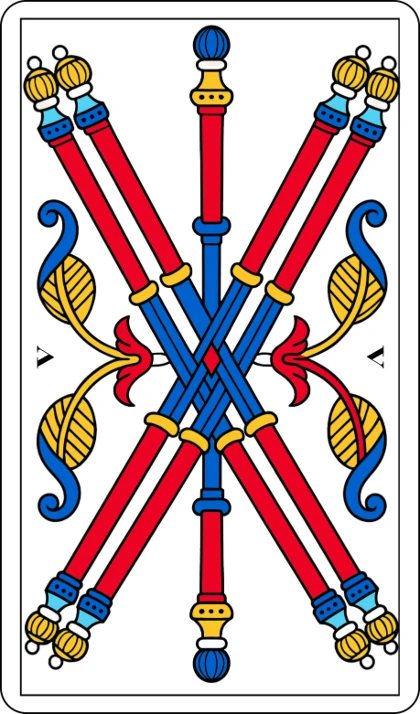
Le Cinq de Bâton is a numeral card of the Batons suit in the Marseille Tarot. It shows five straight staves interlaced in a spindle at the center, with palms and scrollwork on the sides, and the numeral V printed laterally on both sides. Upright, it signifies contentment that follows work already undertaken; reversed, it signifies contentment deferred, the harvest late.
| Suit | What it covers | Cards | Symmetrical plates |
|---|---|---|---|
| Batons | feeling, mood and the quality of emotions | 14 | 9 |
| Cups | affective life and matters of the heart | 14 | 0 |
| Swords | working life and the field of activity | 14 | 2 |
| Coins | material life and money matters | 14 | 7 |
| Total | 56 | 18 |
This axis is not the Golden Dawn's elemental grid: this school places feeling on the batons and working life on the swords.
The card
Five straight batons with swollen ends cross each other in a spindle at the center of the card. They are interlaced, each one passing over and under the others, creating a woven knot where all five meet at a single point. Palms and scrollwork frame the sides, purely ornamental. The numeral V is printed laterally on both sides, in its additive Roman form. No person, no scene, no decor. The card is perfectly symmetrical: laid on the table, nothing on the card says which side it rests on. This is a fact of the drawing, and it means the card carries its two meanings equally, neither one more true than the other.
What the card says
Le Cinq de Bâton signifies a specific texture of experience: the moment when effort begins to show its fruit, but with a particular instability. The five batons crossed in the center create a spindle, a woven knot where different strands converge. This is not a card of simple arrival. It is a card of convergence, of multiple threads coming together at a single point. The number five sits at the midpoint of the ten numerals, and this midpoint is not a resting place. It is a crossing, a place where things meet and pass through each other.
The contentment this card signifies is not a flat, stable satisfaction. It carries within it the memory of the work that produced it, and it carries the anticipation of what comes next. The card signifies a phase where motion begins to concretize, but this concretization is not automatic.
Upright
Upright, Le Cinq de Bâton signifies contentment. This is the first and most important meaning. It is a specific kind of contentment: it comes after work already undertaken. It is not a windfall or a surprise. It is the fruit of a process already begun. The card signifies a harvest period, a phase of concretization where what was set in motion earlier now begins to take shape.
Reversed
Reversed, Le Cinq de Bâton is not the negation of the upright. It is a distinct meaning, with its own texture. The contentment is deferred. The harvest is late. What was expected keeps being awaited. This is not failure; it is a different experience of time. In this orientation, the fruit of work has not yet appeared, and the waiting itself becomes the dominant experience.
The deferral is not a punishment; it is simply a different phase, one where waiting continues without a set end.
What nuances this reading
A card does not make a spread. Le Cinq de Bâton, like any card, takes its full meaning from its position in a spread, the cards that surround it, and the question that was asked. A card in a position that speaks of the past will not mean the same thing as the same card in a position that speaks of the future. The cards that surround it can sharpen or soften its meaning. And the question asked frames everything: Le Cinq de Bâton drawn in answer to a question about work will not speak the same way as the same card drawn in answer to a question about a relationship. None of this can be known from the card alone.
Frequently asked questions
Upright Le Cinq de Bâton and success
Upright, Le Cinq de Bâton signifies contentment and success foreseen or expected following work already undertaken. It signifies a harvest period, but it does not guarantee an outcome. The card signifies a phase, not a verdict.
Difference between upright and reversed
Upright, Le Cinq de Bâton signifies contentment that follows work already undertaken. Reversed, it signifies contentment deferred, the harvest late. The two orientations are independent meanings, not opposites.
Symmetry of the card
Le Cinq de Bâton is a symmetrical card. Five straight batons interlaced in a spindle, with palms and scrollwork on the sides, and the numeral V printed laterally on both sides. Nothing on the card indicates which side is up. This symmetry is a fact of the drawing, and it means the card carries its two meanings equally.
No specific time frame
No. A card is timeless. Only a position in a spread can frame time, and this page describes no spread. Le Cinq de Bâton signifies a phase of experience, not a duration.