Valet de Bâton: The Young Figure of Unrealized Fire
In brief
- This card shows a person with real ambition and genuine talent, yet they never turn that inner fire into concrete action.
- The central tension is simple: the potential is absolutely real, but the realization is completely absent, so nothing gets built.
- Upright, the person is capable, creative, and willful, but they need a deep inner shift before anything can actually evolve.
- Reversed, the same energy turns into megalomania and self-delusion, the person dreams big, lies to themselves, and produces nothing constructive.
- In both orientations, the message is identical: potential without action is just a fantasy, and the only way forward is to change from within.
Contents
The Valet de Bâton is a court card in the suit of Bâtons, one of the sixteen figured honors in the Marseille Tarot. Upright, it signifies ambition and great inner potential that has not yet been put into motion. Reversed, it signifies megalomania and self illusion without any constructive action.
| Suit | What it covers | Cards | Symmetrical plates |
|---|---|---|---|
| Batons | feeling, mood and the quality of emotions | 14 | 9 |
| Cups | affective life and matters of the heart | 14 | 0 |
| Swords | working life and the field of activity | 14 | 2 |
| Coins | material life and money matters | 14 | 7 |
| Total | 56 | 18 |
This axis is not the Golden Dawn's elemental grid: this school places feeling on the batons and working life on the swords.
The Card Face
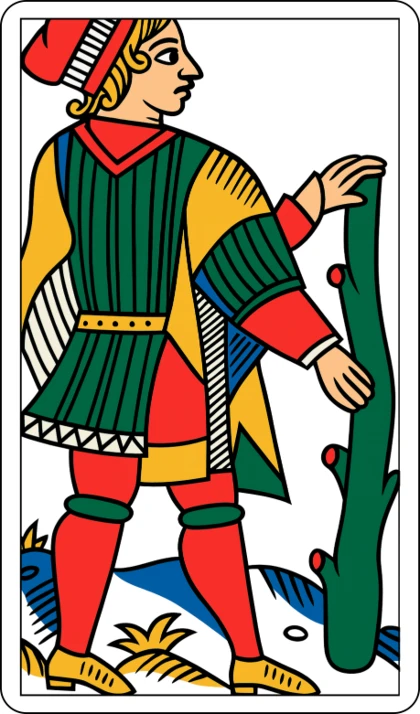
On the Marseille card, a young man stands alone. He is seen from the back and turned in profile, wearing a green tunic, red hose, and a red cap. With both hands he holds a long green baton planted vertically in the ground. The baton still shows its cut branches as small protruding stubs. The card carries no legend and no numeral, as is proper for an honor among the sixteen figures of the deck.
What the Card Says
The Valet de Bâton shows a person who possesses a living tool but does not swing it. The baton is rooted, not raised. The cut branches are raw, unshaped, full of sap but not yet turned into a finished instrument. This is the core of the card: a tension between what is held and what is done. The figure’s back turned to the viewer suggests an inward focus, a potential that has not yet faced the world.
This card does not describe failure. It describes a state of readiness that has not found its outlet. The person has the means, the fire, the raw material, but the posture remains static. The necessity is not to acquire more ability but to shift from holding the baton to moving with it. That shift is an inner one, not a matter of external circumstance.
Upright
In the upright orientation, the Valet de Bâton signifies ambition as a living force. The person carries great potentialities: inner qualities, talent, creative fire, even genius. These are not small gifts; they are substantial and real. Yet the card also shows that nothing has been realized. The baton remains planted. The ambition is present, but it has not been tested in the world. This is a card of latency, not of lack. The necessary step is an inner change, a shift in posture from holding to acting. Without that change, the potential stays dormant. When the card designates a person, it often signifies a child or adolescent who is capable, creative, and willful, someone whose gifts are obvious but whose path is still unformed.
Reversed
Reversed, the Valet de Bâton carries its own meaning, not the opposite of the upright. Here the axis is megalomania. The person tends to lie, to dream, and to fall into self illusion. There is a delusion of grandeur that inflates the self without any corresponding act. The baton is still planted, but now the person believes it is already a scepter. There is a total absence of constructive action. The reversed Valet de Bâton can designate a child or adolescent who is uncomfortable in their own skin, dreamy and inhibited, lost in fantasies that replace real movement.
What Nuances This Reading
A single card never determines a reading. The Valet de Bâton shifts meaning according to its position in a spread, the cards around it, and the question asked. If it appears near cards of action or realization, the gap between potential and movement may be closing. If it appears near cards of stagnation or confusion, the gap widens. The question frames whether the figure is the querent, another person, or a quality to cultivate. The card itself carries no time frame; only the position in a spread can suggest when or where the potential might unfold. Surrounding cards can show whether the baton is about to be lifted or remains a decorative prop.
Frequently Asked Questions
Is the Valet de Bâton always a young person?
Not always. As an honor, it can designate a child or adolescent, but it can also describe a quality in anyone: a state of unformed potential or a tendency to dream without acting. The age is less important than the posture.
What does the planted baton mean?
The baton is rooted in the ground, not raised or swung. It shows that the energy is present but not yet directed. The cut branches are raw, unrefined, full of life but not shaped into a tool. The person holds it with both hands, suggesting attachment but not movement.
How is the reversed Valet de Bâton different from the upright Valet de Bâton?
Upright, the card signifies real potential that has not been realized. Reversed, it signifies a false sense of greatness that replaces action. The reversed meaning is not the absence of potential; it is the inflation of the self through lies, dreams, and delusions of grandeur.
Does this card predict success?
No card predicts an outcome by itself. The Valet de Bâton shows a condition: ambition and talent that need inner change to become effective. Whether that change happens depends on the whole reading, not on this card alone.