Le Huit de Bâton: A Woven Cage of Dreams
In brief
- This card’s core is a dream that replaces reality: you take your desires for facts, and this leads to total passivity, apathy, and a refusal to act.
- The central tension is a paradox: the dream is a refuge, but when it turns over, the refuge becomes a prison, you know you are passive yet nothing moves, and unreality stops protecting you.
- You are the one who fails to assume responsibilities, lost in an irrational belief, a spirituality without any foundation, not the card acting upon you.
- The specific angle here is not about movement or speed, it is about the paralysis of idealism, a utopia that keeps you from seeing the ground under your feet.
Contents
Le Huit de Bâton is a numeral card of the Batons suit in the Marseille Tarot. Upright, it signifies illusion: a mind that has lost its grip on the ground. Reversed, it signifies an illusion that no longer protects, a dream that has stopped soothing without offering a way out.
| Suit | What it covers | Cards | Symmetrical plates |
|---|---|---|---|
| Batons | feeling, mood and the quality of emotions | 14 | 9 |
| Cups | affective life and matters of the heart | 14 | 0 |
| Swords | working life and the field of activity | 14 | 2 |
| Coins | material life and money matters | 14 | 7 |
| Total | 56 | 18 |
This axis is not the Golden Dawn's elemental grid: this school places feeling on the batons and working life on the swords.
The Card
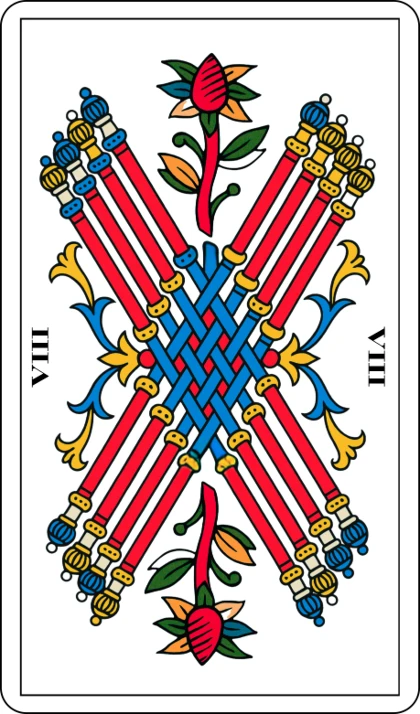
Eight straight batons with swollen ends interlace in a spindle shape at the center of the card. Palms and scrollwork frame the sides. The numeral VIII is printed laterally on both sides. No figures, no scenes, no decor. The card is perfectly symmetrical: laid on the table, nothing on it says which way it rests.
What the Card Says
The interlaced batons form a closed structure, a woven pattern that is beautiful but sealed. Each baton crosses the others, creating a lattice that holds itself together. This is the geometry of a mind that has built its own architecture and lives inside it. The symmetry is not accidental: it shows a world that mirrors itself, a loop that feeds on its own reflections.
Le Huit de Bâton describes the relationship between inner vision and outer reality. The batons are all identical, all pointing inward, all part of the same weave. Nothing enters from outside. Nothing leaves. The card shows a self-contained system, a pattern that is complete in itself and shows no need for the world beyond its edges.
Upright
Upright, Le Huit de Bâton signifies the axis of illusion. The person loses their sense of reality. Idealism becomes excessive, a nature inclined to utopia, to dream, to taking desires for realities. The woven pattern of the batons is not a prison here; it is a refuge. The person lives inside the weave and does not know it is a weave.
This is a state of total passivity. Nothing gets accomplished. The person does not act, does not build, does not move. Apathy and laziness settle in. The person lets themselves go, drifting through days that have no edges. The card shows a spirituality without foundation, a belief without grounding. The person believes completely, irrationally, without asking what the belief rests on.
The person does not assume their responsibilities. Lost in dreams, without awareness of reality, they float. Le Huit de Bâton upright is not a card of action; it is a card of absence from action. The person is elsewhere, inside the woven pattern, and the world outside goes on without them.
Reversed
Reversed, Le Huit de Bâton signifies the axis of illusion without refuge. The illusion turns back on itself. The dream no longer soothes. The person knows they are passive, knows they are lost, and nothing moves. This is not the opposite of the upright meaning; it is a different state entirely.
The woven pattern is still there, but it no longer feels like a refuge. The person sees the weave for what it is and cannot leave it. Unreality ceases to protect. The dream that once comforted now feels like a weight. The person is aware of their own passivity, aware of the gap between what they dream and what they do, and this awareness changes nothing.
Le Huit de Bâton reversed shows a person who has woken up inside the dream and found the dream still there. The illusion no longer works, but it has not released its hold. The person is caught between knowing and doing, between seeing the pattern and stepping out of it. This is a card of lucid paralysis, of a clarity that does not lead to movement.
What Nuances This Reading
Le Huit de Bâton is a symmetrical numeral card. Its upright and reversed meanings are two independent axes, not opposites. The card shows a closed, woven pattern; nothing on the card indicates which way it rests.
Frequently Asked Questions
Is Le Huit de Bâton a bad card?
No card is good or bad. Le Huit de Bâton describes a state of illusion or of illusion that has stopped protecting. Whether that state is painful or comfortable depends on the person and the question. The card does not judge; it shows.
Does Le Huit de Bâton reversed mean the illusion is ending?
Not necessarily. Le Huit de Bâton reversed shows an illusion that no longer soothes, but it does not show the illusion ending. The person may remain caught in the pattern. The card describes a state, not a timeline.
Why is the card symmetrical?
The symmetry is a fact of the drawing. It shows a self-contained pattern, a world that mirrors itself. The card has both its meanings equally, and nothing on the card says which way it rests.
Can Le Huit de Bâton indicate creativity?
The woven pattern of the batons can suggest a creative mind, but the card’s emphasis is on the gap between inner vision and outer reality. Creativity that stays inside the weave, that never becomes action, is closer to what this card describes.