Six of Batons: The Crossed Staves of Inner Confusion
In brief
- The person this card represents is caught in a whirlwind of inner disorder, with too many thoughts and too many tasks piling up at once.
- This inner chaos is the source of their creative genius, a fertile ground for inventors, artists, and dreamers.
- The central tension is that this same richness becomes a trap, because paralyzing doubts and sterile loops slow down every step forward.
- When reversed, the confusion closes, the dispersion turns into inertia, and the inner wealth finds no outlet to the outside world.
- The person must hold the paradox: their inner chaos is both their greatest resource and their biggest obstacle, and only they can choose to let it flow.
Contents
- The Card Face
- What the Card Signifies
- Upright
- Reversed
- What Nuances This Reading
- Frequently Asked Questions
The Six of Batons is a minor numeral card from the Batons suit in the Marseille Tarot. Its face shows six staves crossed in a central spindle, with no person and no scene, and it carries two independent meanings: upright, it points to mental confusion and creative dispersion; reversed, it points to a closed confusion that turns into inertia.
| Suit | What it covers | Cards | Symmetrical plates |
|---|---|---|---|
| Batons | feeling, mood and the quality of emotions | 14 | 9 |
| Cups | affective life and matters of the heart | 14 | 0 |
| Swords | working life and the field of activity | 14 | 2 |
| Coins | material life and money matters | 14 | 7 |
| Total | 56 | 18 |
This axis is not the Golden Dawn's elemental grid: this school places feeling on the batons and working life on the swords.
The Card Face
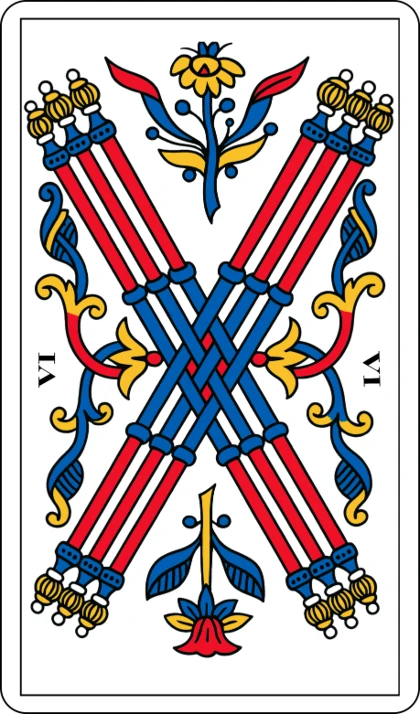
On the Marseille plate, the Six of Batons shows six straight staves with thickened ends, interlaced in a tight fuse or spindle shape at the center of the card. Palm fronds and scrollwork fill the side spaces. The numeral VI is printed laterally, on both the left and right edges. There is no human figure, no animal, no landscape, and no narrative element. The design is perfectly symmetrical: if you place the card on a table, nothing on its face tells you which way it lies. This is a fact of the drawing, not a flaw. The card still carries both orientations, each with its own meaning. As a numeral card, it belongs to the ornamental series of the minor arcana: it repeats its suit symbol six times, surrounded by decorative foliage, and nothing else.
What the Card Signifies
The Six of Batons is a card of mental entanglement. The six staves cross at the center, each one a line of thought, a task, or an impulse, and together they form a dense knot. No hand reaches in to untangle them, no figure chooses one stave over another. That absence is meaningful: the confusion this card points to is not imposed from outside. It is generated by the person’s own inner multiplicity. Too many possibilities, ideas, or obligations occupy the same space at once. The person may feel rich in inner material but unable to sort it. The card does not predict an event; it describes a quality of mind. The symmetrical design reinforces that this state has no clear beginning or end, no single point of entry. It is a condition, not a story.
Because the card shows only crossed staves and no scene, its meaning stays close to the person’s internal world. The six batons are not weapons or tools in action; they are lines of force that have become tangled. The card speaks of a mind that cannot settle, a heart pulled in several directions, or a schedule overloaded with unfinished starts. The confusion is real, but it is also a sign of abundance: there is too much, not too little. That abundance can be a gift or a burden, depending on how the person meets it.
Upright
In the upright orientation, the Six of Batons signifies confusion as a living, active state. The person experiences mental disorder, a crowded inner landscape. They may think too much, start too many things, or hold too many conflicting emotions at once. This leads to a lack of organization and a sense of dispersion. Projects develop slowly, not because of external obstacles, but because internal doubts paralyze and make effort sterile. The person is prey to their emotions, tossed between impulses and unable to choose a single direction.
Yet this same inner richness is also a source of creative genius. The torn nature, the inability to settle on one line, can produce original connections and inventive leaps. The card is favorable to creators, inventors, and artists, because their best work often comes from a mind that cannot stay still. The confusion is not a failure; it is the raw material of a fertile but unmanaged inner life. The upright Six of Batons does not promise a clean resolution. It shows a state where the person must learn to work with the tangle rather than against it.
Reversed
In the reversed orientation, the Six of Batons signifies a confusion that has closed in on itself. The dispersion does not spread outward; it collapses into inertia. The inner richness no longer finds any outlet. The person turns inside their own disorder, circling the same thoughts without resolution. What was once a creative tangle becomes a stagnant knot. The six staves, still crossed, now suggest a locked structure rather than a dynamic one. The person may feel stuck, unable to move from thought to action, trapped in a loop of overanalysis.
This is not the opposite of the upright meaning. It is a distinct state where the confusion has become a closed system. The energy that could have been creative is now spent on maintaining the disorder itself. The person may replay the same doubts, revisit the same half-finished plans, and find no exit. The reversed Six of Batons points to a need to break the internal symmetry, to introduce an outside element, but it does not say how or when. It simply names the condition: a rich inner world that has turned into a prison of its own making.
What Nuances This Reading
A single card never makes a reading. The meaning of the Six of Batons shifts depending on its position in a spread, the cards around it, and the question asked. In a position about the past, it may describe a period of mental clutter that has already passed. In a position about obstacles, it may point to the person’s own disorganization as the main block. If surrounded by other Batons cards, the theme of action and projects is reinforced. If surrounded by Cups, the confusion may be more emotional than practical. The question also matters: asked about a creative project, the upright Six of Batons can be a strong sign of inventive potential. Asked about a decision, it warns against overthinking. The card does not set a timeframe; only the position in a spread can indicate when or for how long. No card acts alone, and this one especially needs context because its symmetry offers no direction on its own.
Frequently Asked Questions
Does the Six of Batons predict a specific event?
No. It describes a state of mind, not an external occurrence. It points to confusion, dispersion, or creative richness, but it does not foretell a particular incident.
Is the reversed Six of Batons just the upright meaning blocked?
No. The reversed orientation carries its own independent meaning: closed confusion and inertia. It is not a negation of the upright, but a different condition where inner richness finds no outlet.
Why does the card have no person on it?
Because it is a numeral card in the Marseille Tarot. Numeral cards show only their suit symbol repeated as many times as the rank, surrounded by ornamental scrollwork. They do not depict scenes or figures.
Can the Six of Batons indicate creativity?
Yes, especially upright. It points to creative genius born from inner turmoil, favorable to artists, inventors, and anyone whose work depends on making unexpected connections.