Seven of Batons: The Marseille Card of Quiet Fulfilment
In brief
- The strength of this card is an inner balance and deep happiness that makes it one of the most beneficial minor cards, a state of being well in your own skin.
- The central tension is radiating outward versus holding inward: upright, the accomplishment flows into all domains, reversed, the same serenity stays a private treasure.
- The specific angle is the quality of your inner life, not external action, so the question is whether you let this peace be a lived experience or a guarded secret.
- The guiding line is that the accomplishment is always real, but the reversed position shows a happiness that does not let itself be inhabited, an equilibrium kept for yourself alone.
Contents
The Seven of Batons is a minor numeral of the Batons suit in the Marseille Tarot. Upright, it signifies a deep sense of accomplishment, inner balance, and happiness that is lived rather than performed. Reversed, it carries its own independent meaning: an accomplishment that remains held inward, present but not fully inhabited or shown.
| Suit | What it covers | Cards | Symmetrical plates |
|---|---|---|---|
| Batons | feeling, mood and the quality of emotions | 14 | 9 |
| Cups | affective life and matters of the heart | 14 | 0 |
| Swords | working life and the field of activity | 14 | 2 |
| Coins | material life and money matters | 14 | 7 |
| Total | 56 | 18 |
This axis is not the Golden Dawn's elemental grid: this school places feeling on the batons and working life on the swords.
The Card Face
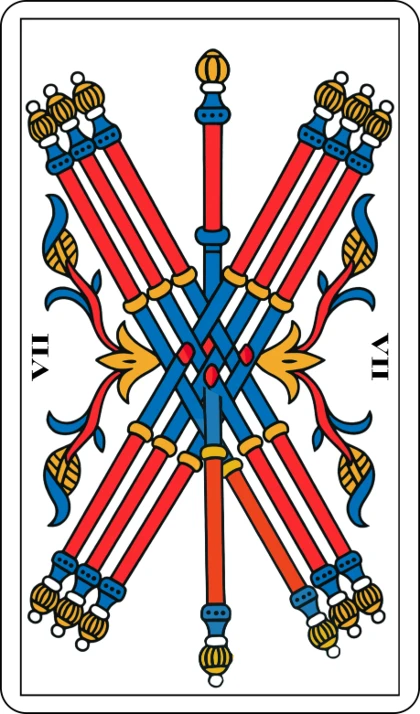
On the Marseille plate, seven straight batons with thickened ends cross in a central spindle or sheaf. Palm fronds and scrolling foliage fill the sides. The numeral VII is printed laterally on both sides, in its additive Roman form. There is no person, no scene, no landscape. The design is symmetrical: placed on a table, nothing on the card indicates which end is up. This symmetry does not erase the two orientations; it simply means the card carries both meanings without a visual cue.
What the Card Means
As a minor numeral, the Seven of Batons belongs to the fifty-six minor cards, of which forty are rank cards from one to ten. The full deck has seventy-eight cards, but the twenty-two majors do not enter this page. In Marseille minors, numerals are ornamental, not narrative. The card shows its suit repeated seven times, surrounded by rinceaux and flowers, and nothing else. Its meaning comes from number and suit, not from a depicted event.
Seven in Batons speaks of a point where effort has gathered into form. The crossed batons form a bundle, a convergence. This is not a card of struggle or defense; it is a card of gathered achievement. The person, not the card, may feel that their actions have aligned. The card signifies a state where inner and outer life are no longer at odds. It indicates a quiet fullness, not a loud victory. The batons are upright, not broken, not scattered. They cross at the center, suggesting that different drives or projects have found a common axis. The palm and rinceaux reinforce a sense of organic completion, like a harvest that has already been brought in. This card carries no promise of future success; it describes a present condition of realized balance.
Upright
Upright, the Seven of Batons signifies first happiness and realized success. The person is not chasing something; they are living from a place of completion. There is a sense of inner balance, a feeling of being comfortable in one’s own skin. This is not a card of external applause. It describes a person who is happy, wise, and serene, someone who flourishes in what they do and feels that their life is genuinely their own.
This inner realization supports rapid and positive evolution in many areas. Because the person is not fighting themselves, decisions come more cleanly, relationships feel less forced, and work carries a natural momentum. Among the minor cards, this is one of the most beneficial. Its quality is not loud; it is a settling. The accomplishment is real, but it is lived as ease rather than as strain.
As an accessory meaning, separate from the main axis, when a question explicitly concerns physical state, the card can be read alongside a context of recovery or strong vitality. It does not diagnose or predict; it simply sits beside a question of health as a sign of restored balance.
Reversed
Reversed, the Seven of Batons does not mean failure or the opposite of happiness. It carries its own axis: accomplishment held back. The happiness is present, but the person does not fully inhabit it. There is a real inner balance, yet it is kept private, almost guarded. The person may feel complete inside but show nothing of it outwardly. This is not blockage in the sense of something broken; it is a state where fulfilment remains interior.
The serenity exists, but it does not translate into visible ease. Others may see distance or reserve where the person actually feels a quiet fullness. The card indicates a gap between what is felt and what is expressed. The accomplishment is not lost; it is retained, held like a breath. This can be protective, even wise, but it also means the person may not let the happiness touch their daily life. With the reversed Seven of Batons, the question is whether that inner completion is being allowed to live, or only to be kept.
What Nuances This Reading
A card never makes a reading. Its position in a spread frames time and role. Surrounding cards modulate. The question asked changes emphasis. For example, in a question about work, upright indicates realized professional balance; in a question about inner life, it indicates self-acceptance. Reversed next to a card of expression may show a person who has the inner resource but does not show it; next to a card of solitude, it may show a chosen retreat. The same card can lean toward visible ease or quiet reserve depending on whether it sits in a past, present, or future position. No card acts alone. The Seven of Batons is not a promise of duration; only the spread position can suggest timing. This page describes the card’s own voice, not a particular reading.
Frequently Asked Questions
Does the Seven of Batons show a person defending themselves?
No. That image belongs to later illustrated decks. The Marseille numeral shows only seven crossed batons and ornament. The meaning here is accomplishment, not defense.
Is the reversed Seven of Batons the opposite of the upright?
No. In Marseille practice, reversed is an independent meaning. Here it is accomplishment retained, not failure or blocked happiness. It is its own axis.
Can this card predict a date or a duration?
No. A card is timeless. Only its position in a spread can suggest past, present, or future. This page describes no spread.
Does the Seven of Batons always mean good health?
No. Health is an accessory meaning, separate from the main axis. It can accompany a context of recovery or vitality when the question is explicitly about physical state, but it never replaces medical judgment.