Ten of Batons (Le Dix de Bâton): The Marseille Card of Renewal and Held Renewal
In brief
- You hold the inner clarity and the practical spirit to find the right solutions, which marks your exit from the tunnel.
- The central tension is that the renewal is clear, but the initiative to seize it is either entirely present or completely missing.
- When reversed, the clarity is there but it does not order anything, so you sense the rebirth without taking the step.
- Your sense of responsibility is strong, but the initiative is the only bridge between seeing the exit and actually walking through it.
Contents
The Ten of Batons is a minor numeral of the Marseille Tarot, from the suit of batons. Upright, it signifies renewal, practical clarity, and the capacity to take initiative. Reversed, it carries a distinct meaning: renewal sensed but not yet taken, a threshold where the exit is visible and the step is not made.
| Suit | What it covers | Cards | Symmetrical plates |
|---|---|---|---|
| Batons | feeling, mood and the quality of emotions | 14 | 9 |
| Cups | affective life and matters of the heart | 14 | 0 |
| Swords | working life and the field of activity | 14 | 2 |
| Coins | material life and money matters | 14 | 7 |
| Total | 56 | 18 |
This axis is not the Golden Dawn's elemental grid: this school places feeling on the batons and working life on the swords.
La planche
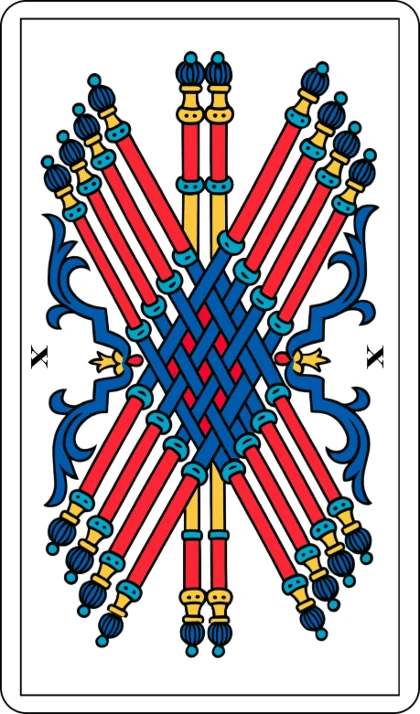
On the Marseille card, ten upright batons with swollen ends are interlaced in a spindle at the center. Palms and scrollwork frame the sides. The numeral X is printed laterally, on both sides. No person, no scene, no decor. The card is symmetrical: laid on the table, nothing indicates which side is up. This is a fact of drawing, and it does not weaken the card; it carries its two meanings like any other.
Like all Marseille numerals, this card is ornamental. It shows its suit repeated ten times, surrounded by scrolls and flowers, and nothing else. The sixteen court cards are the only figures among the fifty-six minors. The full deck has 78 cards: 22 majors and 56 minors. The 22 majors exist, but none enters what this page describes.
Ce que dit la lame
The Ten of Batons is a numeral of completion, but its completion is not a dead end. The ten batons form a woven spindle, a structure that holds together without a single figure to carry it. The interlaced batons do not suggest burden; they suggest a woven order, a structure that is full but not chaotic.
The card speaks of renewal. The number ten in the Marseille minors often marks the end of a cycle, but this end is not a closure; it is a turning point. The person who draws this card upright is not at the bottom of a well; they are at the mouth of a tunnel, and the light is already on their face. The renewal is not a distant promise; it is present in the very arrangement of the batons, each one supporting the others.
This card also carries a strong practical dimension. The renewal it signifies is not mystical or vague. It is a renewal that can be acted upon. The person has the inner clarity to see what needs to be done, and the practical spirit to do it. The sense of responsibility is not a weight; it is a form of attention, a willingness to hold the structure together.
À l’endroit
Upright, the Ten of Batons carries the axis of renewal. This is the first meaning: a period of renewal, of rebirth, an improvement in the general conditions of existence. The person is capable of taking initiatives, of finding solutions adapted to the problems at hand. This is not a vague optimism; it is a practical clarity, an inner light that orders the next steps.
The card is a card of exiting the tunnel. The person has been through a dense passage, and now the way out is visible. The practical spirit and the great sense of responsibility are not burdens; they are the tools of this renewal. The person can hold the ten batons without being crushed by them, because the structure is symmetrical and the center holds.
À l’envers
Reversed, the Ten of Batons carries the axis of held renewal. This is not the opposite of the upright; it is a distinct state. The renewal is sensed but not taken. The exit is in sight, and the initiative is missing. The clarity is there, but it does not yet order anything. The person stands at the threshold of change, sees the way out, and does not step forward.
The ten batons are still interlaced, but the symmetry now reads as a holding pattern. The person may feel the pull of renewal, may recognize the solution, but the hand does not move. This is not failure, and it is not blockage in the sense of a wall. It is a pause with its own texture, a moment where the inner clarity is real but remains contemplative. The renewal is held, not absent.
Ce qui nuance cette lecture
No single card determines a spread. The meaning of the Ten of Batons is modulated by its position, the surrounding cards, and the question asked. In a past position, it may indicate a renewal already underway; in a future position, a potential not yet activated. Next to heavy majors, the renewal may be more internal, a shift in perspective; next to light minors, it may be more external, a change in circumstances. The question also matters: a question about work will read the practical spirit and responsibility differently than a question about inner life. This page describes no spread, so no duration, no date, no specific outcome can be attached to the card alone.
Questions fréquentes
Does the Ten of Batons predict a specific event?
No. It signifies a state of renewal or held renewal. It does not predict a date or a particular happening. Only a spread position can frame time.
Is the reversed Ten of Batons a bad omen?
No. It is not the negation of the upright. It carries the axis of held renewal: the exit is visible, the initiative is not yet taken. It is a pause, not a failure.
How does this card differ from the Rider-Waite-Smith Ten of Wands?
The Marseille Ten of Batons is ornamental, showing ten interlaced batons with no person. The Rider-Waite-Smith card shows a figure carrying ten wands, a scene that does not exist on any Marseille numeral. The meanings also differ: Marseille upright is renewal, not burden.
Can this card indicate a health or financial outcome?
No. A tarot card does not give medical or financial prognosis. It can reflect a person’s practical spirit, sense of responsibility, or inner clarity, but it does not diagnose or predict money or death.