The Ace of Batons: The Hand That Grips the First Fire
In brief
- This Ace of Batons is the raw spark of life, a pure vitality that you can hold as an unphysical urge to act, create, and engage with the world.
- Its central tension is that this same energy, when turned inward or blocked, becomes its exact opposite: a heavy pessimism, a lack of drive, and a tendency to idleness.
- The card is a potential, not a promise: it is up to you to decide whether this flame becomes a blazing torch or a smoldering, dull ash.
- Upright it signifies exaltation and joy, but reversed it is not a different card, it is the same fire that has lost its outlet, leading to dejection and a feeling of being stuck.
Contents
The Ace of Batons is the seed of an impulse, the raw surge before a project takes shape. It speaks of a vital current that rises, a confidence that can lift a person or, when inverted, a heaviness that pulls them down. This card does not describe an outcome: it describes the quality of energy a person carries into whatever they begin.
| Suit | What it covers | Cards | Symmetrical plates |
|---|---|---|---|
| Batons | feeling, mood and the quality of emotions | 14 | 9 |
| Cups | affective life and matters of the heart | 14 | 0 |
| Swords | working life and the field of activity | 14 | 2 |
| Coins | material life and money matters | 14 | 7 |
| Total | 56 | 18 |
This axis is not the Golden Dawn's elemental grid: this school places feeling on the batons and working life on the swords.
La planche
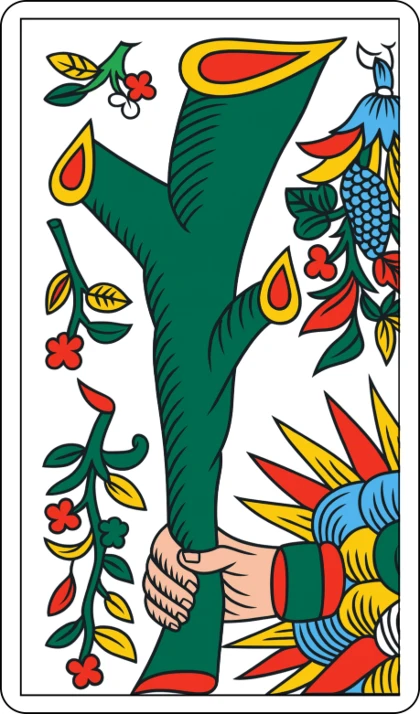
What you see on the Marseille card is simple and striking. A hand emerges from the bottom edge of the card, fingers wrapped firmly around a thick green baton set diagonally across the space. The baton is not smooth: cut branches remain protruding along its length, little knots where growth was pruned back. Around the baton, the card is filled with foliage, flowers, and a radiant sheaf of lines that fan outward like a burst of light or heat. There is no person, no landscape, no scene. Only the hand, the baton, and the vegetal abundance surrounding it. The number is read directly from the single baton itself: one baton, the ace, the first of its suit.
Ce que dit la lame
The Ace of Batons signifie le potentiel brut saisi. The hand does not hold the baton passively: it seizes it. The cut branches tell you this is not a polished tool. It is a living branch, pruned but still full of sap, still capable of sprouting. The radiant sheaf around it suggests that this potential is not hidden: it announces itself, it overflows, it wants to be seen.
This card speaks of the moment when a person feels the first stirring of a desire, a project, a creative urge, or a simple appetite for life. It is not the plan, not the strategy, not the result. It is the initial ignition, the spark that makes everything else possible. The hand from below suggests something rising from the depths, from instinct, from the gut. The baton is green, the color of living wood, of spring, of what has not yet dried or hardened.
What makes this card specific is its excess of vitality. It is not measured, not moderate, not careful. It is a surge. The flowers and foliage around the baton are not cultivated: they are abundant, almost wild. This is energy that spills over, that cannot be contained, that seeks expression for its own sake.
À l’endroit
Upright, the Ace of Batons speaks of exaltation. A person carries a great energy, an astonishing vitality that colors everything they touch. Their mood is gay, joyful, confident. They are naturally extroverted, enjoué, quick to laugh, quick to act. Optimism is not a choice here: it is a state, a warmth that radiates outward like the sheaf on the card.
This is the card of euphoria, of that moment when everything seems possible and the body itself feels light. It does not promise success, but it describes the inner weather of someone who believes in what they are doing. The hand grips the baton firmly: there is no hesitation, no second-guessing. The person acts from a place of trust in their own impulse.
In a reading, this card points to a temperament or a moment when a person is fully alive, when their enthusiasm is contagious and their confidence is not arrogance but a natural overflow. It is the energy of beginnings, of mornings, of the first step taken with joy.
À l’envers
Reversed, the Ace of Batons signifie abattement. This is not the absence of the upright energy, but a different quality altogether. Where the upright card shows a hand seizing the baton, the reversed card speaks of a hand that has let go, or that holds on without conviction. The person feels pessimism, discouragement, a weight that makes every movement feel heavy.
This is the card of dejection, of a lack of confidence that colors everything gray. The person is discontent, dissatisfied, unable to find pleasure in what once sparked them. It can go as far as depression, a state where the vital current has withdrawn and left only fatigue. There is a tendency to idleness, to désoeuvrement, not from laziness but from a loss of entrain, a loss of the very impulse that makes action feel worthwhile.
The reversed Ace of Batons does not mean "blocked energy" in the sense of something waiting to be released. It means the person is living in a different inner climate, one where the sap has stopped rising. The baton is still there, the potential is still real, but the hand no longer reaches for it with the same fire.
Ce qui nuance cette lecture
A single card never tells the whole story. The Ace of Batons se comprend selon sa position dans un tirage. In a position that speaks of the past, it may describe the energy that launched a situation. In a position that speaks of obstacles, it may point to an excess of enthusiasm that overlooked practical details. The cards beside it can sharpen or soften its message: a major arcanum of structure may temper its wildness, while a card of stillness may deepen its reversed heaviness.
The question asked also matters. Asked about work, the upright Ace speaks of creative drive and initiative. Asked about a relationship, it speaks of the spark of attraction, the joy of being together. Asked about an inner state, it speaks of the person’s relationship to their own vitality. The card does not change: the context reveals which facet of its meaning is most alive.
Questions fréquentes
Does the Ace of Batons predict success?
No. It describes the quality of energy a person brings to a situation, not the outcome. A person can be full of exaltation and still fail, or full of discouragement and still succeed. The card speaks of inner weather, not external results.
Is the reversed Ace of Batons the opposite of the upright?
No. The two orientations carry two independent meanings. Upright, the card speaks of exaltation. Reversed, it speaks of abattement. One is not the negation of the other: they are two distinct inner climates, each with its own texture and weight.
Why is there a hand on the card and not a person?
The hand is the only figuration on this numeral card. It shows the act of seizing, of grasping potential. The absence of a full person keeps the card universal: it is not about a specific individual, but about the gesture of reaching for life itself.
What does the green baton mean?
The green color speaks of living wood, of sap still flowing, of something that has not dried or hardened. The cut branches show that it has been pruned, prepared, but it remains alive. It is raw material, not a finished tool.