The Queen of Batons: The Crowned Hand That Holds the Staff of Command
In brief
- The Queen of Batons signifies the accession to a high position, a command that is both a social honor and a personal responsibility.
- Upright, she is the woman of character who governs by her own presence, a director whose authority is natural, not forced.
- The central tension is that the same power that commands can turn authoritarian: the same hand that holds the baton can crush with it.
- Reversed, she is the abuse of power, the despotism that wants to settle everything by force, and the loss of gentleness and humanity that follows.
- The card never acts, it only signifies a power that is either a command or a tyranny, and the person who holds it is the one who decides.
Contents
You are looking at one of the sixteen honours of the Marseille Tarot, a court figure from the suit of Batons. This card speaks of accession to power and the weight of authority, whether worn with grace or wielded as a weapon. Its two orientations do not oppose each other: they describe two distinct relationships to command, one that elevates and one that hardens.
| Suit | What it covers | Cards | Symmetrical plates |
|---|---|---|---|
| Batons | feeling, mood and the quality of emotions | 14 | 9 |
| Cups | affective life and matters of the heart | 14 | 0 |
| Swords | working life and the field of activity | 14 | 2 |
| Coins | material life and money matters | 14 | 7 |
| Total | 56 | 18 |
This axis is not the Golden Dawn's elemental grid: this school places feeling on the batons and working life on the swords.
La planche
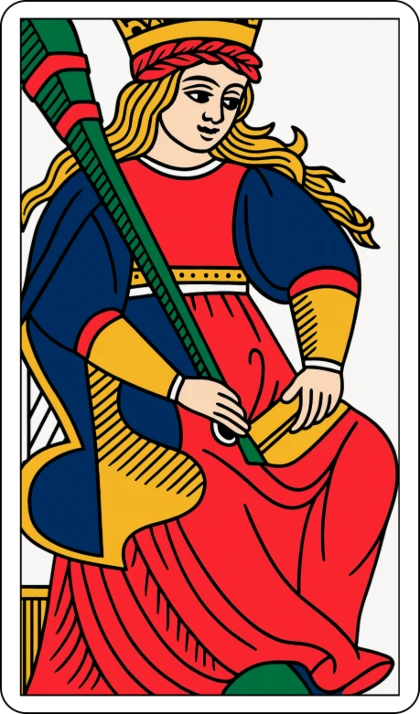
What you see on the card is a crowned queen seated, her long hair loose and falling past her shoulders. She wears a red robe under a blue mantle, the two colours meeting at the centre of her body. Across her, held in one hand and resting on her shoulder, lies a long baton, the emblem of her suit. The card carries no printed legend, no number, no title. Only the figure, the crown, the garment, and the staff. Nothing else is drawn. No throne is visible, no landscape, no attendant. The queen fills the frame, and the baton crosses her like a line of authority made visible.
Ce que dit la lame
This is a card about governing, not about ambition in the abstract. The card signifies the occupation of power. The crown is already on her head, the staff already in her hand. What the card signifies is the moment when a person steps into a position of direction, or the state of already being there. It speaks of hierarchy, of rank, of the social recognition that comes with responsibility. The baton is not a weapon here, it is a sign of office, held across the body as if to say: this is mine, and I know what to do with it.
But the card also conveys a tension. The queen’s hair is loose, unbound, flowing. In the visual language of the Marseille honours, this is not a detail. It suggests that the person who commands is not entirely contained by the role. There is something alive and unsubdued in her, a temperament that does not disappear under the crown. The card therefore speaks of authority that is inhabited by a real person, not by a functionary. It is the difference between holding a title and being the kind of person who can actually direct others.
The Queen of Batons belongs to the suit of Batons. Among the honours, the card signifies the transformation of energy into structure. It does not scatter force: it organises it. Where the Valet of Batons is still learning to hold the staff, and the Cavalier is riding with it, the Queen is seated. She has arrived. The card signifies a settled form of power, one that no longer needs to prove itself through movement.
À l’endroit
Upright, the card speaks of accession to a high position. A person reaches a place of command, or is recognised as having reached it. This may be a promotion, an election, a nomination, or simply the moment when others begin to treat someone as the one who decides. The card does not describe the effort of climbing: it describes the state of having arrived. The crown is on, the staff is held, the seat is taken.
What follows from this is the exercise of command. The person directs, governs, organises. They set the course and others follow. This is not coercion: it is the natural authority of someone who knows what they are doing and has the position to do it. The card signifies leadership that is recognised, not imposed. The social status that comes with it is honourific, a mark of respect earned through competence and presence.
When the card designates a person, it points to a woman of character, someone assertive and self-possessed. She may be a director, a manager, a head of household, a public figure. But the card is not limited to women: it can describe anyone who embodies this quality of assured command, regardless of gender. The figure is a queen, but the meaning is broader than the image.
À l’envers
Reversed, the card does not mean the absence of power. It means power that has lost its humanity. The same staff, the same crown, the same seated position, but now the command has become rigid. The person no longer directs: they dominate. The card speaks of authoritarianism, of the will to settle everything by force, of a leadership that has forgotten that those who follow are people, not instruments.
This is the axis of abuse of power. The person in authority uses their position to impose, to control, to silence. They mistake obedience for respect and fear for loyalty. The card signifies despotism in its everyday forms: the manager who micromanages, the parent who rules by decree, the partner who decides for both. The baton is no longer a sign of office: it has become a weapon of coercion.
What is missing, the card says, is douceur, that quality of gentleness and human warmth that makes authority bearable. The reversed Queen of Batons has all the strength of the upright card, but none of its grace. She is hard where she should be firm, cold where she should be clear. When the card designates a person, it can point to a strong woman going through a difficult passage, someone whose natural assertiveness has turned brittle under pressure, and who is now using force because she has forgotten how to use presence.
Ce qui nuance cette lecture
A single card never tells the whole story. The card’s meaning varies depending on its position in a spread. In a position that speaks of the past, it may describe the authority that shaped a person. In a position that speaks of the present, it may describe the authority a person currently holds or faces. In a position that speaks of what is coming, it may point to a role that is about to be assumed. The card itself carries no time: the position does.
 L'Arcane sans nom
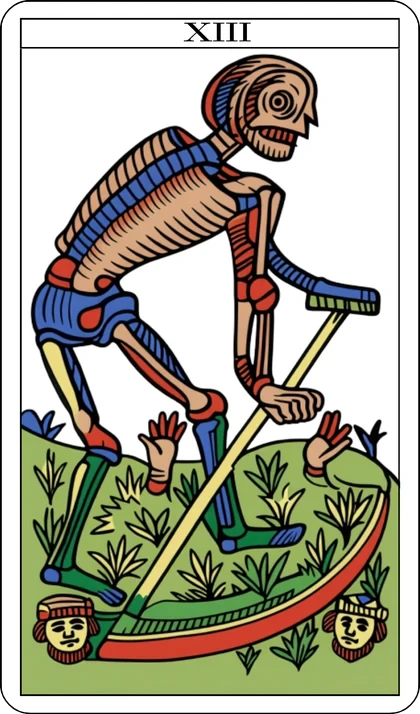
The cards around it also matter. Surrounded by Batons, it speaks of power within action, of leadership in a project or a struggle. Surrounded by Cups, it speaks of authority in emotional life, of the way command and care interact. Near the major arcana, it may be coloured by the larger forces at play: near the Emperor, it is a figure of institutional power; near the Arcane sans nom, it may signal the end of a form of authority. None of this is fixed: it is read in relation.
The question asked also shapes the reading. Asked about work, the card speaks of hierarchy and direction. Asked about love, it speaks of the balance of power in a relationship. Asked about oneself, it speaks of the relationship a person has with their own authority, their own capacity to lead. The card is not a verdict: it is a mirror held up to a specific question.
Questions fréquentes
Does the Queen of Batons always represent a woman?
No. The figure is a queen, but the card signifies a quality of command that can be embodied by anyone. It points to a way of holding authority, not to a gender.
Is the reversed card simply the upright card blocked?
No. The two orientations carry two independent meanings. Upright, the card speaks of command exercised with legitimacy. Reversed, it speaks of command exercised through force. One is not the failure of the other: they are two distinct relationships to power.
Does this card predict a promotion?
It can point to accession to a high position, but only a spread can say whether that is past, present, or future. The card itself describes a state of command, not a timeline.
What is the difference between the Queen of Batons and the King of Batons?
The King holds authority as a matter of sovereignty, of rule over a domain. The Queen holds it as a matter of embodied direction: she is the one who makes the staff part of her own body, who carries command as something lived rather than something decreed.