The Three of Batons: When Overflowing Energy Seeks Its Direction
In brief
- Quick action and overflowing energy drive you to react fast, but this same impulse can make you force things and settle everything by brute strength.
- You take power and break free from heavy chains, yet the liberation is only real when you do not turn it into a blind rush.
- The reversed side shows your combativeness turning inward, when your energy wears out without a target and becomes irritation instead of action.
- The tension is taking power versus blind haste: you either seize your freedom or you merely wish for it, and the difference lies in how you direct your fire.
Contents
The Three of Batons is a minor numeral of the Marseille Tarot, carrying the rank three in the suit of Batons. It signifies raw momentum, a force that either finds its target or turns back on itself. This page describes what the card means in both orientations, without reference to any particular reading.
| Suit | What it covers | Cards | Symmetrical plates |
|---|---|---|---|
| Batons | feeling, mood and the quality of emotions | 14 | 9 |
| Cups | affective life and matters of the heart | 14 | 0 |
| Swords | working life and the field of activity | 14 | 2 |
| Coins | material life and money matters | 14 | 7 |
| Total | 56 | 18 |
This axis is not the Golden Dawn's elemental grid: this school places feeling on the batons and working life on the swords.
The Card
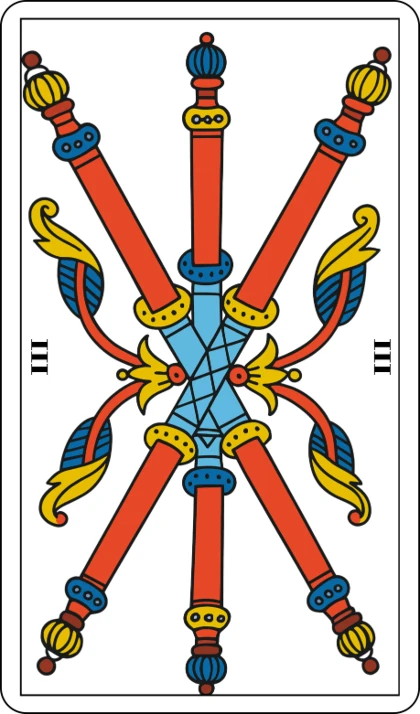
What you see on the card is simple and entirely ornamental. Three straight batons with swollen, rounded ends cross one another at the center of the card, forming a tight spindle or star. Around them, palms and scrollwork fill the side spaces, symmetrical and decorative. The numeral III is printed laterally, once on each side, in the additive Roman form. There is no figure, no scene, no landscape, no gesture. The card is perfectly symmetrical: laid flat on the table, nothing on its face tells you which way it rests. That symmetry is a fact of the drawing, and it does not weaken the card. The Three of Batons carries its two meanings as fully as any other numeral.
What the Card Signifies
The Three of Batons belongs to the ornamental numerals of the Marseille Tarot. It does not depict a situation; it presents a number and a suit, and from that combination a meaning emerges. Three is the number that breaks the stillness of two. It is the first rank where a third element enters, and with it comes movement, friction, and the possibility of direction. The suit of Batons is the suit of impulse, of vital heat, of the force that rises before thought can catch up. Together, they describe a state of heightened reactivity, where energy is abundant and seeks an outlet.
This card is not about patience. It is about the moment when something inside a person surges, when the body and the emotions move faster than deliberation. The Three of Batons shows a person who is carried by their own momentum, for better or for worse. The energy is real, it is not imagined, and it demands expression. What matters is whether that expression finds a channel or turns inward and burns there.
Upright
Upright, the Three of Batons carries the axis of combativity. It describes a person in a state of great activity, someone whose energy overflows the usual containers. This is not quiet determination; it is a surge, a readiness to act that precedes any invitation. The person reacts quickly to what presents itself, sometimes before the situation has fully taken shape. There is a force in that speed, a capacity to seize the moment that slower temperaments lack.
The card also signifies emotional force. The person is not acting from cold calculation; they are moved by something that burns. That heat gives their actions weight and conviction. It can make them persuasive, magnetic, difficult to ignore. It can also make them impulsive and expeditious, inclined to settle every matter by direct force rather than by patience or negotiation. The Three of Batons does not indicate moderation; it simply shows what is present.
At its strongest, this card indicates a taking of power and independence. The person frees themselves from chains, from ties that have become burdensome, from obligations that no longer fit. The liberation is active, chosen, and carried out with the full force of the personality. It is not a quiet slipping away; it is a break, clean and decisive.
Reversed
Reversed, the Three of Batons carries the axis of thwarted impulse. This is not the absence of energy; it is energy that has lost its object. The same surge that, upright, moves outward here turns back toward the interior. The person feels the impulse rise, feels the readiness to act, but finds no target worthy of the force. The combativity does not disappear; it wears itself out without an object, circling, pressing against the inside of the skin.
What was speed becomes irritation. The person is quick to react, but the reactions have nowhere to land. Small frictions become large ones, not because the stakes are high, but because the energy must go somewhere. The card describes a state of being wound tight, of feeling ready for something that does not arrive. It is not depression; it is frustration with a pulse.
There is also a particular nuance here: the liberation is wanted but not taken. The person sees the chains, feels their weight, and desires freedom. But the decisive act does not come. The impulse rises and then hesitates, not from fear, but from a kind of inner short-circuit. The force is real, the desire is real, and yet the break remains unmade. The Three of Batons reversed shows that gap between wanting and doing, and it does not signify a judgment. It simply signifies it.
What Nuances This Reading
A single card never makes a reading. The meaning of the Three of Batons is colored by the question asked and by the cards around it. In a spread about work, its upright meaning may point to a period of intense activity and initiative; in a spread about a relationship, the same card may describe a person who is too quick to force an outcome. The card does not change; the context does.
Its position in a spread also matters. A card placed in a past position indicates what has already moved through a situation; the same card in a future position indicates what is still forming. The Three of Batons carries no duration of its own. Only the structure of the reading gives it a place in time.
Finally, the surrounding cards can sharpen or soften what this card indicates. Next to a card of stillness, the Three of Batons may show a force that disturbs a quiet balance. Next to a card of structure, it may show a force that tests the limits of that structure. The card is never read alone, and its meaning is always a conversation with what lies beside it.
Frequently Asked Questions
Does the Three of Batons predict a specific event?
No. The card describes a state of energy, a quality of movement or of blocked movement. It does not indicate a particular outcome, a date, or a duration. What it shows is a force that is present, and the person’s relationship to that force.
Is the reversed Three of Batons the opposite of the upright card?
No. The reversed card is not the negation of the upright meaning. It carries its own axis: the impulse that turns inward, the combativity that wears itself out without an object, the liberation that is wanted but not taken. It is a distinct meaning, not a failed version of the other.
Why does the card have no figures or scenes?
The numeral cards of the Marseille Tarot are ornamental. They show the suit repeated as many times as the rank, surrounded by scrollwork and flowers, and nothing else. The meaning comes from the number and the suit together, not from any depicted situation. The Three of Batons is a pure expression of rank three in the suit of Batons.
Can the Three of Batons indicate anger?
It can, particularly in its reversed orientation, where the thwarted impulse turns to irritation. But the card is broader than any single emotion. It signifies a force that seeks expression, and anger is only one of the forms that force can take when it finds no other outlet.