King of Batons: The Marseille Tarot’s Crown of Recognition and Its Shadow of Submission
In brief
- Ce roi incarne l’autorité reconnue, celle qui vient de mérites réels, de travaux accomplis et d’une élévation sociale que personne ne peut contester.
- La tension centrale tient dans le même personnage qui peut basculer dans la soumission et la perte de pouvoir, affaibli par une autorité familiale ou professionnelle plus forte que la sienne.
- À l’endroit, cette lame désigne un homme de caractère, un dirigeant ou un chef dont la parole pèse parce que ses actes ont été récompensés, pas parce qu’il occupe un titre.
- À l’envers, elle montre ce même homme fort traversant une situation difficile, dévalorisé, et la question devient comment il endure d’être sous la coupe d’un autre.
- Le fil conducteur est simple : cette lame mesure l’écart entre l’honneur reçu et l’humiliation subie, et elle ne dissout jamais cette tension en juste milieu.
Contents
The King of Batons is one of the sixteen court cards in the Marseille Tarot’s minor arcana. Upright, this card points to recognition, honors, and moral authority. Reversed, it points to submission, loss of power, and devaluation.
| Suit | What it covers | Cards | Symmetrical plates |
|---|---|---|---|
| Batons | feeling, mood and the quality of emotions | 14 | 9 |
| Cups | affective life and matters of the heart | 14 | 0 |
| Swords | working life and the field of activity | 14 | 2 |
| Coins | material life and money matters | 14 | 7 |
| Total | 56 | 18 |
This axis is not the Golden Dawn's elemental grid: this school places feeling on the batons and working life on the swords.
The Card
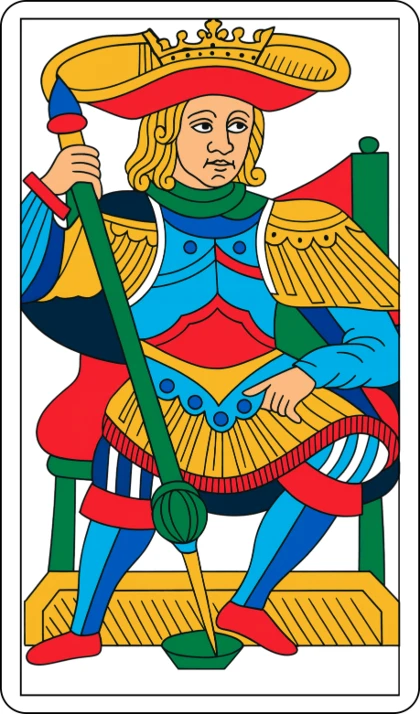
A crowned king sits on a seat. He wears a wide hat over the crown, armor, and a mantle. He holds a long baton raised diagonally, his hand high on the shaft. The printed card carries no legend and no numeral, like all court cards in this deck.
The King of Batons belongs to the suit of batons, one of four suits in the fifty-six minor cards. The full Marseille Tarot has seventy-eight cards: twenty-two majors and fifty-six minors. Among the minors, only the sixteen court cards show a person. The forty numbered cards are ornamental, repeating their suit symbol among leaves and flowers. This king is a figure, not a scene.
What the Card Means
The King of Batons shows a person who has reached a position of command. The crown and the wide hat combine two forms of authority: institutional rank and personal presence. The armor under the mantle says that this standing was not given freely. It was earned through struggle, and it is still protected. The baton is not resting on the ground. It is held high and diagonal, a sign that the will remains active even while seated.
This card speaks of established authority, not raw ambition. The king does not chase recognition. He has already received it. His posture is calm, but his hand on the baton shows that he can still act. The suit of batons carries the energy of action, social ascent, and creative drive. In the King, that energy has matured into a stable position from which others are led.
Unlike a numbered baton card, which shows only repeated symbols, this honor card shows a person. That person is not a passive image. He is a model of what happens when effort, character, and opportunity meet. The card does not describe a moment of luck. It describes a state of being recognized and trusted.
Upright
The upright King of Batons points first to honors and public recognition. A person’s merits are seen, named, and rewarded. This is not a vague feeling of being appreciated. It is a concrete acknowledgment from a group, an institution, or a community. The person’s name is spoken with respect. Their work is credited to them.
Next comes moral authority. The figure does not need to raise his voice. His word carries weight because his past actions have built trust. People turn to him for direction, not because he demands it, but because his judgment has proven reliable. This authority is not tyrannical. It is the kind that makes others feel safer and more focused.
The card also indicates social and personal elevation. A person rises in rank, reputation, or self-respect. This elevation is not sudden luck. It is the visible result of sustained effort. The baton held high shows that the person’s will remains engaged, even at the top. There is no retirement into passivity.
As a person, the King of Batons can designate a man of character, a director, a chief, or a leader. He is not necessarily older. He is someone whose presence organizes a room. He may be a mentor, a boss, a father, or a public figure. His defining trait is that others recognize his standing without being forced to.
Reversed
The reversed King of Batons speaks of submission to an overpowering authority. A person finds themselves under a family or professional power that leaves little room for their own will. This is not the upright meaning failing. It is a distinct situation where the person’s position is weakened, not by their own fault, but by a structure that demands obedience.
The card also indicates loss or absence of power. The person may have held authority before, or may never have had it. Now they must answer to someone else’s decisions. The baton, which was raised in the upright image, reads here as a weight or a reminder of what is not in their hands. They may still have ideas and strength, but no platform to use them.
Devaluation follows. The person’s merits are ignored, minimized, or attributed to someone else. They may work hard and receive no credit. Their name is not spoken when rewards are distributed. This is not a lack of talent. It is a lack of recognition, often enforced by a dominant figure who takes the credit or blocks the person’s rise.
As a person, the reversed King of Batons can designate a strong, assertive man who is going through a difficult situation. He is not weak by nature. He is caught in circumstances that reduce his usual authority. He may be a former leader now sidelined, or a capable person trapped under a controlling parent or employer.
What Nuances This Reading
A single card never tells a whole story. The King of Batons gains precision from where it falls in a spread. In a position about the past, the upright recognition may describe a foundation already built. In a position about obstacles, the reversed submission may point to a current pressure. The cards beside it matter too. Next to a numbered baton, the upright king emphasizes active projects. Next to a coin card, the recognition may concern material results. Next to a major card, the authority or submission may take on a deeper, more structural meaning.
The question asked also shapes the reading. Asked about love, the upright king may indicate a partner who is respected and protective. Asked about work, it may indicate a promotion or a director. Asked about a conflict, the reversed king may show a person who has lost the power to negotiate. None of these are fixed. They are angles that the surrounding cards and the question bring into focus.
Frequently Asked Questions
Is the King of Batons always a man?
No. As a court card, it can designate a person of any gender who embodies the qualities of authority, recognition, or, in reverse, submission. The image is male because of the historical deck, but the meaning is not limited to men.
Does the reversed King of Batons mean the upright meaning is blocked?
No. In Marseille Tarot, reversed cards carry their own meaning. The reversed King of Batons is not a failed upright card. It is the axis of submission, loss of power, and devaluation. It describes a different situation, not the same situation with less energy.
What is the difference between the King of Batons and the other kings?
Each king rules a suit. The King of Batons is tied to action, will, and social visibility. The King of Coins concerns material stability, the King of Swords concerns intellectual clarity, and the King of Cups concerns emotional authority. The baton king’s recognition is public and active, not private or passive.
Can the King of Batons indicate a specific event or date?
No card indicates a dated event. The King of Batons describes a quality of position: recognition or submission. Only a spread position can suggest timing, and this page does not describe any spread.