The Nine of Batons: Where the Gift of Self Finds Its Shape
In brief
- This card points to a person who gives themselves through service, with spiritual depth and a concrete social role, not a vague ideal.
- The central tension: generosity flows outward, but humility can tip into self-effacement when the impulse to give finds no real object.
- Reversed, the giving turns back on itself, a spiritual life lived behind closed doors, with the human connection left unfulfilled.
- The accessory meaning of fertility and birth adds a creative layer to this giving, a transmission that goes beyond simple duty.
- Hold the paradox: true self-giving needs both an inner balance and an outward gesture, and neither one dissolves the other.
Contents
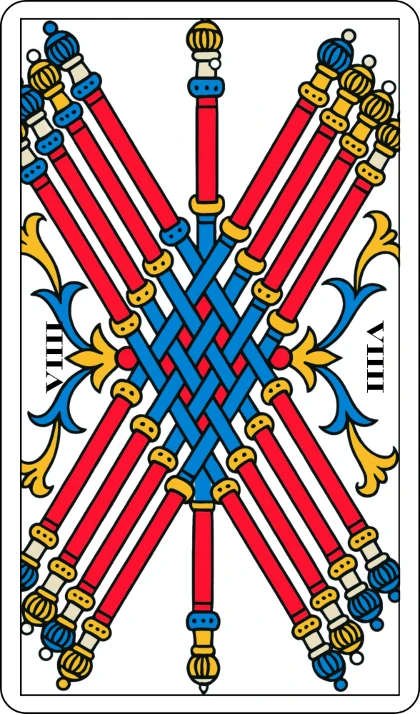
The Nine of Batons is a minor numeral from the Marseille Tarot, one of the forty cards ranked one through ten in the suit of Batons. It carries the numeral VIIII printed in its additive form on both sides of the card. This card speaks of a person who gives of themselves, and when reversed, it speaks of that same gift turning inward, folded back upon itself.
| Suit | What it covers | Cards | Symmetrical plates |
|---|---|---|---|
| Batons | feeling, mood and the quality of emotions | 14 | 9 |
| Cups | affective life and matters of the heart | 14 | 0 |
| Swords | working life and the field of activity | 14 | 2 |
| Coins | material life and money matters | 14 | 7 |
| Total | 56 | 18 |
This axis is not the Golden Dawn's elemental grid: this school places feeling on the batons and working life on the swords.
The planche
What you see on this card is nine straight batons, each with bulbed ends, crossed together in a spindle at the center of the card. The batons interlace to form a tight, woven bundle, their shafts overlapping in a symmetrical pattern. Around this central arrangement, palms and scrollwork fill the side margins, ornamental flourishes that frame the batons without adding any narrative content. The numeral VIIII appears laterally, printed on both the left and right edges of the card. There is no person, no scene, no landscape, no object beyond the batons and the decorative vegetation. The card is perfectly symmetrical: if you place it on the table, nothing on the printed surface tells you which end is up. This symmetry is a fact of the drawing, and it does not diminish the card. The Nine of Batons carries its two orientations like every other card in the deck, each with its own independent meaning.
Ce que dit la lame
The Nine of Batons speaks of the impulse to give. At its core, this card points to a person whose inner life has reached a point of fullness, a fullness that seeks expression through generosity, service, and a genuine concern for others. The nine batons, bound together at the center, suggest a convergence of energies, a gathering of forces that do not scatter but instead form a single, coherent structure. This is not the restless energy of scattered efforts. It is the quiet strength of someone who has gathered themselves and now has something to offer.
The card also carries a spiritual dimension. The interlaced batons, rising like a column or a sheaf, evoke a sense of verticality, of something reaching upward while remaining firmly rooted. A person who embodies this card often lives with a sense of inner balance, a spiritual life that is not performed for others but is simply present, informing their actions without fanfare. Humility is central here: the Nine of Batons does not seek recognition. It gives because giving is what a full heart does.
There is also a social weight to this card. The Nine of Batons often appears when a person is called to occupy a role that serves a larger purpose, a mission that goes beyond personal gain. This is not ambition in the conventional sense. It is the recognition that one has something to contribute, and that withholding it would be a form of dishonesty. The card points to responsibilities that are accepted willingly, not imposed from outside.
À l’endroit
Upright, the Nine of Batons carries the axis of gift of self. The person this card describes is someone who gives freely, without calculation. Their generosity is not a strategy. It flows from a genuine love for others, a deep humanity that sees the needs of those around them and responds without being asked. This is altruism in its most grounded form: not a distant ideal, but a daily practice of putting oneself at the service of others.
The card also points to spiritual life as a lived reality. The person may hold a religious belief, or they may simply live with a sense of inner equilibrium that others recognize as something rare. This spiritual dimension is not separate from their daily actions. It informs how they treat people, how they carry their responsibilities, how they move through the world. Humility is the quiet engine of this card: the person does not need to be seen giving. They give because it is who they are.
In social terms, the Nine of Batons often indicates a role of service. The person may be called to a humanitarian mission, a position of social responsibility, or simply a place in their community where their presence makes a difference. This is not about power. It is about being useful, about occupying a place where one’s gifts can actually reach others. The card speaks of disinterestedness, of acting without expecting anything in return.
As an accessory meaning, dissociated from the main axis, the Nine of Batons can also point to fertility and birth. This is a secondary reading, not the heart of the card, but it is present: the image of nine batons bound together can evoke the idea of new life, of something coming into being through the convergence of many forces.
À l’envers
Reversed, the Nine of Batons carries the axis of gift withdrawn. This is not the opposite of the upright meaning. It is its own territory, with its own texture and its own truth. Here, the impulse to give is still present, but it has no object. The person feels the urge to be generous, to serve, to offer themselves, but that urge finds no place to land. The gift remains held inside, ungiven, and this holding creates a particular kind of ache.
The humility that characterizes the upright card turns, in this orientation, into self-effacement. The person does not simply avoid recognition. They begin to disappear. Their willingness to put others first becomes a habit of erasing themselves, of making themselves small, of believing that their own needs do not matter. This is not humility. It is a slow withdrawal from the world, a retreat into invisibility that serves no one.
The spiritual life, so central to the upright card, becomes in this orientation a private affair. The person lives their inner life behind closed doors, keeping their beliefs, their practices, their sense of the sacred entirely to themselves. This is not necessarily a rejection of spirituality. It is a spirituality that has become isolated, cut off from the world of others, unable to find expression in action or in relationship. The gift is still there. It is simply folded back upon itself, waiting for a reason to unfold.
Ce qui nuance cette lecture
A single card never tells the whole story. The Nine of Batons takes its full meaning from where it falls in a spread. In a position that speaks of the past, it may point to a period of service or spiritual growth that has shaped the present. In a position that speaks of obstacles, it may indicate a gift that is being withheld, either by circumstance or by choice. The same card, in a position of outcome, suggests that the path forward involves giving of oneself in some concrete way.
The cards that surround the Nine of Batons also shape its meaning. Placed near a card of action, it may indicate that the impulse to give is about to find expression. Placed near a card of withdrawal, it may suggest that the gift is being held back, perhaps for good reason. The question asked in the reading matters too. A question about work will draw out the card’s social dimension, its sense of mission and responsibility. A question about relationships will draw out its generosity, its willingness to put the other first. A question about inner life will draw out its spiritual core.
None of this changes what the card is. It only changes what the card is saying in this particular moment, to this particular person, in response to this particular question.
Questions fréquentes
Does the Nine of Batons always mean someone is religious?
No. The card points to a spiritual dimension, but this can take many forms. It may be a formal religious belief, or it may be a sense of inner balance, a quiet connection to something larger than oneself. The card does not prescribe a particular faith. It simply indicates that the person’s inner life is a real and active force in how they move through the world.
Is the reversed Nine of Batons a bad card?
Not in the sense of being a punishment or a warning. The reversed orientation carries its own meaning: a gift that is held back, a humility that has become self-effacement, a spiritual life lived in isolation. This is a real experience, and it has its own weight and its own truth. It is not the failure of the upright meaning. It is a different state, with its own lessons and its own possibilities.
Why does the card show no people or scenes?
The numeral cards of the Marseille Tarot are ornamental. They show their suit repeated as many times as their rank, surrounded by decorative flourishes, and nothing else. The Nine of Batons shows nine batons, interlaced, with palms and scrollwork on the sides. There is no narrative image because the Marseille tradition does not illustrate its numeral cards with scenes. The meaning comes from the number, the suit, and the arrangement of the elements, not from a depicted situation.
Can the Nine of Batons predict a birth?
The card carries fertility and birth as an accessory meaning, dissociated from its main axis. In a reading where the question and the surrounding cards point toward this theme, the Nine of Batons can indeed suggest the arrival of a child or the beginning of something new. But this is not its primary meaning, and it should not be read as a prediction on its own. The card’s heart is the gift of self, the willingness to give, the spiritual life that informs action.