The Knight of Batons: When Persistence Becomes a Direction
In brief
- The card’s core is perseverance, you must continue your current path, not seek a new direction.
- The central tension is a paradox of mobility: the knight is mounted, yet the card demands you stay put, resisting any urge to travel or relocate.
- When reversed, the meaning does not flip, it amplifies the slowness, so any movement becomes even more counterproductive and the need to stay becomes absolute.
- Concretely, it points to staying in place, the same region, the same quarter, and fully exploiting the present moment rather than looking elsewhere.
- The specific angle is a sedentary force, a knight who signifies immobility, not action, a paradox you must hold without dissolving it.
Contents
You are looking at a card that speaks of continuity over change. The Knight of Batons, a minor honor in the Marseille Tarot, carries a message about staying the course, even when the course feels slow. This guide covers what the card actually shows, what it means upright, and what it means reversed, so you can read it with precision.
| Suit | What it covers | Cards | Symmetrical plates |
|---|---|---|---|
| Batons | feeling, mood and the quality of emotions | 14 | 9 |
| Cups | affective life and matters of the heart | 14 | 0 |
| Swords | working life and the field of activity | 14 | 2 |
| Coins | material life and money matters | 14 | 7 |
| Total | 56 | 18 |
This axis is not the Golden Dawn's elemental grid: this school places feeling on the batons and working life on the swords.
La planche
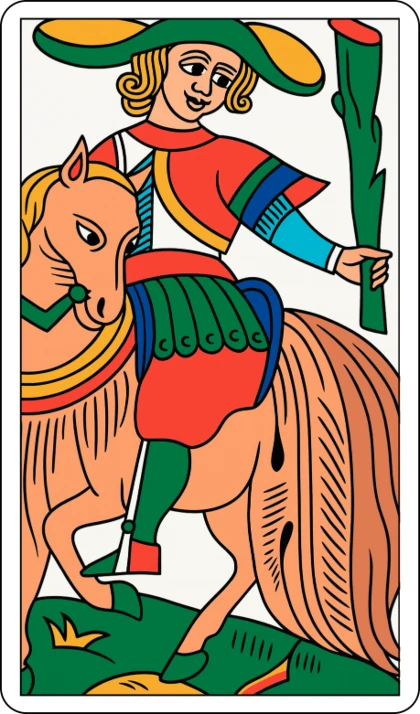
On the Marseille card, you see a rider on a light-colored horse, moving toward the left. The rider wears a wide green hat and holds a green baton raised in the right hand. The ground beneath the horse is green. The card carries no printed legend, no number, and no title. That is all. There is no landscape, no building, no second figure. The image is spare, and that spareness matters: the eye rests on the raised baton, the forward motion, and the green that ties rider, weapon, and ground into a single visual field.
Ce que dit la lame
The Knight of Batons belongs to the honors of the Batons suit, one of the sixteen figured cards in the deck. Unlike the numbered cards, which are purely ornamental, the honors carry a person, and that person gives the card its voice. Here, the voice is not about arrival or conquest. It is about maintaining a direction that has already been chosen. The raised baton is not a weapon being swung; it is a standard being held. The horse moves, but without urgency. The green ground suggests rootedness, not flight.
This card does not promise a breakthrough. It points to a situation where the present position is the resource. The rider is not looking for a new road. The road is under the horse’s hooves. What the card signifies is the value of staying with what is already in motion, even when the motion feels modest. The change you might be tempted to seek is not what this card describes. What it describes is the quiet work of continuing.
À l’endroit
Upright, the Knight of Batons carries the axis of perseverance. The first thing to understand is that continuing is the point. The card does not suggest that a new strategy is needed, nor that the current path is wrong. It suggests the opposite: the situation in place is worth exploiting, and the present moment holds more than a change of direction would. This is a card of maintenance and continuity, not of departure.
There is a secondary layer, and it is worth naming separately. The card is not favorable to travel. Movements are very limited. The image of a rider on a horse might suggest mobility, but the Marseille reading points the other way: staying in the same region, the same neighborhood, the same familiar ground. The horse moves, but the horizon does not change. If you are asking about displacement, this card says: stay where you are.
À l’envers
Reversed, the Knight of Batons does not become its opposite. The meaning is practically unchanged, but it bends toward an even greater slowness. The axis here is perseverance slowed down. What was already a card of limited movement becomes a card of sedentary persistence. The rider is still on the horse, still holding the baton, but the pace has dropped. The card opposes all displacement, more firmly than its upright position does.
This is not a blockage, and it is not a failure. It is an attenuation. The reversed Knight of Batons says: the situation asks for patience, and the patience will feel long. The card does not reverse the meaning of the upright position; it softens the motion and hardens the stillness. If you draw this card reversed, do not read it as "the opposite of perseverance." Read it as perseverance that has settled into a chair.
Ce qui nuance cette lecture
A single card never makes a reading. The Knight of Batons takes its full meaning from where it falls in a spread and what surrounds it. In a position that speaks of the past, it may point to a long period of staying put that shaped the present. In a position that speaks of obstacles, it may indicate that the obstacle is not external but internal: a reluctance to move, a comfort in the familiar. The cards beside it matter. A major arcana like The World or The Sun will lift the card’s stillness toward completion or clarity. A card like The Hanged Man or The Hermit will deepen its slowness into something more deliberate.
The question you bring also shapes the card. Asked about work, the Knight of Batons points to staying in a role and deepening it. Asked about love, it points to a bond that grows through repetition, not novelty. Asked about a move, it points away from the move. The card does not set a duration. It does not say "for three months" or "until spring." Only the position in a spread can carry time, and this page describes no spread.
Questions fréquentes
Does the Knight of Batons mean I should never change anything?
No. It means that in the situation you are asking about, change is not the answer right now. The card points to the value of the present position. It does not forbid change forever; it simply does not describe change as the useful move.
Is the reversed Knight of Batons a bad card?
No. It is a slow card, not a harmful one. It describes a pace that feels heavy, a persistence that has become sedentary. It asks for patience, not for alarm.
Why does a rider on a horse mean I should not travel?
Because the Marseille reading of this honor is not literal. The horse and rider are a figure of directed energy, and the direction here is inward, toward the ground already underfoot. The card’s stillness outweighs its motion.
What is the difference between the Knight of Batons and the other Knights?
Each Knight carries the energy of its suit. The Knight of Batons carries the fire of persistence: not the emotional drive of Cups, not the material drive of Coins, not the cutting drive of Swords. It is the drive to keep going on the same road.