Three of Cups: Shared Passion and Its Destructive Double in the Marseille Tarot
In brief
- Shared passion is the core of this card: a sudden attraction, love at first sight, or an intense mutual adoration that fills you with overwhelming joy.
- The same intensity that makes you feel alive can turn into destructive passion: when feelings become too strong, you get jealousy and possessiveness.
- One-sided or obsessive love is the reversed face: you give everything, or the other person does not return it, or you both smother each other.
- The card never dictates, you are the actor: it signifies a state of emotional intensity, not a timeline or a specific event.
- The paradox is real: the warmth that warms you can also burn you, and this card holds both without dissolving the tension.
Contents
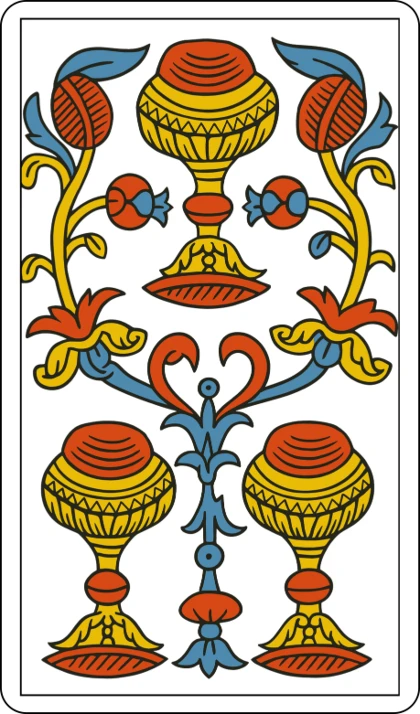
The Three of Cups is a minor numeral of the Cups suit in the Marseille Tarot. Its card face shows three stemmed cups among flowering scrolls, with no person, no scene, and no printed number. Upright, it signifies shared passion, falling in love, and erotic accord; reversed, it points to a passion that consumes, marked by jealousy, possessiveness, and emotional servitude.
| Suit | What it covers | Cards | Symmetrical plates |
|---|---|---|---|
| Batons | feeling, mood and the quality of emotions | 14 | 9 |
| Cups | affective life and matters of the heart | 14 | 0 |
| Swords | working life and the field of activity | 14 | 2 |
| Coins | material life and money matters | 14 | 7 |
| Total | 56 | 18 |
This axis is not the Golden Dawn's elemental grid: this school places feeling on the batons and working life on the swords.
The Card Face
On the card face, you see exactly three stemmed cups, each with a bowl at the top and a foot at the bottom. One cup stands above, two cups stand below, arranged in a loose triangle among curling leaves and flowers. There is no numeral printed on the side, no human figure, no landscape. The card is purely ornamental, like all Marseille numeral minors: the suit symbol repeated three times, nothing else. The arrangement itself is the only narrative, a high cup feeding two lower cups, or two lower cups rising toward one.
What the Card Says
The Three of Cups does not depict a celebration or a couple. It signifies a structure of feeling. The number three introduces a third term into the pair: not just you and another, but the bond itself, the shared current that circulates between two people. The suit of Cups gives this structure an emotional, desiring quality. So the card speaks of a feeling that exists because it is returned, a passion that gains intensity through reciprocity.
The geometry matters. One cup above, two below: a source and two receivers, or two sources and one vessel. In either reading, the card points to circulation, not isolation. It is the opposite of a solitary emotion. The flowering scrolls around the cups reinforce this: growth, ornament, abundance, but always contained within the suit’s liquid, receptive nature.
Because no person appears, the card does not tell you who feels what. It tells you that a bond of mutual intensity is possible, that adoration can be met with adoration, that desire can find an echo. This is the card’s specific angle: not love in general, but love that is shared, felt on both sides, and therefore amplified.
Upright
Upright, the Three of Cups carries the axis of passion. Its first meaning is shared passion: a feeling that two people experience together, with equal heat. This is the card of falling in love, of sudden mutual recognition, of love at first sight that lands on both hearts at once. The intensity is high, but it is not solitary; it circulates.
The card also points to great joy on the emotional plane, to adoration and desire that are welcomed rather than feared. In a relationship, it signifies erotic accord: not a technique or a performance, but a shared rhythm, a mutual appetite, a physical conversation where both voices speak. The upright Three of Cups says that the feeling is alive, returned, and nourishing.
Reversed
Reversed, the Three of Cups does not mean the absence of passion. It means passion that destroys. The same intensity that uplifts when shared becomes a fire with no outlet when it is one-sided, or a fire that burns the house down when it is too mutual. This is the axis of a one-sided love, a feeling that flows in one direction only, or a love so strong that it suffocates.
Here the card points to jealousy and possessiveness, not as cold calculations but as the fever of adoration turned inward. One person clings, the other withdraws, or both cling until neither can move. The bond becomes a form of emotional servitude, a dependence where the other’s presence is not a joy but a condition for breathing. The reversed Three of Cups signifies being devoured by feeling, or devouring another with it.
What Nuances This Reading
A single card never makes a reading. The Three of Cups takes its color from the question asked and the cards around it. In a question about work, the upright card may point to a passionate collaboration, not a romance; in a question about family, it may point to a bond of adoration between parent and child. The reversed card, read for a creative project, may indicate a team where one person’s intensity dominates and stifles the others.
Position in a spread also matters. A card in the past position frames what has already shaped the situation; a card in the future position frames what is still forming. This page describes no spread, so the Three of Cups here is timeless: it tells you what the card means, not when or to whom it will happen.
Frequently Asked Questions
Does the Three of Cups always mean romantic love?
No. Its suit is emotional, so it often colors romantic bonds, but the card signifies shared passion in any relationship: a deep friendship, a creative partnership, a family bond. The key is reciprocity and intensity, not the type of bond.
Is the reversed Three of Cups just the opposite of the upright?
No. The reversed card is a distinct axis: passion that consumes rather than nourishes. It is not the absence of feeling but an excess or asymmetry of feeling, marked by jealousy, possessiveness, and dependence.
Why are there no people on the card?
Marseille numeral minors are ornamental, not narrative. The three cups themselves carry the meaning through their number and arrangement. The absence of figures is deliberate: the card speaks of a structure of feeling, not a specific scene.
Can this card predict a specific event or timeline?
No. A single card is timeless. Only its position in a spread can indicate timing, and this page describes no spread. The Three of Cups tells you what is signified, not when it will occur.