Nine of Cups: The Ornamental Weight of Choice and Abandonment
In brief
- The central tension of this card is a choice between a stable bond and an external pull, whether that pull is a real rival or a symbolic one like work, a possessive mother, or absorbing friendships. - Upright, the card signifies a period of charm and solicitations, but it does not act: you are the one who must decide whether to yield to the seduction or reaffirm your commitment. - Reversed, the card signifies a feeling of being neglected, where your partner’s investment in work or friends is read as a form of infidelity, even without a concrete betrayal. - The paradox is that the same card signifies you as the tempted or the one left behind, but it only reveals the knot of desire and lack, never the outcome. - The card does not predict an event; it simply describes a state of tension where you must confront the consequences of your own choices or the perceived choices of others.
Contents
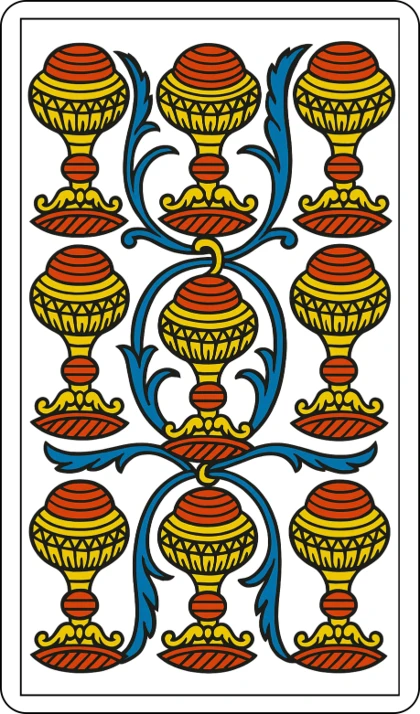
The Nine of Cups is a minor numeral of the Cups suit in the Marseille Tarot. On its face, nine stemmed cups are arranged in three rows of three among flowering scrolls, with no figure, no scene, and no printed number. Upright, it points to an affective choice and possible triangulation. Reversed, it points to feeling neglected or to a partner’s possible infidelity.
| Suit | What it covers | Cards | Symmetrical plates |
|---|---|---|---|
| Batons | feeling, mood and the quality of emotions | 14 | 9 |
| Cups | affective life and matters of the heart | 14 | 0 |
| Swords | working life and the field of activity | 14 | 2 |
| Coins | material life and money matters | 14 | 7 |
| Total | 56 | 18 |
This axis is not the Golden Dawn's elemental grid: this school places feeling on the batons and working life on the swords.
The card face
The Nine of Cups is an ornamental numeral. On its face, nine stemmed cups, each with the bowl at the top and the foot at the bottom, are arranged in three rows of three. The cups sit among flowering scrolls, the only other element on the card. There is no person, no scene, and no printed numeral: the number nine is read from the cups themselves. The composition is symmetrical and full, a grid of nine identical receptacles.
What the card says
In the Marseille minors, a numeral does not illustrate a story. It repeats its suit sign as many times as its rank, surrounded by ornament. The Nine of Cups therefore signifies through number and suit alone. Nine is the last single digit before ten, a point of near completion, a field already saturated. Cups are the suit of emotion, desire, receptivity, and relationship. Together they point to a situation where the emotional field is full, but not yet closed: there are many cups, and none is singled out.
The tight grid of nine cups suggests abundance, but also pressure. When a person sees this card, the question is not whether there is feeling or attraction, but which of several invitations deserves attention. The flowering scrolls add a note of charm, seduction, and surface appeal. The card carries no promise of satisfaction; it presents a field of options that asks for a choice.
The two orientations do not form a pair of opposites. Upright, the Nine of Cups carries the axis of choice. Reversed, it carries the axis of abandonment. Each is a complete meaning in its own right, not a blocked or negated version of the other.
Upright
Upright, the Nine of Cups points first to an affective choice. The person is not in a void; they are in a field where several emotional possibilities coexist. This can mean a real triangular relationship, where a third person enters the picture, or it can mean a symbolic triangle: a job that overflows, a possessive mother, friendships that demand too much. The common thread is that something or someone competes for the same emotional space.
The card also carries a climate of charm and external solicitations. The person may be the object of seduction, or they may be the one who seduces. The nine cups, all identical and all upright, suggest that attention is being offered from several sides. This is not a card of quiet contentment; it is a card of being courted, noticed, or pulled in multiple directions.
Reversed
Reversed, the Nine of Cups carries the axis of abandonment. The person may feel left aside, no longer the center of someone’s emotional attention. This can point to a partner’s possible infidelity, but it can also point to a less dramatic reality: the partner invests too much in professional life or in friendships, and the person feels neglected. The nine cups, seen reversed, suggest a display that has turned away, an abundance that belongs to someone else or to another domain.
This orientation is not the absence of choice. It is the specific pain of being unchosen, or of watching someone else’s energy flow elsewhere. The card carries no statement that infidelity has occurred; it points to an emotional field experienced as no longer one’s own. The person may be the one who is left, or the one who has left emotionally while still present.
What nuances this reading
A single card never frames a duration, a verdict, or a person’s fate. The Nine of Cups is colored by its position in a spread, the cards around it, and the question asked. If it sits near court cards, the choice or the abandonment likely involves specific people. If it sits near coins, the third pole may be work or money. If it sits near swords, the choice may be mental, verbal, or conflictual. The same card carries a different meaning in a question about a relationship and in a question about a creative project.
Frequently asked questions
Does the Nine of Cups mean a wish will come true?
No. In the Marseille tradition, this numeral is not a wish card. It points to a field of multiple emotional options and the need to choose, not to granted satisfaction. The nine cups are identical and none is singled out, so the card speaks of abundance without resolution.
Is the reversed Nine of Cups just the opposite of the upright?
No. The reversed orientation carries its own axis: abandonment or feeling left aside. It is not the absence of choice, but the presence of a specific pain, being no longer the chosen one or watching a partner’s energy go elsewhere.
Does the Nine of Cups show a person or a scene?
No. It is an ornamental numeral. The card face displays nine stemmed cups in three rows of three among flowering scrolls, with no figure, no scene, and no printed number. Any image of a satisfied person or a wish fulfilled comes from another deck, not from the Marseille card face.
Can the Nine of Cups predict infidelity?
It can point to a possible triangulation or to a partner’s overinvestment elsewhere, but it never states a fact. The surrounding cards and the question determine whether this is literal or symbolic, and whether the person is the one choosing, the one left aside, or the one pulling away.